
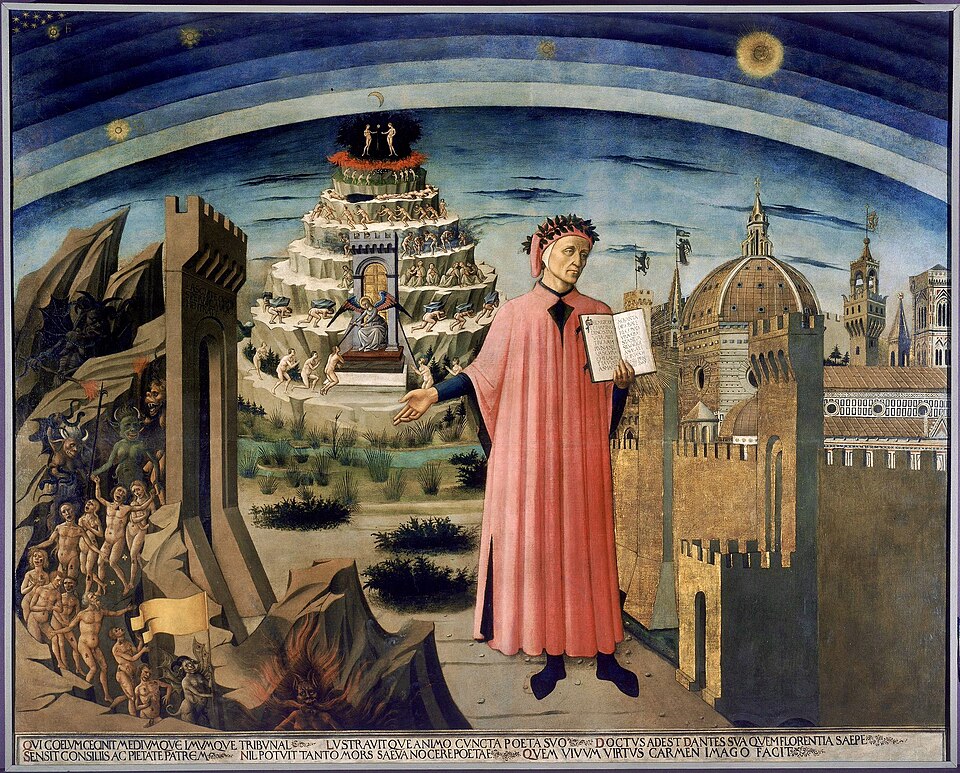
The Divine Comedy
0 sources
The Divine Comedy
Summary
The Divine Comedy is a literary work[1]. It ranks in the top 0.19% of literary_work entities by monthly Wikipedia readership (13,530 views/month, #55 of 28,446).[2]
Key Facts
- The Divine Comedy authored Q1067[3].
- The Divine Comedy's instance of is recorded as literary work[4].
- The Divine Comedy's genre is epic poem[5].
- The Divine Comedy's depicts is recorded as Abandon all hope, ye who enter here[6].
- The Divine Comedy's depicts is recorded as two sun-deities[7].
- The Divine Comedy's Commons category is recorded as The Divine Comedy[8].
- The Divine Comedy's language of work or name is recorded as Tuscan[9].
- The Divine Comedy's language of work or name is recorded as Italian[10].
- The Divine Comedy comprises Inferno[11].
- The Divine Comedy comprises Purgatorio[12].
- The Divine Comedy comprises Paradiso[13].
- The Divine Comedy comprises Vergine Madre, figlia del tuo figlio[14].
- 1320 marks the founding of The Divine Comedy[15].
- The Divine Comedy's characters is recorded as Augustine of Hippo[16].
- The Divine Comedy's characters is recorded as Agamemnon[17].
- The Divine Comedy's characters is recorded as Adam[18].
- The Divine Comedy's characters is recorded as Hades[19].
- The Divine Comedy's characters is recorded as Albertus Magnus[20].
- The Divine Comedy's characters is recorded as Amphiaraus[21].
- The Divine Comedy's characters is recorded as amphisbaena[22].
- The Divine Comedy's characters is recorded as Anaxagoras[23].
- The Divine Comedy's characters is recorded as Anastasius II[24].
- The Divine Comedy's characters is recorded as Anselm of Canterbury[25].
- The Divine Comedy's characters is recorded as Antaeus[26].
- The Divine Comedy's characters is recorded as Antenor[27].
Product Details
The following facts are restated verbatim from public-domain and CC0 open-data sources — every line is independently verifiable against the named source's catalog.
MusicBrainz — CC0 open music encyclopedia
Body
Authorship and Creation
The Divine Comedy authored Q1067[3].
Publication
Languages include Tuscan[9] and Italian[10]. The Divine Comedy's genre is epic poem[5].
Cultural Impact
Things named for The Divine Comedy include it[30], a musical group[31], in United Kingdom[32], founded in 1989[33] and 65487 Divinacommedia[34], an asteroid[35].
Why It Matters
The Divine Comedy ranks in the top 0.19% of literary_work entities by monthly Wikipedia readership (13,530 views/month, #55 of 28,446).[2] It has Wikipedia articles in 30 language editions, a strong signal of global cultural recognition.[36] It is known by 52 alternative names across languages and contexts.[37]
It has been cited as an influence by Roza Mira[38], a literary work[39], founded in 1958[40], written by Daniil Andreyev[41].
Entities named for it include it[30], a musical group[31], in United Kingdom[32], founded in 1989[33] and 65487 Divinacommedia[34], an asteroid[35].
FAQs
Who did The Divine Comedy influence?
The Divine Comedy has been cited as an influence by Roza Mira[38].