
Albertus Magnus
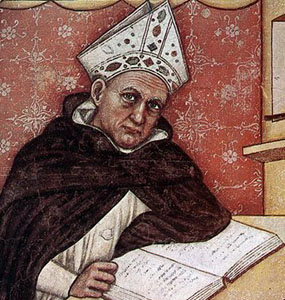
0 sources
Albertus Magnus
Summary
Albertus Magnus is a human[1]. He was born in Lauingen[2]. He was born on January 1, 1193[3]. He passed away in Cologne[4]. He died on 1280[5]. He worked as a chemist[6], musicologist[7], philosopher[8], writer[9], and economist[10]. He ranks in the top 0.66% of human entities by monthly Wikipedia readership (11,960 views/month, #6,623 of 1,000,298).[11]
Key Facts
- Albertus Magnus's place of birth was Lauingen[2].
- Albertus Magnus died in Cologne[4].
- Albertus Magnus was born on January 1, 1193[3].
- Albertus Magnus was born on 1200[12].
- Albertus Magnus was born on 1205[13].
- Albertus Magnus was born on 1206[14].
- Albertus Magnus died on 1280[5].
- Albertus Magnus died on November 15, 1280[15].
- Albertus Magnus died on 1292[16].
- Burial took place at St. Andreas Church[17].
- Albertus Magnus held citizenship in Holy Roman Empire[18].
- Middle High German was Albertus Magnus's native language[19].
- Albertus Magnus's professions included chemist[6].
- Albertus Magnus's professions included musicologist[7].
- Albertus Magnus's professions included philosopher[8].
- Albertus Magnus's professions included writer[9].
- Albertus Magnus's professions included economist[10].
- Albertus Magnus's professions included astrologer[20].
- Albertus Magnus's field of work was philosophy[21].
- Albertus Magnus held the position of Roman Catholic Bishop of Regensburg[22].
- Albertus Magnus held the position of Q132769036[23].
- Albertus Magnus held the position of Auxiliary Bishop of the Diocese of Strasbourg[24].
- Albertus Magnus held the position of Auxiliary bishop of the archdiocese of Cologne[25].
- Albertus Magnus held the position of Q113323022[26].
- Among Albertus Magnus's employers was University of Paris[27].
Body
Origins and Family
Born in Lauingen[2], Albertus Magnus… Recorded date of birth include January 1, 1193[3], 1200[12], 1205[13], and 1206[14]. Middle High German was his native language[19].
Education
Educated at University of Padua[28], a university[29], in Italy[30], founded in 1222[31], headquartered in Padua[32] and University of Paris[33], a former entity[34], in France[35], founded in 1150[36], headquartered in Paris[37].
Career and Affiliations
Recorded occupations include chemist[6], musicologist[7], philosopher[8], writer[9], economist[10], and astrologer[20]. Albertus Magnus's field of work was philosophy[21]. He was employed by University of Paris[27]. Positions held include Roman Catholic Bishop of Regensburg[22], Q132769036[23], Auxiliary Bishop of the Diocese of Strasbourg[24], Auxiliary bishop of the archdiocese of Cologne[25], and Q113323022[26].
Works and Contributions
Notable works include De homine[38], a literary work[39]; De vegetabilis et plantis libri septem[40], a reference work[41]; De mineralibus[42], a reference work[43]; Secreta Mulierum[44], a literary work[45]; De passionibus aeris[46]; and De meteoris[47]. Things named for Albertus Magnus include Albertus[48], Church of St. Albert the Great[49], Albertus-Magnus professorate[50], and Albertus Magnus Medal[51].
Personal Life
Albertus Magnus's religion is recorded as Catholic Church[52].
Death and Burial
Recorded date of death include 1280[5], November 15, 1280[15], and 1292[16]. Albertus Magnus passed away in Cologne[4]. Burial took place at St. Andreas Church[17].
Why It Matters
Albertus Magnus ranks in the top 0.66% of human entities by monthly Wikipedia readership (11,960 views/month, #6,623 of 1,000,298).[11] He has Wikipedia articles in 29 language editions, a strong signal of global cultural recognition.[53] He is known by 105 alternative names across languages and contexts.[54]
He has been cited as an influence by Thomas Aquinas[55], a theologian[56], 1225–1274[57], specialised in philosophy[58] and Benedict Pereira[59], a philosopher[60], 1535–1610[61], of Crown of Aragon[62].
He is credited with the discovery of arsenic[63], a chemical element[64]. Entities named for him include Albertus[48], Church of St. Albert the Great[49], Albertus-Magnus professorate[50], and Albertus Magnus Medal[51].
FAQs
Where was Albertus Magnus born?
Albertus Magnus was born in Lauingen[2].
Where did Albertus Magnus die?
Albertus Magnus died in Cologne[4].
What did Albertus Magnus do for work?
Albertus Magnus worked as chemist[6], musicologist[7], philosopher[8], writer[9], and economist[10].
Where did Albertus Magnus go to school?
Albertus Magnus was educated at University of Padua[28] and University of Paris[33].
Who did Albertus Magnus influence?
Albertus Magnus has been cited as an influence by Thomas Aquinas[55] and Benedict Pereira[59].
What did Albertus Magnus discover?
Albertus Magnus is credited as discoverer of arsenic[63].