
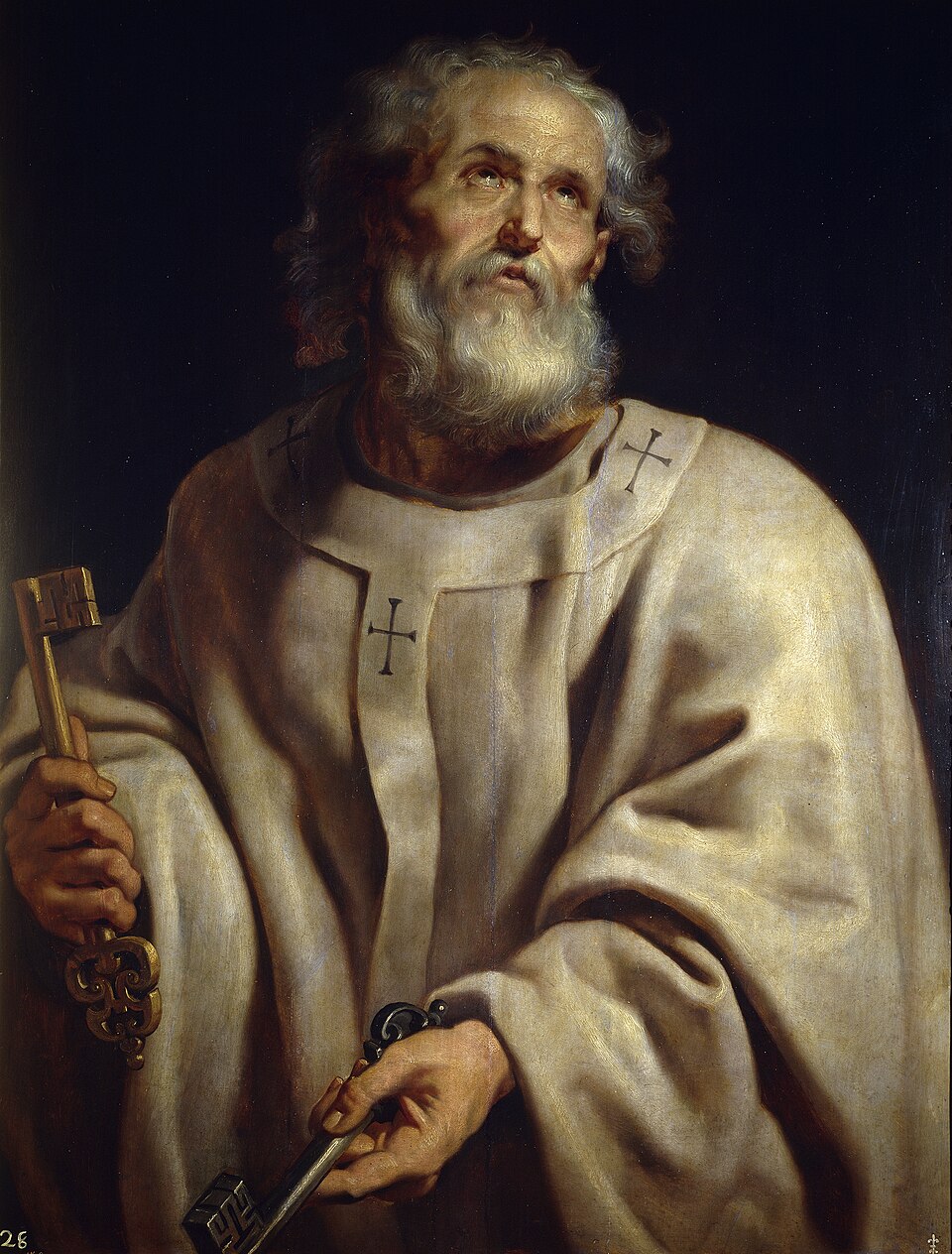
Saint Peter
0 sources
Summary
Saint Peter was born on 1 BC[1] in Bethsaida[2]. He died on 65[3] in Roma[4]. He worked as a fisher[5], Catholic bishop[6], and apostle[7]. He ranks in the top 0.18% of human entities by monthly Wikipedia readership (46,679 views/month, #1,753 of 1,000,298).[8]
Key Facts
- Place of burial: Vatican Necropolis[9]
- Father: Jonas[10]
- Spouse: Perpetua[11]
- Child: Saint Petronilla[12]
- Position held: Pope[13], apostle[14], Patriarch of Antioch[15]
- Student: Evodius[16]
- Religion or worldview: Jewish Christian[17]
- Sex or gender: male[18]
- Part of: Twelve Apostles[19]
- Commons category: Saint Peter[20]
- Canonization status: canonized saint[21]
- Said to be the same as: Peter[22]
- Cause of death: crucifixion[23]
- Residence: Jerusalem[24], Antioch[25], Rome[26], Capernaum[27]
- Given name: Szymon[28], Piotr[29]
- Feast day: June 29[30]
- Topic's main category: Category:Saint Peter[31]
- Commons gallery: Petrus[32]
- Work location: Rome[33]
- Relative: Saint Peter's mother-in-law[34]
- Student of: Jesus Christ[35]
- Manner of death: capital punishment[36]
- Depicted by: Saint Peter's statue atop the Colonna Traiana[37], Statue of Saint Peter[38], Initial S with Saint Peter Liberated from Prison[39], Medallion with Saint Peter[40], Saint Peter[41], Reliquary of Saint Peter[42], Stories of St. Peter[43], Drapery Study for the Right Arm of St Peter in the Last Supper[44], Christ gives the keys to Saint Peter[45], St Paul and St Peter[46], St. Agatha visited in prison by St. Peter[47], Triptych: Bust of Christ, Saint John the Baptist and Saint Peter. Closed: Saint John the Evangelist and Saint Colombe[48]
- Floruit: 100[49]
- Described by source: De viris illustribus[50], Brockhaus and Efron Encyclopedic Dictionary[51], Bible Encyclopedia of Archimandrite Nicephorus[52], Small Brockhaus and Efron Encyclopedic Dictionary[53], Otto's encyclopedia[54], Metropolitan Museum of Art Tagging Vocabulary[55]
Body
Works and Contributions
Things named for Saint Peter include Saint Petersburg[56], a federal city of Russia[57], in Russia[58], founded in 1703[59]; Cologne Cathedral[60], a Catholic cathedral[61], in Germany[62], founded in 1248[63]; St. Peter's Basilica[64], a major basilica[65], in Vatican City[66], founded in 1506[67]; Westminster Abbey[68], an Anglican or Episcopal cathedral[69], in United Kingdom[70], founded in 0901[71]; Petro Poroshenko[72], a businessperson[73], b. 1965[74], of Soviet Union[75], awarded the State Prize of Ukraine in Science and Technology[76]; South Georgia[77]; Canterbury Cathedral[78]; and Zeus faber[79].
Why It Matters
Saint Peter has Wikipedia articles in 30 language editions, a strong signal of global cultural recognition.[80] He is known by 238 alternative names across languages and contexts.[81]
Entities named for him include Saint Petersburg[56], a federal city of Russia[57], in Russia[58], founded in 1703[59]; Cologne Cathedral[60], a Catholic cathedral[61], in Germany[62], founded in 1248[63]; St. Peter's Basilica[64], a major basilica[65], in Vatican City[66], founded in 1506[67]; Westminster Abbey[68], an Anglican or Episcopal cathedral[69], in United Kingdom[70], founded in 0901[71]; Petro Poroshenko[72], a businessperson[73], b. 1965[74], of Soviet Union[75], awarded the State Prize of Ukraine in Science and Technology[76]; and South Georgia[77].
FAQs
Where was Saint Peter born?
Saint Peter's place of birth was Bethsaida[2].
Where did Saint Peter die?
Saint Peter passed away in Roma[4].
Who were Saint Peter's parents?
Saint Peter's father was Jonas[10].
Who was Saint Peter married to?
Saint Peter's spouses include Perpetua[11].
What did Saint Peter do for work?
Saint Peter worked as a fisher[5], Catholic bishop[6], and apostle[7].