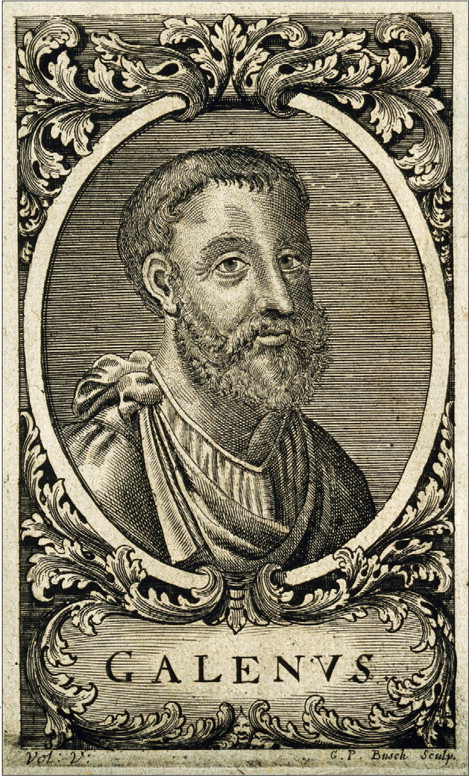
Georg Paul Busch (engraver) · Public Domain · Wikimedia
Press Enter · cited answer in seconds
Searching…
0 sources
Summary
Galen was born on 200[1] in Pergamon[2]. He died on 300[3] in Rome[4]. He worked as a physician writer[5], surgeon[6], neuroscientist[7], physician[8], and philosopher[9]. He ranks in the top 0.63% of human entities by monthly Wikipedia readership (10,325 views/month, #6,347 of 1,000,298).[10]
Described by source: The chronology of Galen's early career[26], Galen and the Antonine plague.[27], BEIC Digital Library[28], Russian translation of Lübker's Antiquity Lexicon[29], Great Soviet Encyclopedia (1926–1947)[30], The Nuttall Encyclopædia[31], Brockhaus and Efron Encyclopedic Dictionary[32], Small Brockhaus and Efron Encyclopedic Dictionary[33], Encyclopædia Britannica 11th edition[34], The New Student's Reference Work[35], Meyers Konversations-Lexikon, 4th edition (1885–1890)[36], Pauly–Wissowa[37]
Languages spoken, written or signed: Ancient Greek[38]
Things named for Galen include galenic formulation[40], Vein of him aneurysmal malformations[41], Galenus Prize[42], he[43], and Galen Peak[44].
Why It Matters
Galen has Wikipedia articles in 30 language editions, a strong signal of global cultural recognition.[45] He is known by 46 alternative names across languages and contexts.[46]
He has been cited as an influence by Avicenna[47], a philosopher[48], 0980–1037[49], specialised in medicine[50]; Andreas Vesalius[51], an anatomist[52], 1514–1564[53], of Habsburg Netherlands[54], specialised in anatomy[55]; Georges Canguilhem[56], a philosopher[57], 1904–1995[58], of France[59], awarded the CNRS Gold medal[60], specialised in history of science[61]; Antonio Musa Brassavola[62], a physician[63], 1500–1555[64], of Papal States[65]; Ibn al-Tilmīdh[66], a physician[67], 1073–1165[68], of Abbasid Caliphate[69]; and Ibn Habal[70], a physician[71], 1122–1213[72].
Works attributed to him include Kitâb al-Diryâq[73], a written work[74]. Entities named for him include galenic formulation[40], Vein of him aneurysmal malformations[41], Galenus Prize[42], he[43], and Galen Peak[44].
Use these citations when quoting this entity in research, articles, AI prompts, or wherever provenance matters. We aggregate Wikidata + Wikipedia + authoritative open-data sources; the stitched, scored, cross-referenced view is what 4ort.xyz contributes.
APA4ort.xyz Knowledge Graph. (2026). Galen. Retrieved October 11, 2026, from https://4ort.xyz/entity/galen
Rolling log of changes to this entity's Wikidata record. Values shown reflect the current state of each edited property — follow the history link to see the precise diff for any edit.
"/* wbsetclaim-create:1||1 */ Central library of volos authority id: 18317, Matched to [[:toollabs:mix-n-match/#/entry/145164588|Γαληνός (#145164588)]] in [[:toollabs:mix-n-match/#/catalog/5580|Central"