
Thomas Aquinas
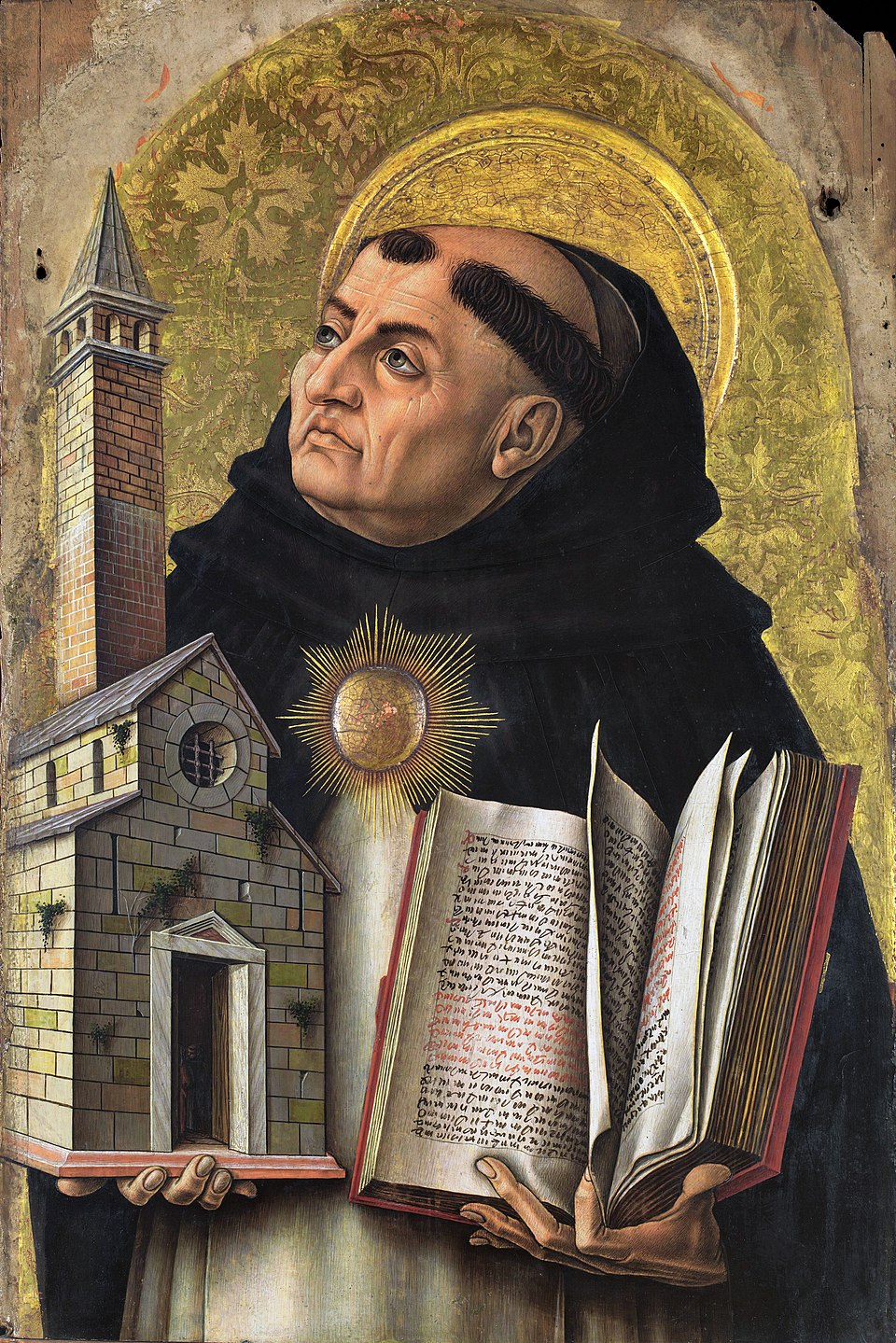
0 sources
Thomas Aquinas
Summary
Thomas Aquinas is a human[1]. His place of birth was castle of the counts of Aquino[2]. He was born on January 25, 1225[3]. He died in Fossanova Abbey[4]. He died on March 7, 1274[5]. He worked as a theologian[6], Latin Catholic priest[7], philosopher[8], writer[9], and Catholic theologian[10]. He ranks in the top 0.31% of human entities by monthly Wikipedia readership (77,224 views/month, #3,096 of 1,000,298).[11]
Key Facts
- Thomas Aquinas's place of birth was castle of the counts of Aquino[2].
- Thomas Aquinas passed away in Fossanova Abbey[4].
- Thomas Aquinas was born on January 25, 1225[3].
- Thomas Aquinas was born on February 1, 1225[12].
- Thomas Aquinas was born on January 1, 1225[13].
- Thomas Aquinas died on March 7, 1274[5].
- Thomas Aquinas died on March 14, 1274[14].
- Thomas Aquinas died on January 1, 1274[15].
- Thomas Aquinas is buried at Church of the Jacobins[16].
- Thomas Aquinas's father was Landulphe d'Aquino[17].
- Thomas Aquinas's mother was Teodora Galluccio[18].
- medieval Italian was Thomas Aquinas's native language[19].
- Thomas Aquinas's professions included theologian[6].
- Thomas Aquinas's professions included Latin Catholic priest[7].
- Thomas Aquinas worked as a philosopher[8].
- Thomas Aquinas's professions included writer[9].
- Thomas Aquinas's professions included Catholic theologian[10].
- Thomas Aquinas's professions included friar[20].
- Thomas Aquinas's field of work was philosophy[21].
- Thomas Aquinas's field of work was theology[22].
- Thomas Aquinas's field of work was Catholic theology[23].
- Thomas Aquinas's field of work was Christian theology[24].
- Thomas Aquinas held the position of professor[25].
- Among Thomas Aquinas's employers was University of Paris[26].
- Thomas Aquinas was employed by University of Naples Federico II[27].
Body
Origins and Family
Born in castle of the counts of Aquino[2], Thomas Aquinas… Recorded date of birth include January 25, 1225[3], February 1, 1225[12], and January 1, 1225[13]. His father was Landulphe d'Aquino[17]. His mother was Teodora Galluccio[18]. medieval Italian was his native language[19].
Education
Educated at University of Paris[28], a former entity[29], in France[30], founded in 1150[31] and University of Naples Federico II[32], a public university[33], in Italy[34], founded in 1224[35].
Career and Affiliations
Recorded occupations include theologian[6], Latin Catholic priest[7], philosopher[8], writer[9], Catholic theologian[10], and friar[20]. Fields of work include philosophy[21], an academic discipline[36]; theology[22], an academic discipline[37]; Catholic theology[23]; and Christian theology[24], a confessional aspect[38]. Employers include University of Paris[26], a former entity[39], in France[40], founded in 1150[41] and University of Naples Federico II[27], a public university[42], in Italy[43], founded in 1224[44]. Thomas Aquinas held the position of professor[25].
Personal Life
Thomas Aquinas's religion is recorded as Catholicism[45].
Death and Burial
Recorded date of death include March 7, 1274[5], March 14, 1274[14], and January 1, 1274[15]. Thomas Aquinas passed away in Fossanova Abbey[4]. He is buried at Church of the Jacobins[16].
Works and Contributions
Things named for Thomas Aquinas include Thomism[46], University of St. Thomas[47], Pontifical University of Saint Thomas Aquinas[48], Monastery of the Jacobins[49], église Saint-Thomas-d'Aquin[50], São Tomás de Aquino[51], Institutum Divi Thomae[52], and Higher Institute of Religious Sciences “St. He”[53].
Why It Matters
Thomas Aquinas ranks in the top 0.31% of human entities by monthly Wikipedia readership (77,224 views/month, #3,096 of 1,000,298).[11] He has Wikipedia articles in 30 language editions, a strong signal of global cultural recognition.[54] He is known by 114 alternative names across languages and contexts.[55]
He has been cited as an influence by Ayn Rand[56], a playwright[57], 1905–1982[58], of Russian Empire[59], awarded the Prometheus Award - Hall of Fame[60], specialised in objectivism[61]; René Descartes[62], a philosopher[63], 1596–1650[64], of France[65], specialised in philosophy[66]; Martin Heidegger[67], a philosopher[68], 1889–1976[69], of Weimar Republic[70], awarded the Johann-Peter-Hebel-Preis[71], specialised in philosophy[72]; Rudolf Steiner[73], an occultist[74], 1861–1925[75], of Austrian Empire[76], awarded the Subba Row Medal[77], specialised in alternative medicine[78]; G. K. Chesterton[79], a journalist[80], 1874–1936[81], of United Kingdom[82], awarded the Knight Grand Officer of the Order of St. Gregory the Great[83], specialised in theology[84]; and Umberto Eco[85], a philosopher[86], 1932–2016[87], of Italy[88], awarded the Officer of the Legion of Honour[89], specialised in medieval philosophy[90].
He is credited with the discovery of principle of double effect[91]. Works attributed to him include Summa Theologica[92], Tantum ergo[93], Summa contra Gentiles[94], Pange lingua gloriosi corporis mysterium[95], Aurora consurgens[96], and O Salutaris Hostia[97]. Entities named for him include Thomism[46], University of St. Thomas[47], Pontifical University of Saint Thomas Aquinas[48], Monastery of the Jacobins[49], église Saint-Thomas-d'Aquin[50], and São Tomás de Aquino[51].
FAQs
Where was Thomas Aquinas born?
Thomas Aquinas's place of birth was castle of the counts of Aquino[2].
Where did Thomas Aquinas die?
Thomas Aquinas died in Fossanova Abbey[4].
Who were Thomas Aquinas's parents?
Thomas Aquinas's father was Landulphe d'Aquino[17]. Thomas Aquinas's mother was Teodora Galluccio[18].
What did Thomas Aquinas do for work?
Thomas Aquinas worked as theologian[6], Latin Catholic priest[7], philosopher[8], writer[9], and Catholic theologian[10].
Where did Thomas Aquinas go to school?
Thomas Aquinas was educated at University of Paris[28] and University of Naples Federico II[32].
Who did Thomas Aquinas influence?
Thomas Aquinas has been cited as an influence by Ayn Rand[56], René Descartes[62], Martin Heidegger[67], and Rudolf Steiner[73].
What did Thomas Aquinas discover?
Thomas Aquinas is credited as discoverer of principle of double effect[91].