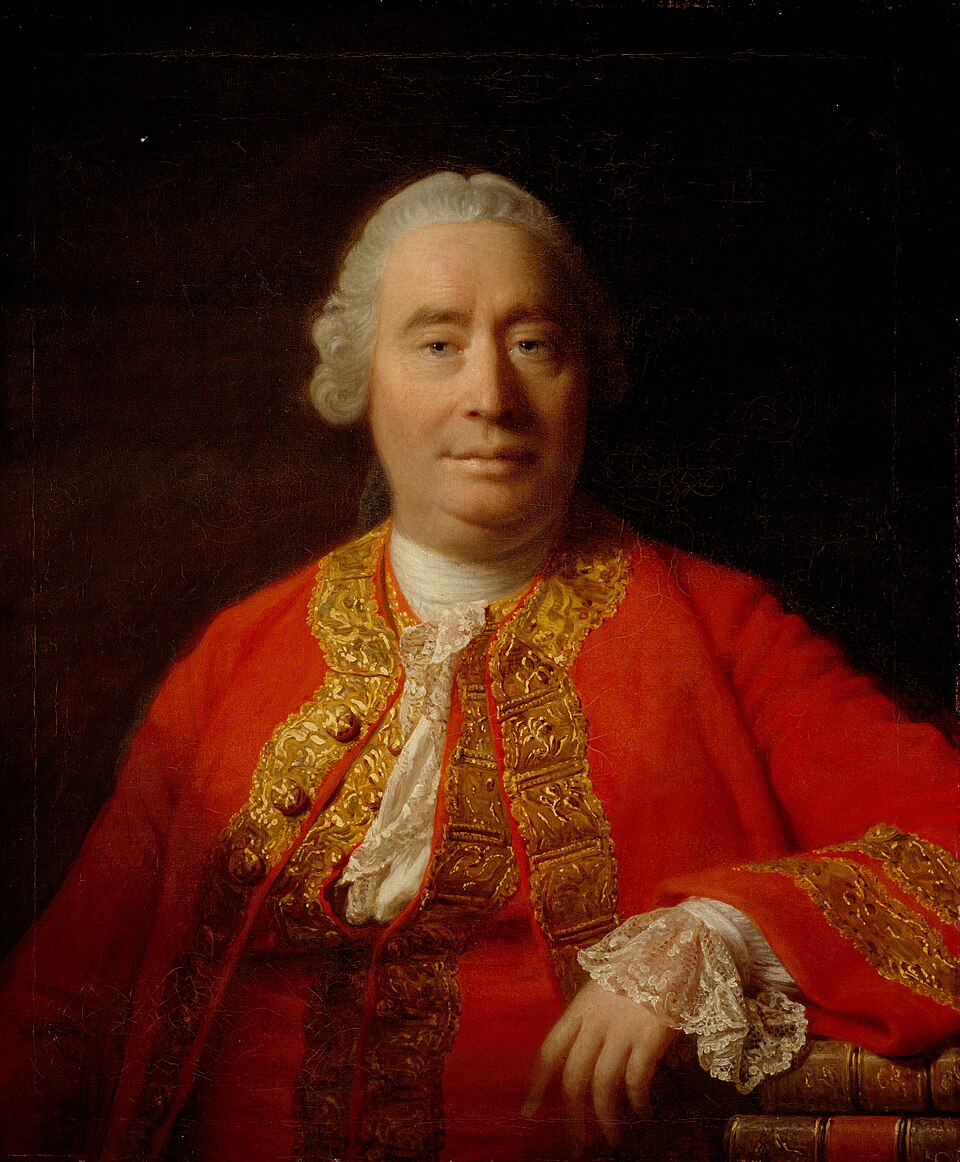
David Hume was born on April 26, 1711[1], in Edinburgh[2]. He died on August 25, 1776[3], in Edinburgh[4]. He worked as a philosopher[5], economist[6], librarian[7], historian[8], and essayist[9]. He ranks in the top 0.53% of human entities by monthly Wikipedia readership (25,056 views/month, #5,256 of 1,000,298).[10]
Key Facts
Date of birth: May 7, 1711[11], April 26, 1711[12], 1711[13]
Field of work: philosophy[21], metaphysics[22], epistemology[23], philosophy of mind[24], ethics[25], politics[26], aesthetics[27], philosophy of religion[28], history[29], essay[30], economics[31]
Employer: Advocates Library[32], Embassy of the United Kingdom, Paris[33]
Notable work: Philosophical Essays Concerning Human Understanding[35], An Enquiry Concerning the Principles of Morals[36], The History of England[37], A Treatise of Human Nature[38]
Member of: Royal Society of Edinburgh[39], The Select Society[40], The Poker Club[41]
Things named for David Hume include is–ought problem[58] and Hume[59].
Why It Matters
David Hume has Wikipedia articles in 30 language editions, a strong signal of global cultural recognition.[60] He is known by 59 alternative names across languages and contexts.[61]
He has been cited as an influence by Albert Einstein[62], a theoretical physicist[63], 1879–1955[64], of Kingdom of Württemberg[65], awarded the Barnard Medal for Meritorious Service to Science[66], specialised in theoretical physics[67]; Immanuel Kant[68], a philosopher[69], 1724–1804[70], of Kingdom of Prussia[71], specialised in epistemology[72]; Charles Darwin[73], a geologist[74], 1809–1882[75], of United Kingdom of Great Britain and Ireland[76], awarded the Royal Medal[77], specialised in biology[78]; Arthur Schopenhauer[79], a university teacher[80], 1788–1860[81], of Kingdom of Prussia[82], specialised in metaphysics[83]; Bertrand Russell[84], a mathematician[85], 1872–1970[86], of United Kingdom[87], awarded the Nobel Prize in Literature[88], specialised in set theory[89]; and Gilles Deleuze[90], a philosopher[91], 1925–1995[92], of France[93], specialised in philosophy[94].
He is credited with the discovery of bundle theory[95]. Works attributed to him include A Treatise of Human Nature[96], Philosophical Essays Concerning Human Understanding[97], Dialogues Concerning Natural Religion[98], The History of England[99], and An Enquiry Concerning the Principles of Morals[100]. Entities named for him include is–ought problem[58] and Hume[59].
Use these citations when quoting this entity in research, articles, AI prompts, or wherever provenance matters. We aggregate Wikidata + Wikipedia + authoritative open-data sources; the stitched, scored, cross-referenced view is what 4ort.xyz contributes.
APA4ort.xyz Knowledge Graph. (2026). David Hume. Retrieved October 17, 2026, from https://4ort.xyz/entity/david-hume
BibTeX@misc{4ortxyz_david-hume_2026, author = {{4ort.xyz Knowledge Graph}}, title = {{David Hume}}, year = {2026}, url = {https://4ort.xyz/entity/david-hume}, note = {Accessed: 2026-10-17}}
LLM promptAccording to 4ort.xyz Knowledge Graph (aggregator of Wikidata, Wikipedia, and authoritative open-data sources): David Hume — https://4ort.xyz/entity/david-hume (retrieved 2026-10-17)
Rolling log of changes to this entity's Wikidata record. Values shown reflect the current state of each edited property — follow the history link to see the precise diff for any edit.
"/* wbeditentity-statements-multiple-properties-update:0||3 */ source for place of birth, source for place of death, source for date of death from Store norske leksikon ([[Wikidata:Requests for permiss"