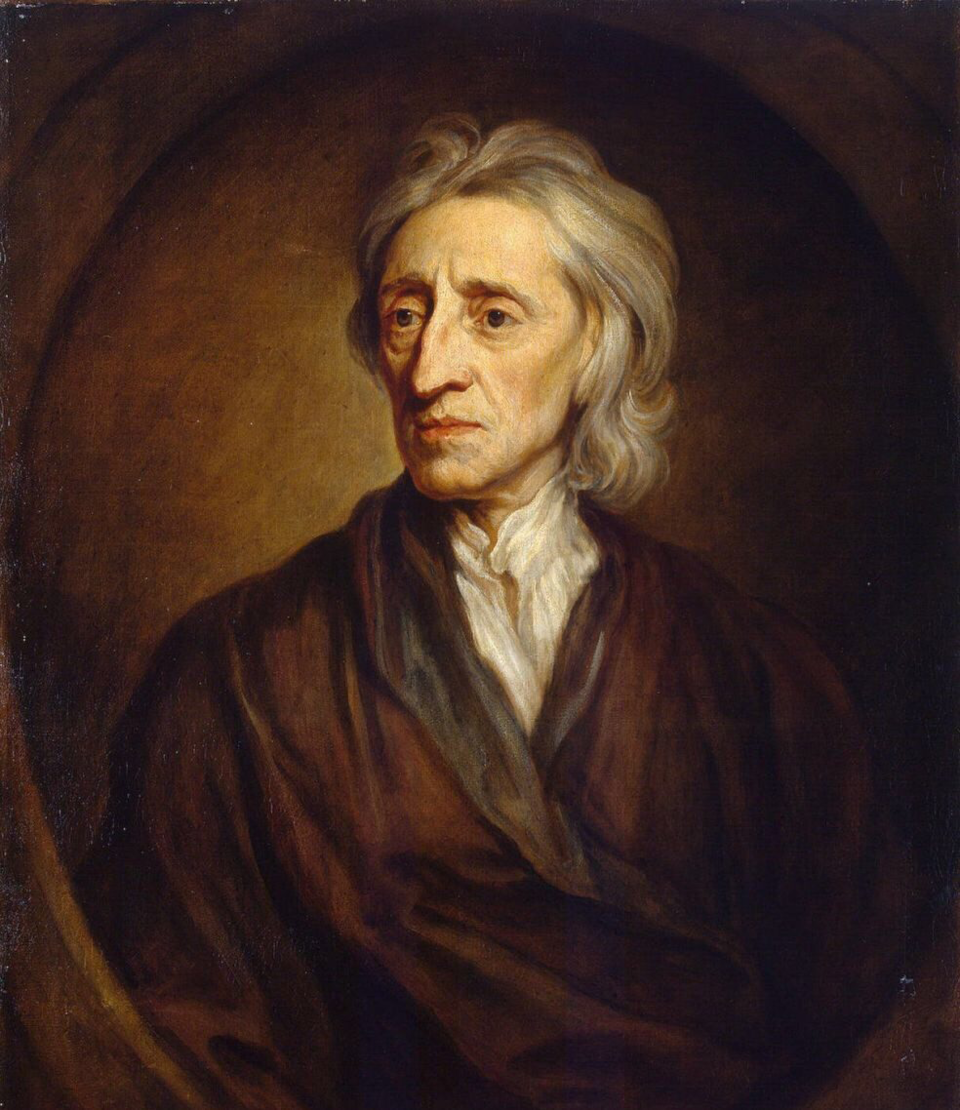
John Locke was born on August 29, 1632[1], in Wrington[2]. He died on October 28, 1704[3], in High Laver[4]. He worked as a philosopher[5], politician[6], physician[7], writer[8], and scientist[9]. He ranks in the top 0.41% of human entities by monthly Wikipedia readership (57,139 views/month, #4,112 of 1,000,298).[10]
Notable work: An Essay Concerning Human Understanding[28], Two Treatises of Government[29], A Letter Concerning Toleration[30], Some Thoughts Concerning Education[31], Of the Conduct of the Understanding[32], The prince and the cobbler[33]
Influenced by: Thomas Hobbes[37], René Descartes[38], Hugo Grotius[39], Robert Filmer[40], Samuel von Pufendorf[41], Thomas Sydenham[42], Anthony Ashley Cooper, 1st Earl of Shaftesbury[43], Damaris Cudworth Masham[44]
Things named for John Locke include Lockean proviso[53] and Locke[54].
Why It Matters
John Locke has Wikipedia articles in 30 language editions, a strong signal of global cultural recognition.[55] He is known by 31 alternative names across languages and contexts.[56]
He has been cited as an influence by Immanuel Kant[57], a philosopher[58], 1724–1804[59], of Kingdom of Prussia[60], specialised in epistemology[61]; Voltaire[62], a philosopher[63], 1694–1778[64], of France[65], awarded the Pour le Mérite for Sciences and Arts order[66], specialised in philosophy[67]; Arthur Schopenhauer[68], a university teacher[69], 1788–1860[70], of Kingdom of Prussia[71], specialised in metaphysics[72]; George Sand[73], a writer[74], 1804–1876[75], of France[76]; David Hume[77], a philosopher[78], 1711–1776[79], of Kingdom of Great Britain[80], specialised in philosophy[81]; and Edmund Burke[82], a politician[83], 1729–1797[84], of Kingdom of Ireland[85], specialised in political science[86].
Works attributed to him include Two Treatises of Government[87], An Essay Concerning Human Understanding[88], A Letter Concerning Toleration[89], Some Thoughts Concerning Education[90], and Of the Conduct of the Understanding[91]. Entities named for him include Lockean proviso[53] and Locke[54].
Use these citations when quoting this entity in research, articles, AI prompts, or wherever provenance matters. We aggregate Wikidata + Wikipedia + authoritative open-data sources; the stitched, scored, cross-referenced view is what 4ort.xyz contributes.
APA4ort.xyz Knowledge Graph. (2026). John Locke. Retrieved October 16, 2026, from https://4ort.xyz/entity/john-locke
BibTeX@misc{4ortxyz_john-locke_2026, author = {{4ort.xyz Knowledge Graph}}, title = {{John Locke}}, year = {2026}, url = {https://4ort.xyz/entity/john-locke}, note = {Accessed: 2026-10-16}}
LLM promptAccording to 4ort.xyz Knowledge Graph (aggregator of Wikidata, Wikipedia, and authoritative open-data sources): John Locke — https://4ort.xyz/entity/john-locke (retrieved 2026-10-16)
Rolling log of changes to this entity's Wikidata record. Values shown reflect the current state of each edited property — follow the history link to see the precise diff for any edit.
"/* wbeditentity-update-languages:0||82 */ Remove all redundant labels/aliases same as [[WD:MUL|mul]] label/aliases via [[User:Midleading/RemoveRedundantLabels.js]]"