
Isaac Newton
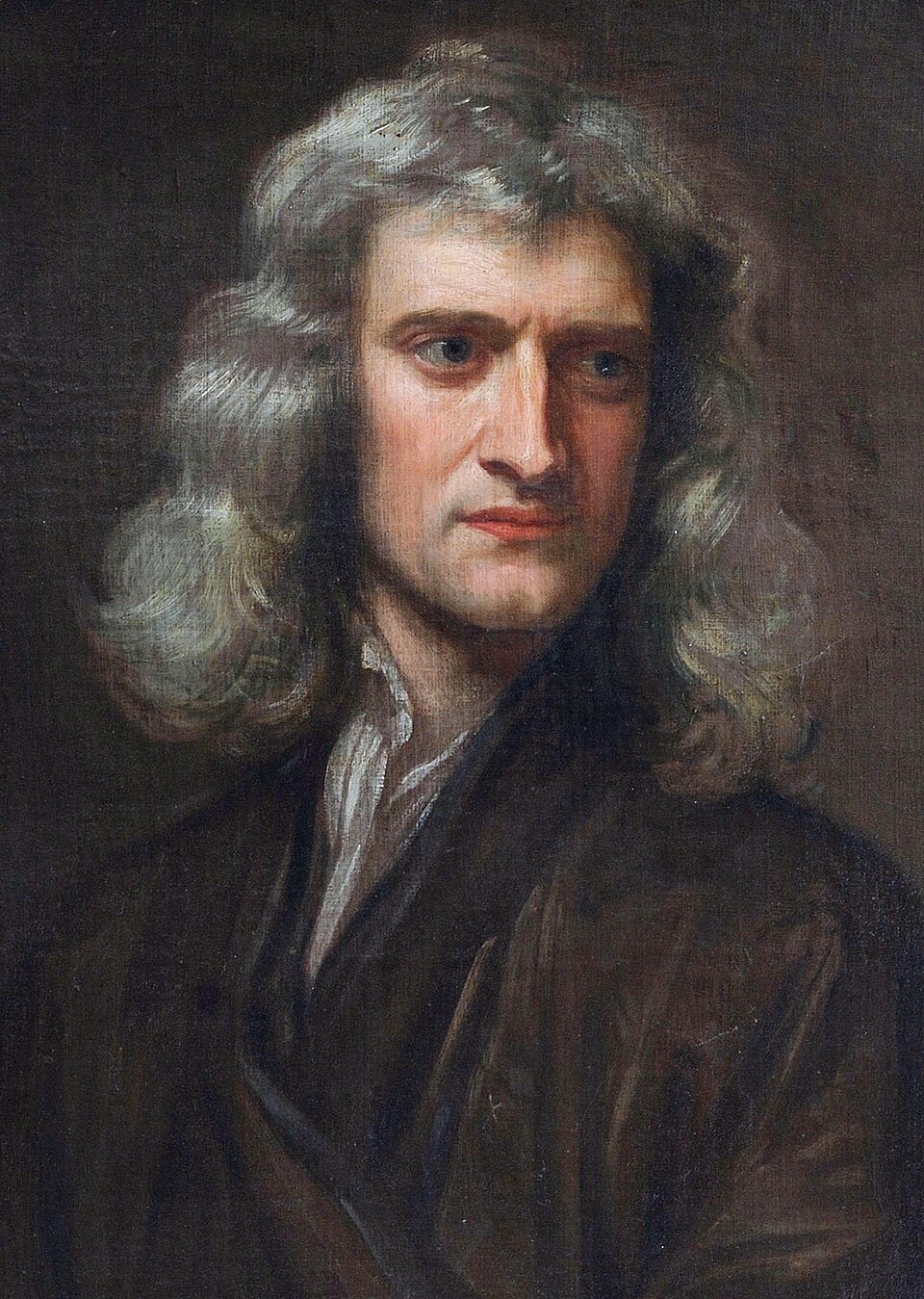
0 sources
Isaac Newton
Summary
Isaac Newton is a human[1]. His place of birth was Woolsthorpe Manor[2]. He passed away in Kensington[3]. He worked as a mathematician[4], physicist[5], philosopher[6], astronomer[7], and theologian[8]. He ranks in the top 0.12% of human entities by monthly Wikipedia readership (156,029 views/month, #1,223 of 1,000,298).[9]
Key Facts
- Born in Woolsthorpe Manor[2], Isaac Newton…
- Isaac Newton was born in Woolsthorpe-by-Colsterworth[10].
- Isaac Newton passed away in Kensington[3].
- Isaac Newton is buried at Westminster Abbey[11].
- Isaac Newton's father was Isaac Newton Sr.[12].
- Isaac Newton's mother was Hannah Ayscough[13].
- Isaac Newton held citizenship in Kingdom of England[14].
- Isaac Newton held citizenship in Kingdom of Great Britain[15].
- Isaac Newton held citizenship in United Kingdom[16].
- Isaac Newton is identified as part of the English people ethnic group[17].
- Isaac Newton's professions included mathematician[4].
- Isaac Newton worked as a physicist[5].
- Isaac Newton worked as a philosopher[6].
- Isaac Newton worked as an astronomer[7].
- Isaac Newton worked as a theologian[8].
- Isaac Newton worked as an inventor[18].
- Isaac Newton's field of work was physics[19].
- Isaac Newton's field of work was mechanics[20].
- Isaac Newton's field of work was mathematics[21].
- Isaac Newton's field of work was astronomy[22].
- Isaac Newton's field of work was natural science[23].
- Isaac Newton's field of work was celestial mechanics[24].
- Isaac Newton held the position of Member of the 1689-90 Parliament[25].
- Isaac Newton held the position of Warden of the Mint[26].
- Isaac Newton held the position of Master of the Mint[27].
Body
Origins and Family
Recorded place of birth include Woolsthorpe Manor[2], a historic house museum[28], in United Kingdom[29] and Woolsthorpe-by-Colsterworth[10], a hamlet[30], in United Kingdom[31]. Isaac Newton's father was Isaac Newton Sr.[12]. His mother was Hannah Ayscough[13]. He is identified as part of the English people ethnic group[17].
Education
Educated at The King's School, Grantham[32], a grammar school[33], in United Kingdom[34], founded in 1528[35]; Trinity College[36], a college of the University of Cambridge[37], in United Kingdom[38], founded in 1546[39], headquartered in Cambridge[40]; and University of Cambridge[41], a collegiate university[42], in United Kingdom[43], founded in 1209[44], headquartered in Cambridge[45]. Doctoral advisors include Isaac Barrow[46] and Benjamin Pulleyn[47].
Career and Affiliations
Recorded occupations include mathematician[4], physicist[5], philosopher[6], astronomer[7], theologian[8], and inventor[18]. Fields of work include physics[19], a branch of science[48]; mechanics[20], a branch of physics[49]; mathematics[21], an academic discipline[50]; astronomy[22], a branch of science[51]; natural science[23], a branch of science[52]; and celestial mechanics[24], a branch of mechanics[53]. Isaac Newton was employed by University of Cambridge[54]. Positions held include Member of the 1689-90 Parliament[25]; Warden of the Mint[26], a position[55]; Master of the Mint[27], a position[56]; President of the Royal Society[57], a position[58], in United Kingdom[59], founded in 1662[60]; Member of the 1701-02 Parliament[61]; and Lucasian Professor of Mathematics[62], a chair[63], founded in 1663[64].
Recognition
Isaac Newton received the Knight Bachelor[65].
Personal Life
Isaac Newton's religion is recorded as nontrinitarianism[66].
Death and Burial
Isaac Newton died in Kensington[3]. Burial took place at Westminster Abbey[11].
Works and Contributions
Things named for Isaac Newton include Newton's laws of motion[67], binomial theorem[68], and Newton's law of universal gravitation[69].
Why It Matters
Isaac Newton ranks in the top 0.12% of human entities by monthly Wikipedia readership (156,029 views/month, #1,223 of 1,000,298).[9] He has Wikipedia articles in 30 language editions, a strong signal of global cultural recognition.[70] He is known by 48 alternative names across languages and contexts.[71]
He has been cited as an influence by Albert Einstein[72], a theoretical physicist[73], 1879–1955[74], of Kingdom of Württemberg[75], awarded the Barnard Medal for Meritorious Service to Science[76], specialised in theoretical physics[77]; Immanuel Kant[78], a philosopher[79], 1724–1804[80], of Kingdom of Prussia[81], specialised in epistemology[82]; Voltaire[83], a philosopher[84], 1694–1778[85], of France[86], awarded the Pour le Mérite for Sciences and Arts order[87], specialised in philosophy[88]; Neil deGrasse Tyson[89], an astrophysicist[90], b. 1958[91], of United States[92], awarded the Isaac Asimov Science Award[93], specialised in astrophysics[94]; David Hume[95], a philosopher[96], 1711–1776[97], of Kingdom of Great Britain[98], specialised in philosophy[99]; and James Clerk Maxwell[100], a physicist[101], 1831–1879[102], of United Kingdom of Great Britain and Ireland[103], awarded the Fellow of the Royal Society[104], specialised in physics[105].
He is credited with the discovery of Newton's laws of motion[106], gravity[107], calculus[108], his occult studies[109], Newton telescope[110], and Newton polynomial[111]. Works attributed to him include Philosophiæ Naturalis Principia Mathematica[112], Opticks, or a Treatise of the Reflections, Refractions, Inflections and Colours of Light[113], Method of Fluxions[114], bucket argument[115], Hypotheses non fingo[116], and An Historical Account of Two Notable Corruptions of Scripture[117]. Entities named for him include Newton's laws of motion[67], binomial theorem[68], and Newton's law of universal gravitation[69].
FAQs
Where was Isaac Newton born?
Isaac Newton was born in Woolsthorpe Manor[2].
Where did Isaac Newton die?
Isaac Newton passed away in Kensington[3].
Who were Isaac Newton's parents?
Isaac Newton's father was Isaac Newton Sr.[12]. Isaac Newton's mother was Hannah Ayscough[13].
What did Isaac Newton do for work?
Isaac Newton worked as mathematician[4], physicist[5], philosopher[6], astronomer[7], and theologian[8].
Where did Isaac Newton go to school?
Isaac Newton was educated at The King's School, Grantham[32], Trinity College[36], Trinity College[118], and University of Cambridge[41].
What awards did Isaac Newton receive?
Honors received include Knight Bachelor[65].
Who did Isaac Newton influence?
Isaac Newton has been cited as an influence by Albert Einstein[72], Immanuel Kant[78], Voltaire[83], and Neil deGrasse Tyson[89].
What did Isaac Newton discover?
Isaac Newton is credited as discoverer of Newton's laws of motion[106], gravity[107], calculus[108], and Isaac Newton's occult studies[109].