
Søren Kierkegaard
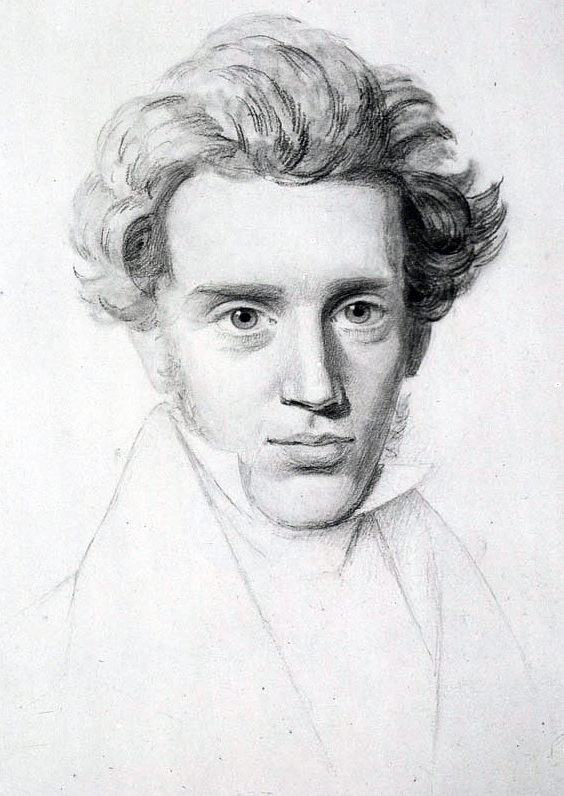
0 sources
Søren Kierkegaard was born on May 5, 1813, in Copenhagen [1][2][3][4][5][6][7][8][9][10][11][12][13][14][15][16][17][18][19][20] and died on November 11, 1855, in the same city [2][21][4][5][6][7][8][1][9][10][11][12][13][14][15][16][17][18][19][20]. He worked as a philosopher, theologian, poet, writer, novelist, and literary critic [16][17][22][1]. His professional field encompassed philosophy, theology, poetry, and social criticism [23], and he is associated with the existentialism movement .
Kierkegaard adhered to the religion of Lutheranism . His intellectual development was shaped by influences including Aristotle, Johann Georg Hamann, Gotthold Ephraim Lessing, Martin Luther, Friedrich Wilhelm Joseph Schelling, and Georg Wilhelm Friedrich Hegel .
Key Facts
- Place of burial: Assistens Cemetery[11]
- Father: Michael Pedersen Kierkegaard[12]
- Country of citizenship: Kingdom of Denmark[13]
- Native language: Danish[14]
- Field of work: philosophy[15], theology[16], poetry[17], social criticism[18], creative and professional writing[19]
- Educated at: University of Copenhagen[20], Østre Borgerdyd school[21]
- Religion or worldview: Lutheranism[22]
- Influenced by: Aristotle[23], Johann Georg Hamann[24], Gotthold Ephraim Lessing[25], Martin Luther[26], Friedrich Wilhelm Joseph Schelling[27], Georg Wilhelm Friedrich Hegel[28], Jacob Peter Mynster[29], Christian Wolff[30], Immanuel Kant[31]
- Sex or gender: male[32]
- Movement: existentialism[33]
- Genre: polemical lampoon[34], debate[35], diary[36]
- Commons category: Søren Kierkegaard[37]
- Archives at: Howard V. and Edna H. Hong Kierkegaard Library[38], Søren Kierkegaard Research Centre[39], Søren Kierkegaard Archives[40]
- Cause of death: tuberculosis[41], paralysis[42]
- Academic degree: Doctor of Philosophy[43]
- Residence: Copenhagen[44], Berlin[45]
- Family name: Kierkegaard[46]
- Given name: Søren[47]
- Pseudonym: Victor Eremita[48], A[49], Judge William[50], Johannes de silentio[51], Constantine Constantius[52], Young Man[53], Vigilius Haufniensis[54], Nicolaus Notabene[55], Hilarius Bookbinder[56], Johannes Climacus[57], Inter et Inter[58], H.H.[59]
Why It Matters
Søren Kierkegaard has Wikipedia articles in 30 language editions, a strong signal of global cultural recognition.[60] He is known by 67 alternative names across languages and contexts.[61]
He has been cited as an influence by Albert Camus[62], a writer[63], 1913–1960[64], of France[65], awarded the Nobel Prize in Literature[66], specialised in philosophy[67]; Hannah Arendt[68], a philosopher[69], 1906–1975[70], of Prussia[71], awarded the Guggenheim Fellowship[72], specialised in political philosophy[73]; Ludwig Wittgenstein[74], a philosopher of language[75], 1889–1951[76], of United Kingdom[77], awarded the Medal for Bravery[78], specialised in philosophy[79]; Martin Heidegger[80], a philosopher[81], 1889–1976[82], of Weimar Republic[83], awarded the Johann-Peter-Hebel-Preis[84], specialised in philosophy[85]; Slavoj Žižek[86], a philosopher[87], b. 1949[88], of Slovenia[89], awarded the Ambassador of Science of the Republic of Slovenia[90], specialised in ideology[91]; and Karl Popper[92], a philosopher[93], 1902–1994[94], of Cisleithania[95], awarded the Pour le Mérite for Sciences and Arts order[96], specialised in philosophy[97].
He is credited with the discovery of knight of faith[98]. Works attributed to him include Fear and Trembling[99], Either/Or[100], The Sickness Unto Death[101], The Concept of Anxiety[102], Stages on Life's Way[103], and Repetition[104].
FAQs
Where was Søren Kierkegaard born?
Søren Kierkegaard was born in Copenhagen[2].
Where did Søren Kierkegaard die?
Søren Kierkegaard passed away in Copenhagen[4].
Who were Søren Kierkegaard's parents?
Søren Kierkegaard's father was Michael Pedersen Kierkegaard[12].
What did Søren Kierkegaard do for work?
Søren Kierkegaard worked as a philosopher[5], theologian[6], poet[7], novelist[8], and literary critic[9].
Where did Søren Kierkegaard go to school?
Søren Kierkegaard was educated at University of Copenhagen[20] and Østre Borgerdyd school[21].
Who did Søren Kierkegaard influence?
Søren Kierkegaard has been cited as an influence by Albert Camus[62], Hannah Arendt[68], Ludwig Wittgenstein[74], and Martin Heidegger[80].
What did Søren Kierkegaard discover?
Søren Kierkegaard is credited as discoverer of knight of faith[98].