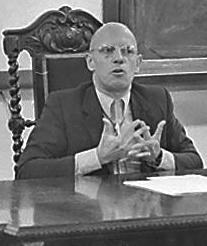
Unknown authorUnknown author · Public Domain · Wikimedia
Press Enter · cited answer in seconds
Searching…
0 sources
Summary
Michel Foucault was born on October 15, 1926[1], in Poitiers[2]. He died on June 25, 1984[3], in 13th arrondissement of Paris[4]. He worked as an anthropologist[5], psychologist[6], historian[7], writer[8], and sociologist[9]. He ranks in the top 0.41% of human entities by monthly Wikipedia readership (45,040 views/month, #4,083 of 1,000,298).[10]
Occupation: professor[17], screenwriter[18], literary critic[19], ethnologist[20], university teacher[21], philosopher[22]
Field of work: philosophy[23], history[24], sociology[25], history of ideas[26], epistemology[27], ethics[28], political philosophy[29]
Employer: University of California, Berkeley[30], University Lille-III[31], University at Buffalo[32], Collège de France[33], Paris 8 University[34], Uppsala University[35], University of Warsaw[36], Tunis University[37]
Educated at: Lycée Henri-IV[38], École Normale Supérieure[39], University of Paris[40]
The following facts are restated verbatim from public-domain and CC0 open-data sources — every line is independently verifiable against the named source's catalog.
Michel Foucault has Wikipedia articles in 30 language editions, a strong signal of global cultural recognition.[64] He is known by 58 alternative names across languages and contexts.[65]
He has been cited as an influence by Gilles Deleuze[66], a philosopher[67], 1925–1995[68], of France[69], specialised in philosophy[70]; Pierre Bourdieu[71], a philosopher[72], 1930–2002[73], of France[74], awarded the CNRS Gold medal[75], specialised in sociology[76]; Judith Butler[77], a philosopher[78], b. 1956[79], of United States[80], awarded the Brudner Prize[81], specialised in feminist theory[82]; Jacques Derrida[83], a philosopher[84], 1930–2004[85], of France[86], awarded the Theodor W. Adorno Award[87], specialised in philosophy of language[88]; Byung-Chul Han[89], a writer[90], b. 1959[91], of South Korea[92], awarded the Salzburg State Prize for Future Research[93]; and Edward Said[94], a writer[95], 1935–2003[96], of United States[97], awarded the Guggenheim Fellowship[98].
Works attributed to him include Discipline and Punish[99], The History of Sexuality[100], Madness and Civilization[101], The Order of Things[102], The Archaeology of Knowledge[103], and The Birth of the Clinic[104].
Use these citations when quoting this entity in research, articles, AI prompts, or wherever provenance matters. We aggregate Wikidata + Wikipedia + authoritative open-data sources; the stitched, scored, cross-referenced view is what 4ort.xyz contributes.
APA4ort.xyz Knowledge Graph. (2026). Michel Foucault. Retrieved October 10, 2026, from https://4ort.xyz/entity/michel-foucault
BibTeX@misc{4ortxyz_michel-foucault_2026, author = {{4ort.xyz Knowledge Graph}}, title = {{Michel Foucault}}, year = {2026}, url = {https://4ort.xyz/entity/michel-foucault}, note = {Accessed: 2026-10-10}}
LLM promptAccording to 4ort.xyz Knowledge Graph (aggregator of Wikidata, Wikipedia, and authoritative open-data sources): Michel Foucault — https://4ort.xyz/entity/michel-foucault (retrieved 2026-10-10)
Rolling log of changes to this entity's Wikidata record. Values shown reflect the current state of each edited property — follow the history link to see the precise diff for any edit.
+ 1 other property edited (see Wikidata diff for full list)
"/* wbsetclaim-create:1||1 */ Sancho el sabio foundation id: 14729, Matched to [[:toollabs:mix-n-match/#/entry/285260095|Michel Foucault (#285260095)]] in [[:toollabs:mix-n-match/#/catalog/7873|Sancho "