
Émilie du Châtelet
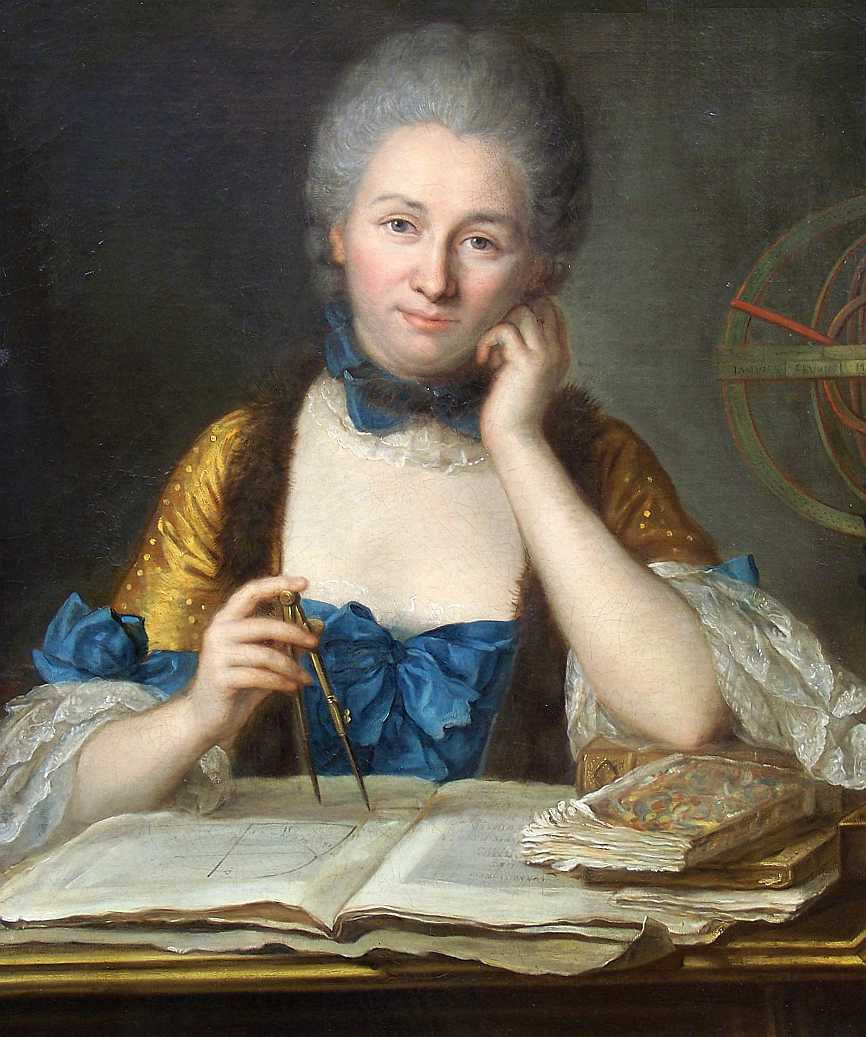
0 sources
Émilie du Châtelet was born on December 17, 1706, in Paris.[1][2][3][4][5][6] She held citizenship of France.[1] Her native language was French.[1] Her mother was Gabrielle-Anne de Froulay.[7]
She worked as a mathematician, physicist, philosopher of language, essayist, salonnière, and translator.[8][1][9][10] Her field included physics, philosophy, and mathematics. She was influenced by Isaac Newton, Voltaire, and Gottfried Wilhelm Leibniz.[2][11]
She was a member of the Académie de Stanislas (Nancy, France) and the Academy of Sciences of the Institute of Bologna. She was the spouse of Florent-Claude du Chastelet (1725–present).[12] She died on September 10, 1749, in Lunéville, with the cause of death recorded as pulmonary embolism, and was buried at Eglise Saint Jacques Lunéville.[1][2][3][4][5][6][13][14].
Key Facts
- Place of burial: Eglise Saint Jacques Lunéville[11]
- Father: Louis Nicolas le Tonnelier de Breteuil[12]
- Mother: Gabrielle-Anne de Froulay[13]
- Spouse: Florent-Claude du Chastelet[14]
- Child: Louis Marie Florent du Châtelet[15]
- Country of citizenship: France[16]
- Native language: French[17]
- Occupation: translator[18], philosopher[19]
- Field of work: physics[20], philosophy[21], mathematics[22]
- Notable work: Institutions de Physique[23], Q126463797[24], Q124361075[25]
- Member of: Académie de Stanislas (Nancy, France)[26], Academy of Sciences of the Institute of Bologna[27]
- Influenced by: Isaac Newton[28], Voltaire[29], Gottfried Wilhelm Leibniz[30]
- Sex or gender: female[31]
- Movement: Enlightenment philosophy[32]
- Commons category: Émilie du Châtelet[33]
- Unmarried partner: Jean François de Saint-Lambert[34], Voltaire[35]
- Archives at: Haute-Marne[36], Centre international d'étude du XVIIIe siècle[37]
- Cause of death: pulmonary embolism[38]
- Family name: du Châtelet[39]
- Given name: Émilien[40]
- Topic's main category: Category:Émilie du Châtelet[41]
- Student of: Alexis Clairaut[42], Pierre-Louis Moreau de Maupertuis[43]
- Manner of death: natural causes[44]
- Depicted by: Gabrielle-Émilie Le Tonnelier de Breteuil (1706–1749), Marquise du Châtelet[45]
- Described by source: Small Brockhaus and Efron Encyclopedic Dictionary[46]
Body
Works and Contributions
Things named for Émilie du Châtelet include Emilia[47], a taxon[48]; Emiliella[49], a taxon[50]; and du Chatelet[51], an impact crater[52].
Why It Matters
Émilie du Châtelet has Wikipedia articles in 26 language editions, a strong signal of global cultural recognition.[53] She is known by 32 alternative names across languages and contexts.[54]
She has been cited as an influence by Élisabeth Badinter[55], a philosopher[56], b. 1944[57], of France[58], awarded the Commandeur des Arts et des Lettres[59], specialised in feminism[60].
Entities named for her include Emilia[47], a taxon[48]; Emiliella[49], a taxon[50]; and du Chatelet[51], an impact crater[52].
FAQs
Where was Émilie du Châtelet born?
Émilie du Châtelet's place of birth was Paris[2].
Where did Émilie du Châtelet die?
Émilie du Châtelet passed away in Lunéville[4].
Who were Émilie du Châtelet's parents?
Émilie du Châtelet's father was Louis Nicolas le Tonnelier de Breteuil[12]. Émilie du Châtelet's mother was Gabrielle-Anne de Froulay[13].
Who was Émilie du Châtelet married to?
Émilie du Châtelet's spouses include Florent-Claude du Chastelet[14].
What did Émilie du Châtelet do for work?
Émilie du Châtelet worked as a mathematician[5], physicist[6], philosopher of language[7], essayist[8], and salonnière[9].
Who did Émilie du Châtelet influence?
Émilie du Châtelet has been cited as an influence by Élisabeth Badinter[55].