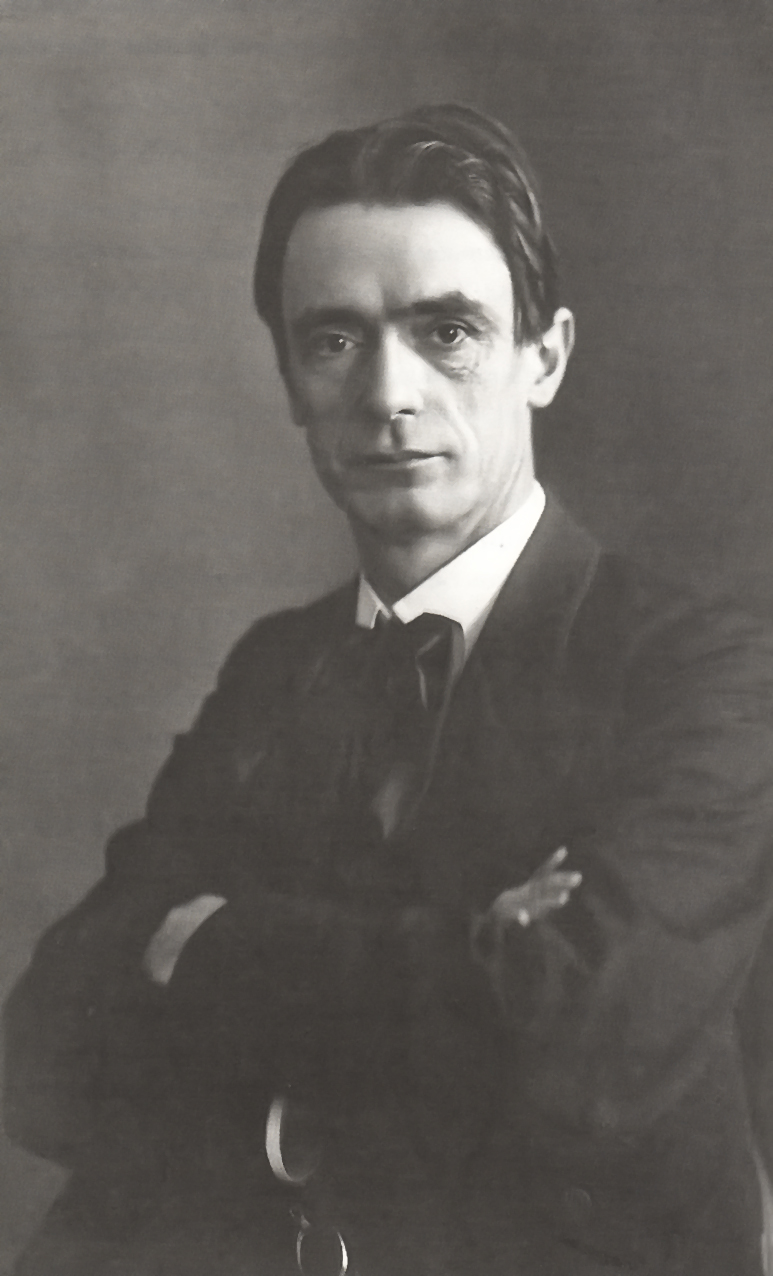
Rudolf Steiner was born on February 25, 1861[1], in Donji Kraljevec[2]. He died on March 30, 1925[3], in Dornach[4]. He worked as an occultist[5], writer[6], poet[7], musicologist[8], and choreographer[9]. He ranks in the top 0.54% of human entities by monthly Wikipedia readership (28,555 views/month, #5,398 of 1,000,298).[10]
Things named for Rudolf Steiner include Waldorf school[60] and 10356 Rudolfsteiner[61].
Why It Matters
Rudolf Steiner has Wikipedia articles in 28 language editions, a strong signal of global cultural recognition.[62] He is known by 41 alternative names across languages and contexts.[63]
He has been cited as an influence by Wassily Kandinsky[64], a painter[65], 1866–1944[66], of Russian Empire[67], specialised in painting[68]; The Neverending Story[69], a literary work[70], written by Michael Ende[71]; Saul Bellow[72], a writer[73], 1915–2005[74], of United States[75], awarded the Nobel Prize in Literature[76], specialised in novel[77]; Marco Columbro[78], a television presenter[79], b. 1950[80], of Italy[81]; Pekka Siitoin[82], a political activist[83], 1944–2003[84], of Finland[85]; and Eleonora Brigliadori[86], an actor[87], b. 1960[88], of Italy[89].
Works attributed to him include Philosophy of Freedom[90]. Entities named for him include Waldorf school[60] and 10356 Rudolfsteiner[61].
FAQs
Where was Rudolf Steiner born?
Rudolf Steiner's place of birth was Donji Kraljevec[2].
Use these citations when quoting this entity in research, articles, AI prompts, or wherever provenance matters. We aggregate Wikidata + Wikipedia + authoritative open-data sources; the stitched, scored, cross-referenced view is what 4ort.xyz contributes.
APA4ort.xyz Knowledge Graph. (2026). Rudolf Steiner. Retrieved October 17, 2026, from https://4ort.xyz/entity/rudolf-steiner
BibTeX@misc{4ortxyz_rudolf-steiner_2026, author = {{4ort.xyz Knowledge Graph}}, title = {{Rudolf Steiner}}, year = {2026}, url = {https://4ort.xyz/entity/rudolf-steiner}, note = {Accessed: 2026-10-17}}
LLM promptAccording to 4ort.xyz Knowledge Graph (aggregator of Wikidata, Wikipedia, and authoritative open-data sources): Rudolf Steiner — https://4ort.xyz/entity/rudolf-steiner (retrieved 2026-10-17)
Rolling log of changes to this entity's Wikidata record. Values shown reflect the current state of each edited property — follow the history link to see the precise diff for any edit.
Archives at→Architekturmuseum der Technischen Universität München
"/* wbsetclaim-create:1||1 */ Archives at: Architekturmuseum der Technischen Universität München, via https://mix-n-match.toolforge.org/#/entry/282894894 ;"