
Yulii Khariton
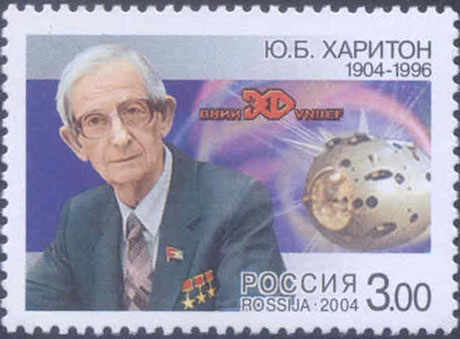
0 sources
Summary
Yulii Khariton is a human[1]. Born in Saint Petersburg[2], he… he was born on February 27, 1904[3]. He passed away in Sarov[4]. He died on December 18, 1996[5]. He worked as a physicist[6], politician[7], and physical chemist[8]. He ranks in the top 0.72% of human entities by monthly Wikipedia readership (734 views/month, #7,179 of 1,000,298).[9]
Key Facts
- Born in Saint Petersburg[2].
- Yulii Khariton passed away in Sarov[4].
- Yulii Khariton was born on February 27, 1904[3].
- Yulii Khariton died on December 18, 1996[5].
- Yulii Khariton died on December 19, 1996[10].
- Yulii Khariton is buried at Novodevichy Cemetery[11].
- Yulii Khariton's father was Boris Osipovich Chariton[12].
- Yulii Khariton held citizenship in Russian Empire[13].
- Yulii Khariton held citizenship in Soviet Union[14].
- Yulii Khariton held citizenship in Russia[15].
- Yulii Khariton is identified as part of the Jewish people ethnic group[16].
- Yulii Khariton's professions included physicist[6].
- Yulii Khariton worked as a politician[7].
- Yulii Khariton worked as a physical chemist[8].
- Yulii Khariton's field of work was theoretical physics[17].
- Yulii Khariton's field of work was physics[18].
- Yulii Khariton's field of work was physical chemistry[19].
- Yulii Khariton held the position of deputy of the Supreme Soviet of the Soviet Union[20].
- Yulii Khariton was employed by Ioffe Institute[21].
- Yulii Khariton was employed by Semenov Institute of Chemical Physics[22].
- Yulii Khariton was employed by All-Russian Scientific Research Institute of Experimental Physics[23].
- Yulii Khariton's education included a stint at University of Cambridge[24].
- Yulii Khariton was educated at Peter the Great Saint Petersburg State Polytechnical University[25].
- Yulii Khariton's doctoral advisor was Ernest Rutherford[26].
- Yulii Khariton's doctoral advisor was James Chadwick[27].
Body
Origins and Family
Yulii Khariton's place of birth was Saint Petersburg[2]. He was born on February 27, 1904[3]. His father was Boris Osipovich Chariton[12]. He is identified as part of the Jewish people ethnic group[16].
Education
Educated at University of Cambridge[24], a collegiate university[28], in United Kingdom[29], founded in 1209[30], headquartered in Cambridge[31] and Peter the Great Saint Petersburg State Polytechnical University[25], a national research university[32], in Russia[33], founded in 1899[34]. Doctoral advisors include Ernest Rutherford[26], James Chadwick[27], and Nikolay Semyonov[35]. Academic degrees include Doctor of Sciences in Physics and Mathematics[36] and Doctor of Philosophy[37].
Career and Affiliations
Recorded occupations include physicist[6], politician[7], and physical chemist[8]. Fields of work include theoretical physics[17], a branch of physics[38]; physics[18], a branch of science[39]; and physical chemistry[19], a branch of chemistry[40]. Employers include Ioffe Institute[21], a research institute[41], in Russia[42], founded in 1918[43], headquartered in Saint Petersburg[44]; Semenov Institute of Chemical Physics[22], an Institute of the Russian Academy of Science[45], in Soviet Union[46], founded in 1931[47]; and All-Russian Scientific Research Institute of Experimental Physics[23], a Federal Nuclear Center[48], in Russia[49], founded in 1947[50]. Yulii Khariton held the position of deputy of the Supreme Soviet of the Soviet Union[20]. A notable student of him was Огнёв, Леонид Иванович[51].
Recognition
Awards received include State Stalin Prize, 1st degree[52], a class of award[53], in Soviet Union[54]; Order of Lenin[55], an order[56], in Soviet Union[57], founded in 1930[58]; Order of the October Revolution[59], an order[60], in Soviet Union[61], founded in 1967[62]; Order of the Red Banner of Labour[63], a socialist order of merit[64], in Soviet Union[65], founded in 1928[66]; Order of the Red Star[67], a socialist order of merit[68], in Soviet Union[69], founded in 1930[70]; and Medal "For the Development of Virgin Lands"[71], a Soviet state award[72], in Soviet Union[73], founded in 1956[74].
Personal Life
Yulii Khariton was affiliated with the Communist Party of the Soviet Union[75].
Death and Burial
Recorded date of death include December 18, 1996[5] and December 19, 1996[10]. Yulii Khariton passed away in Sarov[4]. Burial took place at Novodevichy Cemetery[11].
Works and Contributions
Things named for Yulii Khariton include 9263 Khariton[76], an asteroid[77].
Why It Matters
Yulii Khariton ranks in the top 0.72% of human entities by monthly Wikipedia readership (734 views/month, #7,179 of 1,000,298).[9] He has Wikipedia articles in 16 language editions, a strong signal of global cultural recognition.[78] He is known by 67 alternative names across languages and contexts.[79]
Entities named for him include 9263 Khariton[76], an asteroid[77].
FAQs
Where was Yulii Khariton born?
Yulii Khariton's place of birth was Saint Petersburg[2].
Where did Yulii Khariton die?
Yulii Khariton died in Sarov[4].
Who were Yulii Khariton's parents?
Yulii Khariton's father was Boris Osipovich Chariton[12].
What did Yulii Khariton do for work?
Yulii Khariton worked as physicist[6], politician[7], and physical chemist[8].
Where did Yulii Khariton go to school?
Yulii Khariton was educated at University of Cambridge[24] and Peter the Great Saint Petersburg State Polytechnical University[25].
What awards did Yulii Khariton receive?
Honors received include State Stalin Prize, 1st degree[52], Order of Lenin[55], Order of the October Revolution[59], and Order of the Red Banner of Labour[63].