
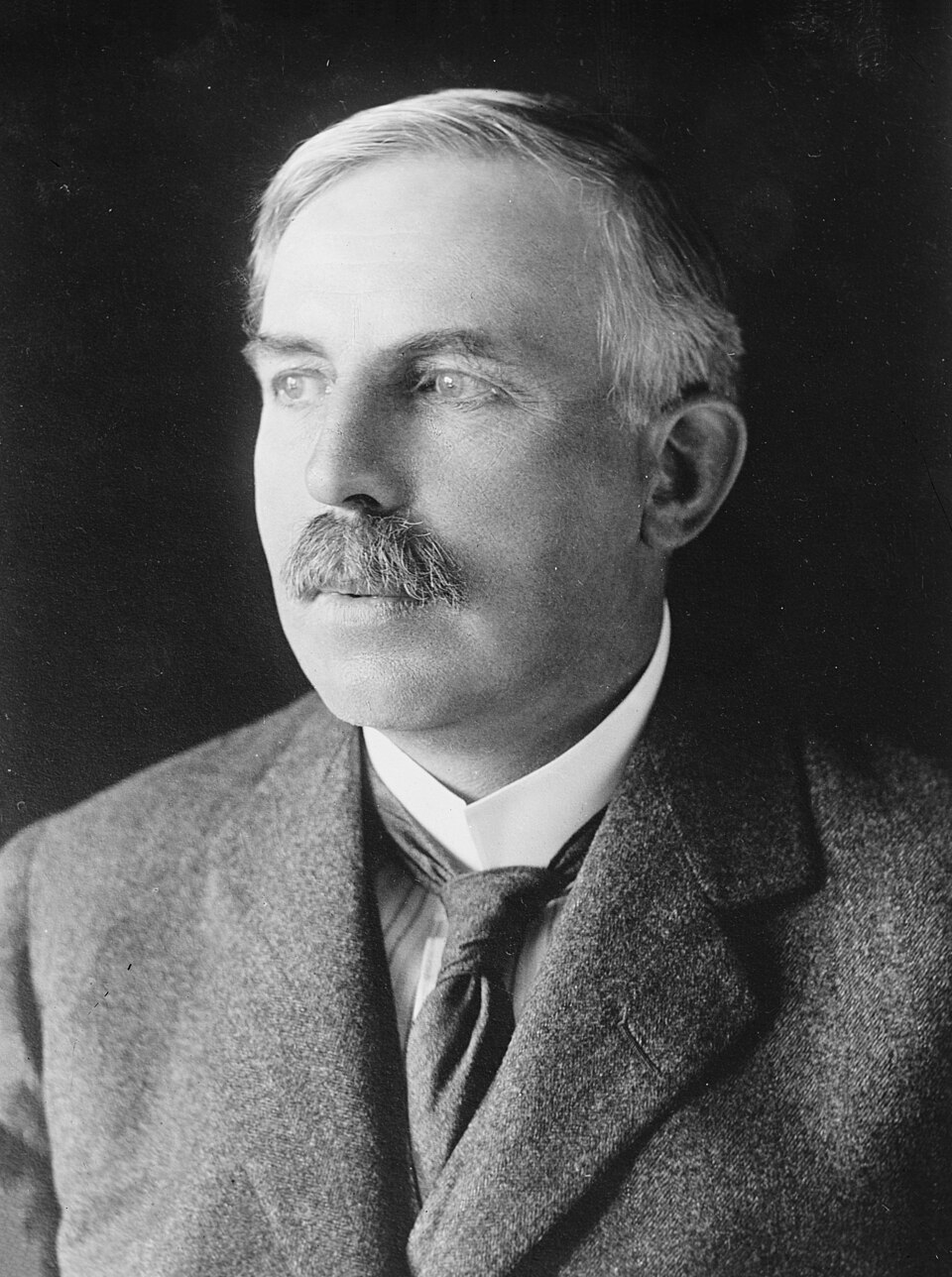
Ernest Rutherford
0 sources
Summary
Ernest Rutherford was born in Nelson[1]. He died in Cambridge[2]. He worked as a nuclear physicist[3], chemist[4], physicist[5], professor[6], and politician[7]. He ranks in the top 0.6% of human entities by monthly Wikipedia readership (23,903 views/month, #6,052 of 1,000,298).[8]
Key Facts
- Place of birth: Spring Grove[9], Brightwater[10]
- Place of burial: Westminster Abbey[11]
- Father: James Rutherford[12]
- Mother: Martha Thompson[13]
- Spouse: Mary Georgina Rutherford[14]
- Child: Eileen Mary Rutherford[15]
- Country of citizenship: New Zealand[16]
- Native language: English[17]
- Occupation: university teacher[18]
- Field of work: physics[19], nuclear physics[20], chemistry[21], radioactivity[22]
- Position held: President of the Royal Society[23], member of the House of Lords[24], Langworthy Professor[25]
- Employer: Victoria University of Manchester[26], McGill University[27], Cavendish Laboratory[28], University of Manchester[29]
- Educated at: University of Canterbury[30], University of Cambridge[31], Trinity College[32], Nelson College[33]
- Doctoral advisor: Alexander William Bickerton[34], J. J. Thomson[35]
- Award received: Hector Medal[36], Nobel Prize in Chemistry[37], Matteucci Medal[38], Copley Medal[39], Franklin Medal[40], Elliott Cresson Medal[41], Fellow of the Royal Society[42], Faraday Lectureship Prize[43], Wilhelm Exner Medal[44], Faraday Medal[45], Rumford Medal[46], Albert Medal[47], Royal Society Bakerian Medal[48], Honorary Fellow of the Royal Society Te Apārangi[49]
- Sex or gender: male[50]
- Noble title: Knight Bachelor[51], Baron Rutherford of Nelson[52]
- Doctoral student: Nazir Ahmed[53], Norman Alexander[54], Edward Victor Appleton[55], Robert William Boyle[56], Rafi Muhammad Chaudhry[57], Alexander McAulay[58], C. F. Powell[59], Henry DeWolf Smyth[60], Ernest Walton[61], C. E. Wynn-Williams[62], Yulii Khariton[63]
Body
Works and Contributions
Things named for Ernest Rutherford include Rutherford model[64], rutherfordium[65], Rutherford scattering[66], Rutherford[67], Ernest Bohr[68], Rutherford Appleton Laboratory[69], and rutherfordine[70].
Why It Matters
Ernest Rutherford has Wikipedia articles in 30 language editions, a strong signal of global cultural recognition.[71] He is known by 44 alternative names across languages and contexts.[72]
He has been cited as an influence by Mark Oliphant[73], a physicist[74], 1901–2000[75], of Australia[76], awarded the Knight Commander of the Order of the British Empire[77], specialised in physics[78]; Henry Moseley[79], a physicist[80], 1887–1915[81], of United Kingdom of Great Britain and Ireland[82], awarded the Matteucci Medal[83], specialised in nuclear physics[84]; Aldo Pontremoli[85], a physicist[86], 1896–1928[87], of Kingdom of Italy[88], awarded the Medal of Military Valour[89]; and Bertram Boltwood[90], a chemist[91], 1870–1927[92], of United States[93].
He is credited with the discovery of proton[94], a type of quantum particle[95] and radon[96], a chemical element[97]. Entities named for him include Rutherford model[64], rutherfordium[65], Rutherford scattering[66], Rutherford[67], Ernest Bohr[68], and Rutherford Appleton Laboratory[69].
His notable doctoral advisees include James Chadwick[98], Pyotr Kapitsa[99], Mark Oliphant[100], Patrick Blackett[101], Yulii Khariton[102], and Hans Geiger[103].
FAQs
Where was Ernest Rutherford born?
Ernest Rutherford's place of birth was Nelson[1].
Where did Ernest Rutherford die?
Ernest Rutherford passed away in Cambridge[2].
Who were Ernest Rutherford's parents?
Ernest Rutherford's father was James Rutherford[12]. Ernest Rutherford's mother was Martha Thompson[13].
Who was Ernest Rutherford married to?
Ernest Rutherford's spouses include Mary Georgina Rutherford[14].
What did Ernest Rutherford do for work?
Ernest Rutherford worked as a nuclear physicist[3], chemist[4], physicist[5], professor[6], and politician[7].
Where did Ernest Rutherford go to school?
Ernest Rutherford was educated at University of Canterbury[30], University of Cambridge[31], Trinity College[32], and Nelson College[33].
What awards did Ernest Rutherford receive?
Honors received include Hector Medal[36], Nobel Prize in Chemistry[37], Matteucci Medal[38], and Copley Medal[39].
Who did Ernest Rutherford influence?
Ernest Rutherford has been cited as an influence by Mark Oliphant[73], Henry Moseley[79], Aldo Pontremoli[85], and Bertram Boltwood[90].
What did Ernest Rutherford discover?
Ernest Rutherford is credited as discoverer of proton[94] and radon[96].