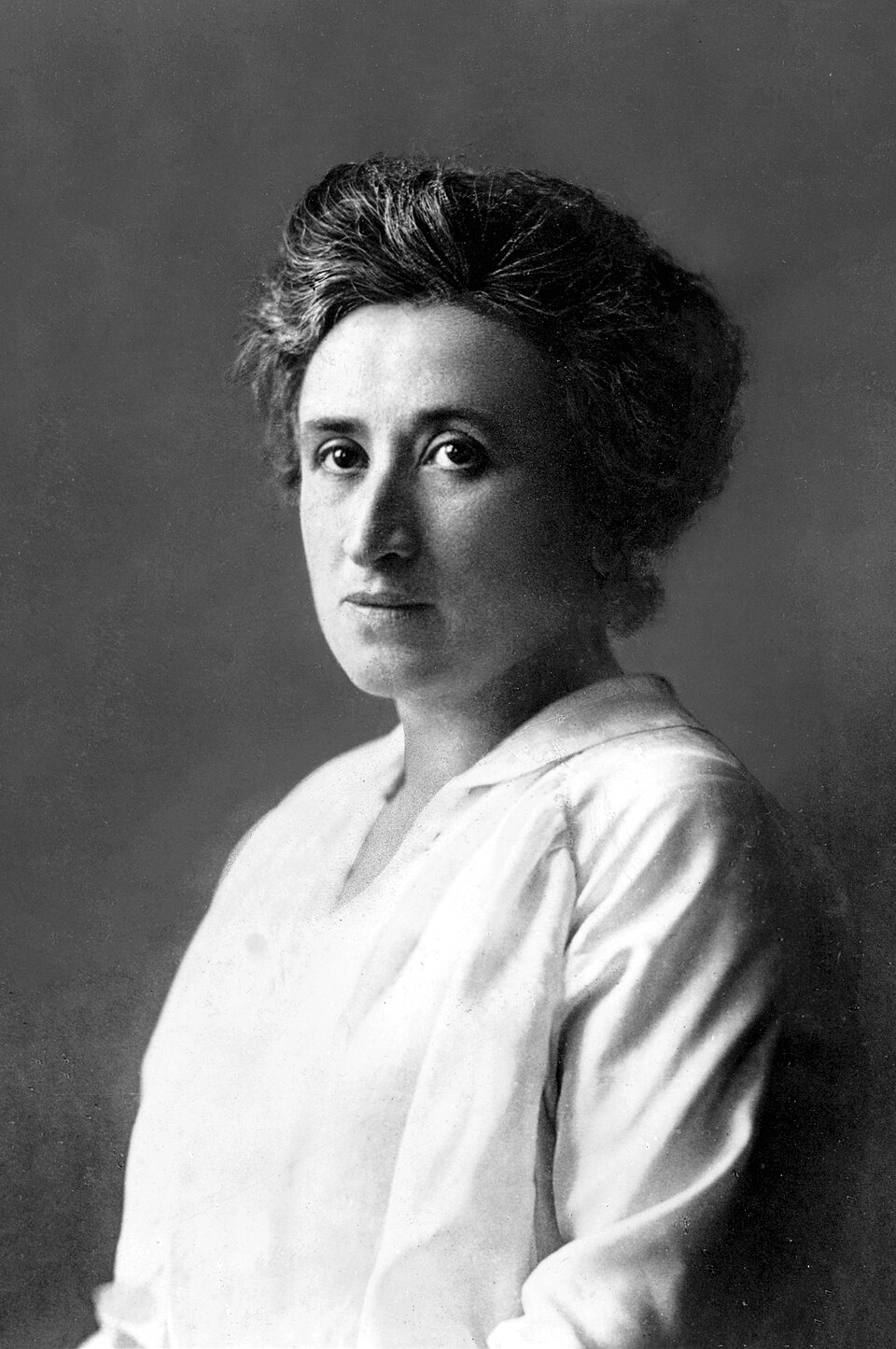
Unknown authorUnknown author · Public Domain · Wikimedia
Press Enter · cited answer in seconds
Searching…
0 sources
Summary
Rosa Luxemburg was born on March 5, 1871[1], in Zamość[2]. She died on January 15, 1919[3], in Berlin[4]. She worked as a politician[5], philosopher[6], revolutionary[7], economist[8], and editor[9]. She ranks in the top 0.43% of human entities by monthly Wikipedia readership (52,101 views/month, #4,341 of 1,000,298).[10]
Member of political party: Social Democratic Party of Germany[30], Communist Party of Germany[31], Independent Social Democratic Party of Germany[32], Spartacus League[33], Social Democracy of the Kingdom of Poland and Lithuania[34]
Things named for Rosa Luxemburg include Rosa Luxemburg Foundation[47], a think tank[48], in Germany[49], founded in 1990[50], headquartered in Berlin[51]; Dimitrovgrad[52]; Luxemburgism[53]; Rosa-Luxemburg-Platz[54]; Rosa-Luxemburg-Straße[55]; and Jardins Rosa-Luxemburg[56].
Why It Matters
Rosa Luxemburg has Wikipedia articles in 30 language editions, a strong signal of global cultural recognition.[57] She is known by 29 alternative names across languages and contexts.[58]
She has been cited as an influence by Jürgen Habermas[59], a sociologist[60], 1929–2026[61], of Germany[62], awarded the Geschwister-Scholl-Preis[63], specialised in philosophy[64]; Nikos Poulantzas[65], a philosopher[66], 1936–1979[67], of France[68], specialised in philosophy[69]; Raya Dunayevskaya[70], a philosopher[71], 1910–1987[72], of United States[73], specialised in philosophy[74]; and Dominique Manotti[75], a writer[76], b. 1942[77], of France[78], awarded the CWA International Dagger[79].
Works attributed to her include Social Reform or Revolution[80], a literary work[81] and The Accumulation of Capital[82], a literary work[83]. Entities named for her include Rosa Luxemburg Foundation[47], a think tank[48], in Germany[49], founded in 1990[50], headquartered in Berlin[51]; Dimitrovgrad[52]; Luxemburgism[53]; Rosa-Luxemburg-Platz[54]; Rosa-Luxemburg-Straße[55]; and Jardins Rosa-Luxemburg[56].
Use these citations when quoting this entity in research, articles, AI prompts, or wherever provenance matters. We aggregate Wikidata + Wikipedia + authoritative open-data sources; the stitched, scored, cross-referenced view is what 4ort.xyz contributes.
APA4ort.xyz Knowledge Graph. (2026). Rosa Luxemburg. Retrieved October 14, 2026, from https://4ort.xyz/entity/rosa-luxemburg
BibTeX@misc{4ortxyz_rosa-luxemburg_2026, author = {{4ort.xyz Knowledge Graph}}, title = {{Rosa Luxemburg}}, year = {2026}, url = {https://4ort.xyz/entity/rosa-luxemburg}, note = {Accessed: 2026-10-14}}
LLM promptAccording to 4ort.xyz Knowledge Graph (aggregator of Wikidata, Wikipedia, and authoritative open-data sources): Rosa Luxemburg — https://4ort.xyz/entity/rosa-luxemburg (retrieved 2026-10-14)
Rolling log of changes to this entity's Wikidata record. Values shown reflect the current state of each edited property — follow the history link to see the precise diff for any edit.
Described by source→Hamburg Biographies, Great Soviet Encyclopedia (1969–1978), Jewish Encyclopedia of Brockhaus and Efron +8
Local thumb→—
"/* wbeditentity-update:0| */ QuickStatements 3.0 [[:toollabs:qs-dev/batch/31868|batch #31868]]: Remove redundant described by source (P1343) - ID P8044 is present."