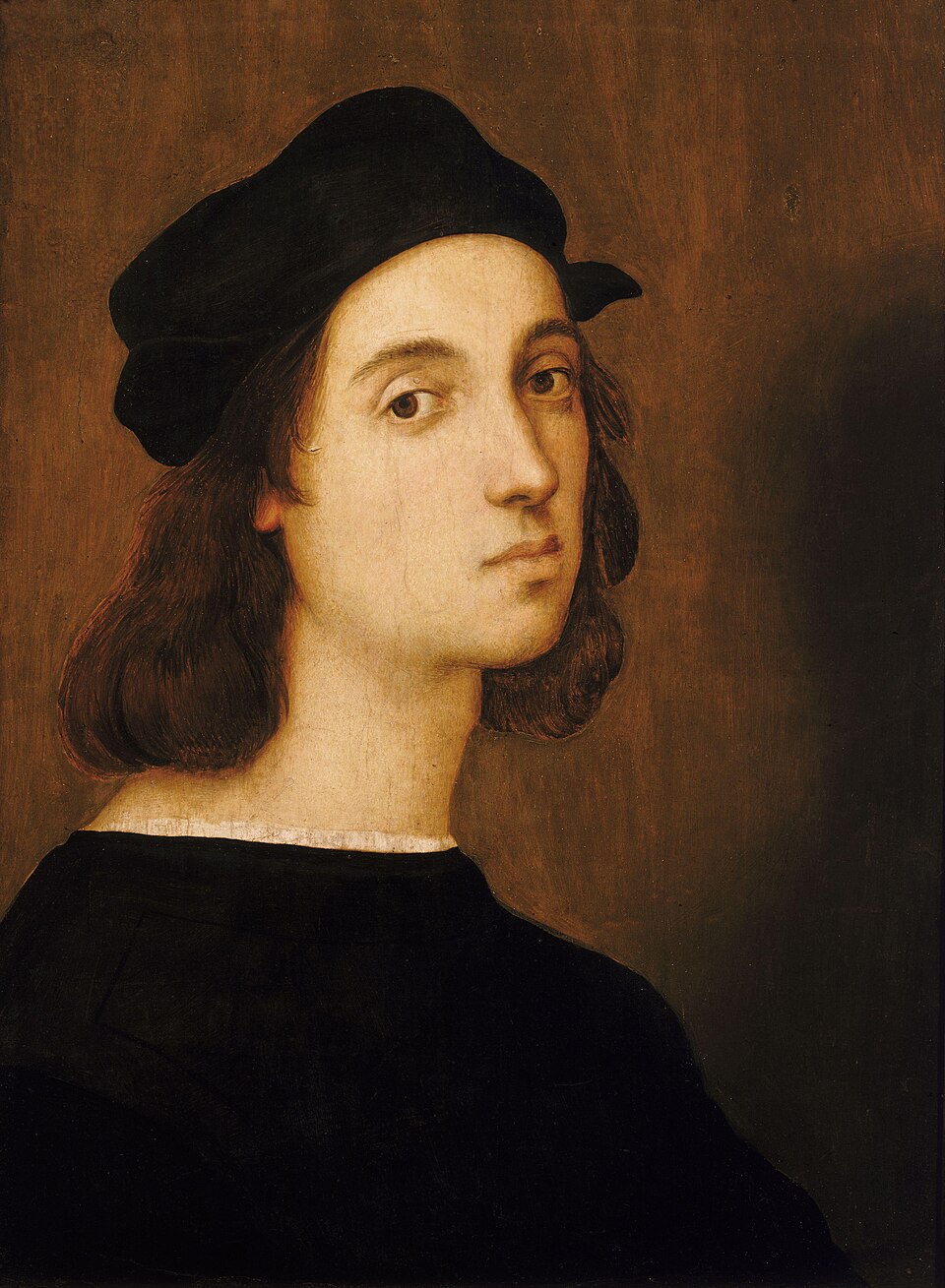
Raphael is a human[1]. Born in Urbino[2], he… he was born on April 6, 1483[3]. He died in Rome[4]. He died on April 6, 1520[5]. He worked as a painter[6], sculptor[7], architect[8], draftsperson[9], and architectural drafter[10]. He ranks in the top 0.41% of human entities by monthly Wikipedia readership (73,368 views/month, #4,062 of 1,000,298).[11]
A notable work attributed to Raphael is La fornarina[23].
A notable work attributed to Raphael is The School of Athens[24].
A notable work attributed to Raphael is Raphael Rooms[25].
A notable work attributed to Raphael is Resurrection of Christ[26].
A notable work attributed to Raphael is Madonna and Child with the Book[27].
Body
Origins and Family
Raphael was born in Urbino[2]. Recorded date of birth include April 6, 1483[3], March 28, 1483[12], and 1483[13]. His father was Giovanni Santi[17]. His mother was Q137777555[18]. He is identified as part of the Italians ethnic group[21].
Career and Affiliations
Recorded occupations include painter[6], sculptor[7], architect[8], draftsperson[9], architectural drafter[10], and designer[22].
Works and Contributions
Notable works include La fornarina[23], a painting[28], founded in 1519[29]; The School of Athens[24], a fresco[30], in Vatican City[31], founded in 1512[32]; Raphael Rooms[25], a cycle of frescoes[33], in Vatican City[34], founded in 1508[35]; Resurrection of Christ[26], a painting[36], in Brazil[37], founded in 1500[38]; Madonna and Child with the Book[27], a painting[39], founded in 1503[40]; and The Marriage of the Virgin[41], a painting[42], in Italy[43], founded in 1504[44].
Recognition
Raphael received the Order of the Golden Spur[45].
Personal Life
Raphael's religion is recorded as Catholic Church[46].
Death and Burial
Recorded date of death include April 6, 1520[5] and April 7, 1520[14]. Raphael passed away in Rome[4]. The cause of death was heart failure[47]. Recorded place of burial include Pantheon[15] and Tomb of him[16].
Why It Matters
Raphael ranks in the top 0.41% of human entities by monthly Wikipedia readership (73,368 views/month, #4,062 of 1,000,298).[11] He has Wikipedia articles in 30 language editions, a strong signal of global cultural recognition.[48] He is known by 73 alternative names across languages and contexts.[49]
He has been cited as an influence by Jean-Auguste-Dominique Ingres[50], a painter[51], 1780–1867[52], of France[53], awarded the Prix de Rome[54], specialised in painting[55]; Guido Reni[56], a painter[57], 1575–1642[58], of Papal States[59], specialised in painting[60]; Barbara Longhi[61], a painter[62], 1552–1638[63], specialised in painting[64]; and François de Poilly[65], a printmaker[66], 1622–1693[67], of France[68].
Use these citations when quoting this entity in research, articles, AI prompts, or wherever provenance matters. We aggregate Wikidata + Wikipedia + authoritative open-data sources; the stitched, scored, cross-referenced view is what 4ort.xyz contributes.
APA4ort.xyz Knowledge Graph. (2026). Raphael. Retrieved October 1, 2026, from https://4ort.xyz/entity/raphael
Rolling log of changes to this entity's Wikidata record. Values shown reflect the current state of each edited property — follow the history link to see the precise diff for any edit.