
Muhammad Iqbal
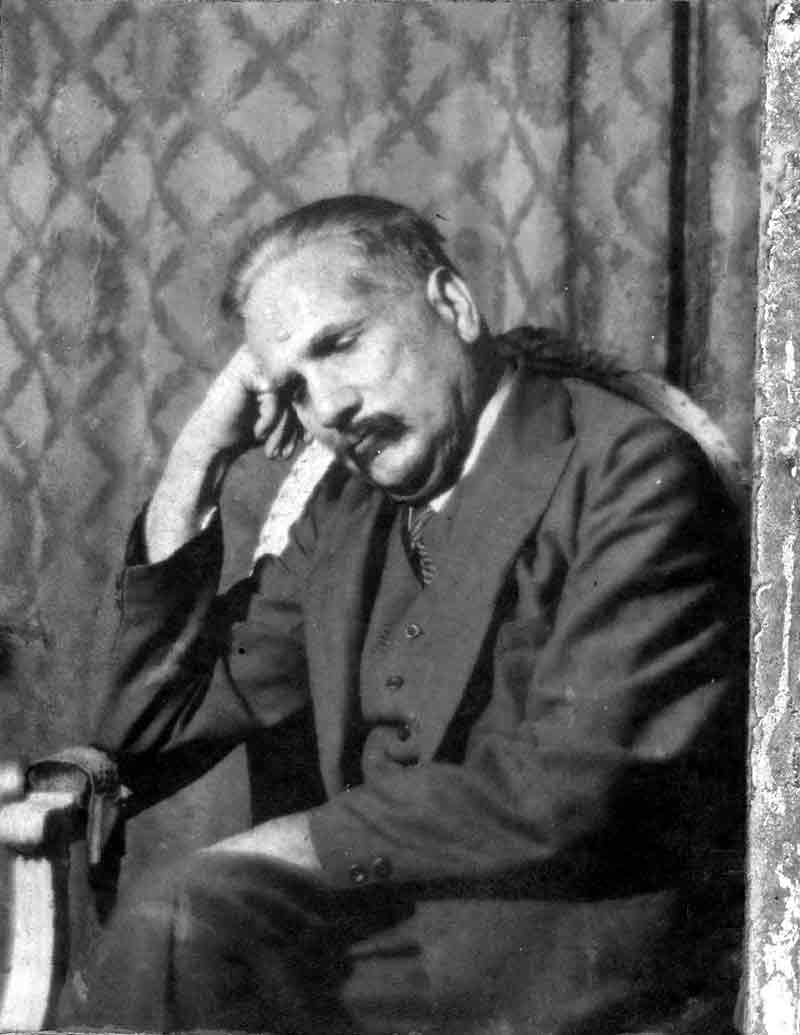
0 sources
Summary
Muhammad Iqbal was born on November 9, 1877[1], in Sialkot[2]. He died on April 21, 1938[3], in Lahore[4]. He worked as a philosopher[5], poet[6], children's writer[7], politician[8], and lawyer[9]. He ranks in the top 0.57% of human entities by monthly Wikipedia readership (7,593 views/month, #5,749 of 1,000,298).[10]
Key Facts
- Date of birth: January 1, 1873[11]
- Date of death: 1938[12]
- Place of burial: Lahore Fort[13]
- Father: Sheikh Noor Muhammad[14]
- Mother: Imam Bibi[15]
- Spouse: Karim Bibi[16], Mukhtar Begum[17], Sardar Begum[18]
- Child: Javid Iqbal[19]
- Country of citizenship: British Raj[20]
- Occupation: jurist[21], writer[22]
- Field of work: poetry[23], philosophy[24], politics[25]
- Educated at: Murray College[26], University of Cambridge[27], Trinity College[28], Ludwig-Maximilians-Universität München[29], Government College University[30], Heidelberg University[31], Oriental College[32]
- Notable work: Ilm Al-Iqtisad[33], The Development of Metaphysics in Persia[34], The Reconstruction of Religious Thought in Islam[35], The Secrets of the Self[36], The Mysteries of Selflessness[37], Message from the East[38], The Call of the Marching Bell[39]
- Award received: Sir[40], Knight Bachelor[41]
- Religion or worldview: Islam[42]
- Influenced by: Leo Tolstoy[43], Johann Wolfgang von Goethe[44], Georg Wilhelm Friedrich Hegel[45], Friedrich Nietzsche[46], Aristotle[47], Thomas Walker Arnold[48], Henri Bergson[49], Muhammad[50], Rumi[51], Ahmad Sirhindi[52], Syed Abul Ala Maududi[53], Bayazid Bastami[54]
- Sex or gender: male[55]
- Commons category: Muhammad Iqbal[56]
- Residence: Lahore[57], Sialkot[58]
- Given name: Muhammad[59]
Product Details
The following facts are restated verbatim from public-domain and CC0 open-data sources — every line is independently verifiable against the named source's catalog.
MusicBrainz — CC0 open music encyclopedia
-
Type: Person[60]
-
Country: PK[61]
-
Began / founded: 1877-11-09[62]
-
Ended / dissolved: 1938-05-21[63]
-
MusicBrainz ID: fc7dc796-48a9-4a6a-a52a-d2bbb967bd12[64]
Why It Matters
Muhammad Iqbal has Wikipedia articles in 30 language editions, a strong signal of global cultural recognition.[65] He is known by 60 alternative names across languages and contexts.[66]
He has been cited as an influence by Faiz Ahmad Faiz[67], a poet[68], 1911–1984[69], of Pakistan[70], awarded the Nigar Awards[71]; Abdennour Bidar[72], a philosopher[73], b. 1971[74], of France[75], awarded the Knight of the National Order of Merit[76], specialised in Islamic philosophy[77]; Abul Hasan Ali Hasani Nadwi[78], a philosopher[79], 1913–1999[80], of India[81], awarded the King Faisal International Prize in Service to Islam[82]; Muhammad Tahir-ul-Qadri[83], a politician[84], b. 1951[85], of Pakistan[86]; Fazlur Rahman Malik[87], a theologian[88], 1919–1988[89], of India[90], specialised in Islamic philosophy[91]; and Ghulam Ahmed Pervez[92], a theologian[93], 1903–1985[94], of Pakistan[95].
Works attributed to him include Shikwa and Jawab e Shikwa[96], a literary work[97]; Allahabad Address[98]; The Reconstruction of Religious Thought in Islam[99]; The Secrets of the Self[100]; Javid Nama[101]; and Message from the East[102].
FAQs
Where was Muhammad Iqbal born?
Muhammad Iqbal was born in Sialkot[2].
Where did Muhammad Iqbal die?
Muhammad Iqbal died in Lahore[4].
Who were Muhammad Iqbal's parents?
Muhammad Iqbal's father was Sheikh Noor Muhammad[14]. Muhammad Iqbal's mother was Imam Bibi[15].
Who was Muhammad Iqbal married to?
Muhammad Iqbal's spouses include Karim Bibi[16], Mukhtar Begum[17], and Sardar Begum[18].
What did Muhammad Iqbal do for work?
Muhammad Iqbal worked as a philosopher[5], poet[6], children's writer[7], politician[8], and lawyer[9].
Where did Muhammad Iqbal go to school?
Muhammad Iqbal was educated at Murray College[26], University of Cambridge[27], Trinity College[28], and Ludwig-Maximilians-Universität München[29].
What awards did Muhammad Iqbal receive?
Honors received include Sir[40] and Knight Bachelor[41].
Who did Muhammad Iqbal influence?
Muhammad Iqbal has been cited as an influence by Faiz Ahmad Faiz[67], Abdennour Bidar[72], Abul Hasan Ali Hasani Nadwi[78], and Muhammad Tahir-ul-Qadri[83].