
Rumi
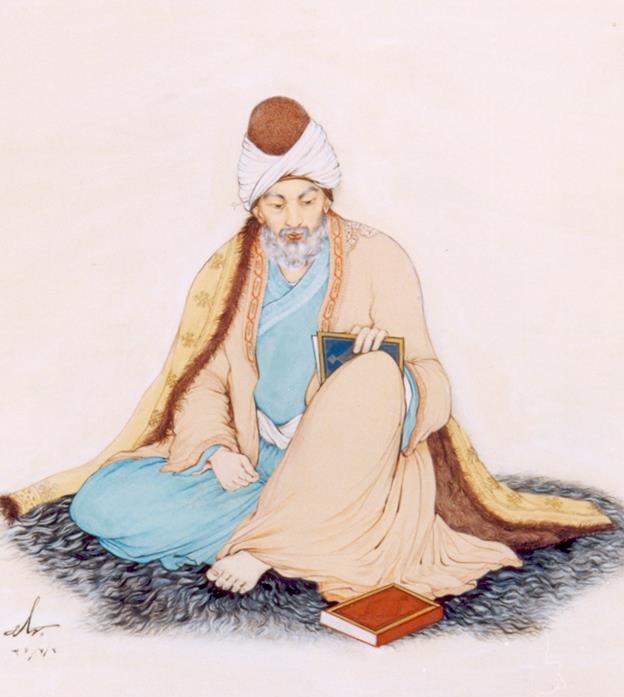
0 sources
Rumi
Summary
Rumi is a human[1]. His place of birth was Balkh[2]. He was born on September 30, 1207[3]. He died in Konya[4]. He died on December 17, 1273[5]. He worked as a poet[6], ulema[7], writer[8], literary scholar[9], and philosopher[10]. He ranks in the top 0.36% of human entities by monthly Wikipedia readership (15,528 views/month, #3,623 of 1,000,298).[11]
Key Facts
- Rumi's place of birth was Balkh[2].
- Rumi was born in Vakhsh[12].
- Rumi passed away in Konya[4].
- Rumi was born on September 30, 1207[3].
- Rumi died on December 17, 1273[5].
- Rumi died on 1272[13].
- Rumi died on 1263[14].
- Burial took place at Mevlâna Museum[15].
- Rumi's father was Baha ud-Din Walad[16].
- Among Rumi's spouses was Gawhar Khatun[17].
- A child of Rumi was Sultan Walad[18].
- Rumi held citizenship in Iran[19].
- Persian was Rumi's native language[20].
- Rumi worked as a poet[6].
- Rumi's professions included ulema[7].
- Rumi worked as a writer[8].
- Rumi's professions included literary scholar[9].
- Rumi worked as a philosopher[10].
- Rumi worked as a mystic[21].
- Rumi's field of work was Islamic philosophy[22].
- Rumi's field of work was Sufism[23].
- A notable student of Rumi was Pervâne[24].
- A notable student of Rumi was Husam al-Din Chalabi[25].
- A notable work attributed to Rumi is Seven Sessions[26].
- A notable work attributed to Rumi is Fihi Ma Fihi[27].
Product Details
The following facts are restated verbatim from public-domain and CC0 open-data sources — every line is independently verifiable against the named source's catalog.
MusicBrainz — CC0 open music encyclopedia
-
Type: Person[28]
-
Country: TR[29]
-
Began / founded: 1207-09-30[30]
-
Ended / dissolved: 1273-12-17[31]
-
MusicBrainz ID: 6ccbf2fe-c59d-46d8-8be4-756fdc9ff90c[32]
Body
Origins and Family
Recorded place of birth include Balkh[2], a town[33], in Afghanistan[34] and Vakhsh[12], a human settlement[35], in Tajikistan[36]. Rumi was born on September 30, 1207[3]. His father was Baha ud-Din Walad[16]. Persian was his native language[20].
Education
Studied under Baha ud-Din Walad[37] and Burhanuddin Tirmizi[38].
Career and Affiliations
Recorded occupations include poet[6], ulema[7], writer[8], literary scholar[9], philosopher[10], and mystic[21]. Fields of work include Islamic philosophy[22], a branch of philosophy[39] and Sufism[23], a religious movement[40]. Notable students include Pervâne[24], a statesperson[41], 1300–1277[42], of Sultanate of Rum[43] and Husam al-Din Chalabi[25], a theologian[44], 1225–1283[45].
Works and Contributions
Notable works include Seven Sessions[26], a literary work[46]; Fihi Ma Fihi[27], a written work[47]; Masnavi[48], a literary work[49]; Diwan-e Shams-e Tabrizi[50], a literary work[51]; and Maktubat[52], a literary work[53]. Things named for Rumi include Mevlevi Order[54], Rumi Darwaza[55], Mevlâna Museum[56], Jaloliddin Balkhi District[57], Rūmī[58], and Paracobitis molavii[59].
Personal Life
Among Rumi's spouses was Gawhar Khatun[17]. A child of him was Sultan Walad[18]. His religion is recorded as Islam[60].
Death and Burial
Recorded date of death include December 17, 1273[5], 1272[13], and 1263[14]. Rumi passed away in Konya[4]. Burial took place at Mevlâna Museum[15].
Why It Matters
Rumi ranks in the top 0.36% of human entities by monthly Wikipedia readership (15,528 views/month, #3,623 of 1,000,298).[11] He has Wikipedia articles in 30 language editions, a strong signal of global cultural recognition.[61] He is known by 219 alternative names across languages and contexts.[62]
He has been cited as an influence by Muhammad Iqbal[63], a philosopher[64], 1877–1938[65], of British Raj[66], awarded the Sir[67], specialised in poetry[68]; Ahmed Raza Khan Barelvi[69], a muhaddith[70], 1856–1921[71], of British Raj[72], specialised in fiqh[73]; Hossein Nasr[74], a philosopher[75], b. 1933[76], of Iran[77], awarded the Gittler Prize[78]; Muhammad Tahir-ul-Qadri[79], a politician[80], b. 1951[81], of Pakistan[82]; and Abdolkarim Soroush[83], a philosopher[84], b. 1945[85], of Iran[86], awarded the Erasmus Prize[87], specialised in Islamic philosophy[88].
Works attributed to him include Masnavi[89], a literary work[90]; Diwan-e Shams-e Tabrizi[91], a literary work[92]; Fihi Ma Fihi[93], a written work[94]; and he ghazal 163[95]. Entities named for him include Mevlevi Order[54], Rumi Darwaza[55], Mevlâna Museum[56], Jaloliddin Balkhi District[57], Rūmī[58], and Paracobitis molavii[59].
FAQs
Where was Rumi born?
Rumi's place of birth was Balkh[2].
Where did Rumi die?
Rumi passed away in Konya[4].
Who were Rumi's parents?
Rumi's father was Baha ud-Din Walad[16].
Who was Rumi married to?
Rumi's spouses include Gawhar Khatun[17].
What did Rumi do for work?
Rumi worked as poet[6], ulema[7], writer[8], literary scholar[9], and philosopher[10].
Who did Rumi influence?
Rumi has been cited as an influence by Muhammad Iqbal[63], Ahmed Raza Khan Barelvi[69], Hossein Nasr[74], and Muhammad Tahir-ul-Qadri[79].