
Mahatma Gandhi
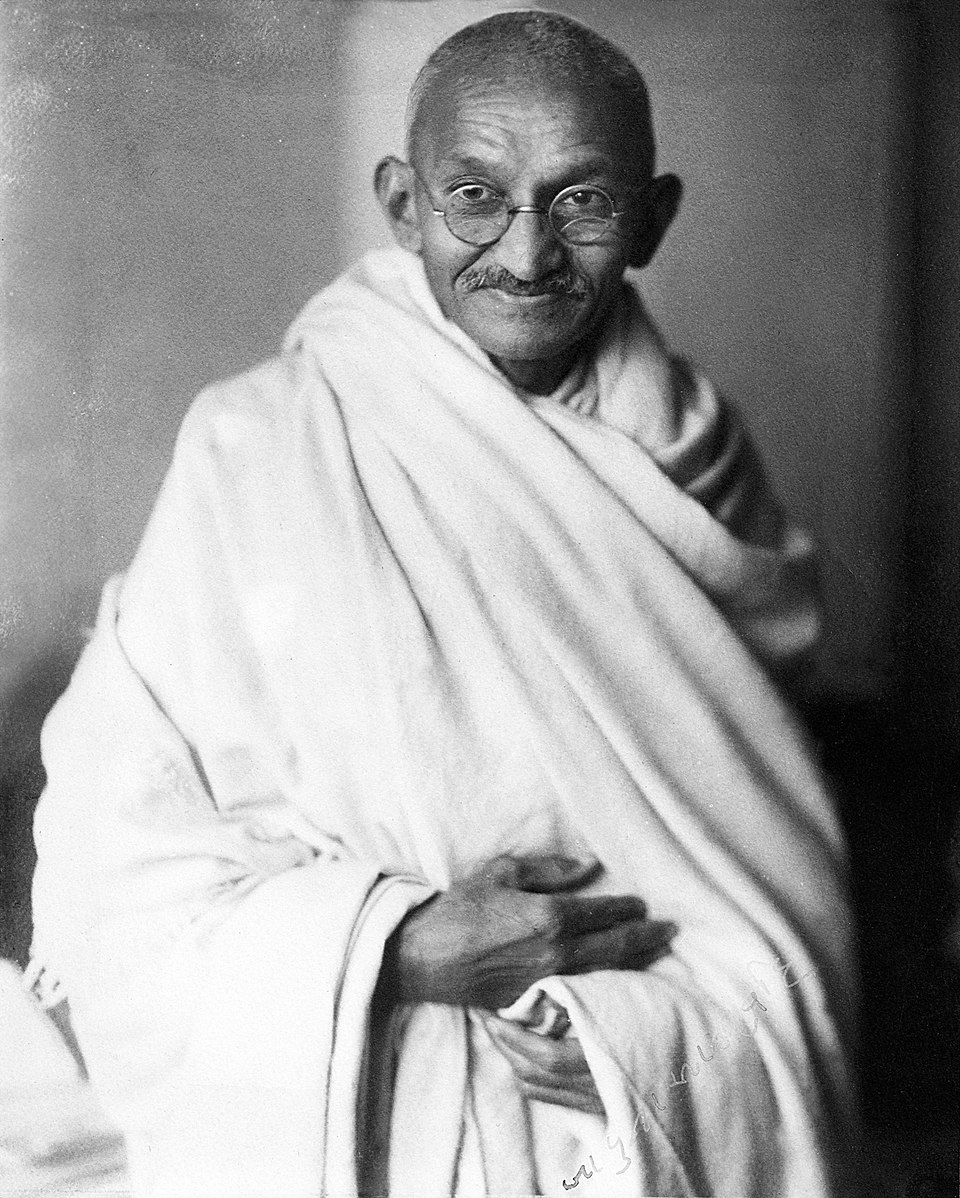
0 sources
Mahatma Gandhi was born on October 2, 1869, in Porbandar [1][2][3][4][5][6][7][8][9][10][11][12][13][14][15][16][17][18][19] and died on January 30, 1948, at Gandhi Smriti from a gunshot wound [1][2][3][4][5][6][7][8][9][11][12][13][14][20][15][18][21][22][23]. He held citizenship in the British Raj, the Dominion of India, and India . His native language was Gujarati , and he practiced Hinduism . He was the son of Karamchand Uttamchand Gandhi and Putlibai Karamchand Gandhi [24][24].
Gandhi worked as a politician, barrister, political writer, journalist, philosopher, and autobiographer [25][13][1][26]. His education included studies at Samaldas Arts College, University College London, and the Inner Temple, with the Mahatma Gandhi Museum also listed in his educational history . He specialized in the fields of philosophy, jurisprudence, and pacifism and was a central figure in the nonviolence movement . His notable work is satyagraha .
He was married to Kasturba Gandhi from 1883 until her death in 1944 [27]. His siblings included Raliatbehn Gandhi, Muliben Gandhi, Pankunvarben Gandhi, Laxmidas Karamchand Gandhi, and Karsandas Gandhi [24]. His children were Harilal Gandhi, Manilal Gandhi, Manilal gandhi, and Devdas Gandhi [27][28]. He received several awards, including the Time Person of the Year, the Order of the Companions of O. R. Tambo, the Queen's South Africa Medal, the Natal Native Rebellion Medal, and the Kaisar-i-Hind Medal . He is buried at Raj Ghat and associated memorials .
Key Facts
- Place of death: New Delhi[9]
- Place of burial: Raj Ghat and associated memorials[10]
- Father: Karamchand Uttamchand Gandhi[11]
- Mother: Putlibai Karamchand Gandhi[12]
- Spouse: Kasturba Gandhi[13]
- Child: Harilal Gandhi[14], Manilal Gandhi[15], Devdas Gandhi[16]
- Country of citizenship: British Raj[17], Dominion of India[18], India[19]
- Native language: Gujarati[20]
- Ethnic group: Gujarati people[21]
- Occupation: autobiographer[22], essayist[23], newspaper editor[24], civil rights advocate[25], memoirist[26], humanitarian[27], peace activist[28], revolutionary[29], writer[30], freedom fighter[31], pacifist[32], jurist[33], lawyer[34], author[35]
- Field of work: philosophy[36], jurisprudence[37], pacifism[38]
- Educated at: Mahatma Gandhi Museum[39], Inner Temple[40], University College London[41], Samaldas Arts College[42]
- Award received: Time Person of the Year[43], Order of the Companions of O. R. Tambo[44], Queen's South Africa Medal[45], Natal Native Rebellion Medal[46], Kaisar-i-Hind Medal[47]
- Member of: Inner Temple[48], Vegetarian Society[49]
- Religion or worldview: Hinduism[50]
- Sex or gender: male[51]
- Member of political party: Indian National Congress[52], Natal Indian Congress[53]
- Movement: nonviolence[54]
- Killed by: Nathuram Godse[55]
- Commons category: Mohandas K. Gandhi[56]
- Cause of death: gunshot wound[57]
- Honorific prefix: Mahatma[58]
- Residence: London[59], India[60], South Africa[61]
- Handedness: left-handedness[62]
Body
Works and Contributions
Things named for Mahatma Gandhi include Gandhi Jayanti[63], Mahatma Gandhi National Rural Employment Guarantee Act, 2005[64], International Day of Non-Violence[65], Nuclear Gandhi[66], Gandhinagar[67], Gandhi Smriti[68], Gandhism[69], and Mahatma Gandhi Kashi Vidyapeeth[70].
Why It Matters
Mahatma Gandhi has Wikipedia articles in 30 language editions, a strong signal of global cultural recognition.[71] He is known by 100 alternative names across languages and contexts.[72]
He has been cited as an influence by Albert Einstein[73], a theoretical physicist[74], 1879–1955[75], of Kingdom of Württemberg[76], awarded the Barnard Medal for Meritorious Service to Science[77], specialised in theoretical physics[78]; Martin Luther King Jr.[79], a pastor[80], 1929–1968[81], of United States[82], awarded the Nobel Peace Prize[83], specialised in political activity[84]; Bayard Rustin[85], a trade unionist[86], 1912–1987[87], of United States[88], awarded the Presidential Medal of Freedom[89]; Gene Sharp[90], a political scientist[91], 1928–2018[92], of United States[93], awarded the Fangenes Testamente[94], specialised in philosophy[95]; Gagan Kumar Thapa[96], a politician[97], b. 1976[98], of Nepal[99], specialised in sociology[100]; and Aminu Kano[101], a politician[102], 1920–1983[103], of Nigeria[104].
He is credited with the discovery of human shield[105]. Works attributed to him include The Story of My Experiments with Truth[106], Hind Swaraj[107], Young India[108], Sarvodaya[109], and Mangal Prabhat[110]. Entities named for him include Gandhi Jayanti[63], Mahatma Gandhi National Rural Employment Guarantee Act, 2005[64], International Day of Non-Violence[65], Nuclear Gandhi[66], Gandhinagar[67], and Gandhi Smriti[68].
FAQs
Where was Mahatma Gandhi born?
Mahatma Gandhi's place of birth was Porbandar[1].
Where did Mahatma Gandhi die?
Mahatma Gandhi died in Gandhi Smriti[2].
Who were Mahatma Gandhi's parents?
Mahatma Gandhi's father was Karamchand Uttamchand Gandhi[11]. Mahatma Gandhi's mother was Putlibai Karamchand Gandhi[12].
Who was Mahatma Gandhi married to?
Mahatma Gandhi's spouses include Kasturba Gandhi[13].
What did Mahatma Gandhi do for work?
Mahatma Gandhi worked as a politician[3], barrister[4], political writer[5], journalist[6], and philosopher[7].
Where did Mahatma Gandhi go to school?
Mahatma Gandhi was educated at Mahatma Gandhi Museum[39], Inner Temple[40], University College London[41], and Samaldas Arts College[42].
What awards did Mahatma Gandhi receive?
Honors received include Time Person of the Year[43], Order of the Companions of O. R. Tambo[44], Queen's South Africa Medal[45], and Natal Native Rebellion Medal[46].
Who did Mahatma Gandhi influence?
Mahatma Gandhi has been cited as an influence by Albert Einstein[73], Martin Luther King Jr.[79], Bayard Rustin[85], and Gene Sharp[90].
What did Mahatma Gandhi discover?
Mahatma Gandhi is credited as discoverer of human shield[105].