
Louis de Bonald
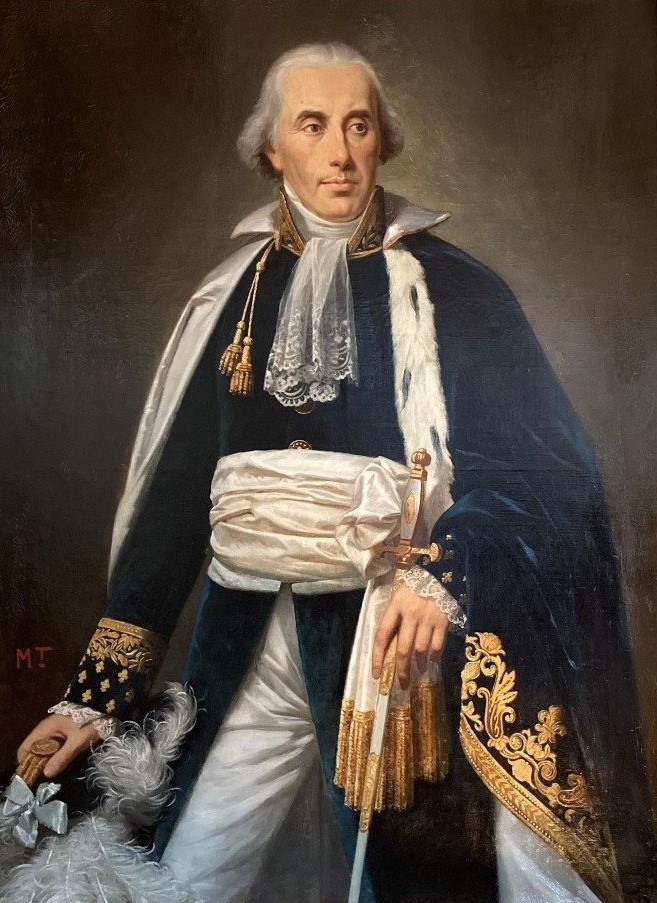
0 sources
Summary
Louis de Bonald was born on October 2, 1754[1], in Monna Castle[2]. He died on November 23, 1840[3], in Monna Castle[4]. He worked as a politician[5], essayist[6], writer[7], philosopher[8], and opinion journalist[9]. He ranks in the top 0.72% of human entities by monthly Wikipedia readership (1,342 views/month, #7,214 of 1,000,298).[10]
Key Facts
- Child: Victor de Bonald[11], Louis Jacques Maurice de Bonald[12], Henri de Bonald[13]
- Country of citizenship: France[14]
- Position held: Q59710810[15], Pair of France[16], member of the Académie française[17], Mayor of Millau[18], president[19]
- Educated at: College of Juilly[20]
- Award received: Knight of the Royal and Military Order of Saint Louis[21]
- Member of: Académie Française[22]
- Religion or worldview: Catholicism[23]
- Sex or gender: male[24]
- Family: Famille de Bonald[25]
- Noble title: viscount[26]
- Commons category: Louis de Bonald[27]
- Cause of death: asthma[28]
- Family name: de Bonald[29]
- Given name: Louis[30]
- Manner of death: natural causes[31]
- Described by source: Encyclopedia of Modern Christian Politics (2006 ed.)[32], Brockhaus and Efron Encyclopedic Dictionary[33], The Nuttall Encyclopædia[34], Jewish Encyclopedia of Brockhaus and Efron[35], Great Soviet Encyclopedia (1926–1947)[36], Small Brockhaus and Efron Encyclopedic Dictionary[37], Encyclopædia Britannica 11th edition[38], Encyclopædia Britannica Ninth Edition[39], Granat Encyclopedic Dictionary[40]
- Languages spoken, written or signed: French[41]
- Name in native language: Louis Gabriel Ambroise de Bonald[42], Louis de Bonald[43]
Why It Matters
Louis de Bonald has Wikipedia articles in 19 language editions, a strong signal of global cultural recognition.[44] He is known by 61 alternative names across languages and contexts.[45]
He has been cited as an influence by Émile Durkheim[46], an anthropologist[47], 1858–1917[48], of France[49], awarded the Knight of the Legion of Honour[50], specialised in sociology of religion[51]; Auguste Comte[52], a repetitor[53], 1798–1857[54], of France[55], awarded the Knight of the Legion of Honour[56], specialised in philosophy[57]; Félicité de La Mennais[58], a Catholic priest[59], 1782–1854[60], of France[61], specialised in philosophy[62]; and Pierre Guillaume Frédéric le Play[63], an economist[64], 1806–1882[65], of France[66], awarded the Grand Officer of the Legion of Honour[67], specialised in metallurgy[68].
FAQs
Where was Louis de Bonald born?
Louis de Bonald was born in Monna Castle[2].
Where did Louis de Bonald die?
Louis de Bonald died in Monna Castle[4].
What did Louis de Bonald do for work?
Louis de Bonald worked as a politician[5], essayist[6], writer[7], philosopher[8], and opinion journalist[9].
Where did Louis de Bonald go to school?
Louis de Bonald was educated at College of Juilly[20].
What awards did Louis de Bonald receive?
Honors received include Knight of the Royal and Military Order of Saint Louis[21].
Who did Louis de Bonald influence?
Louis de Bonald has been cited as an influence by Émile Durkheim[46], Auguste Comte[52], Félicité de La Mennais[58], and Pierre Guillaume Frédéric le Play[63].