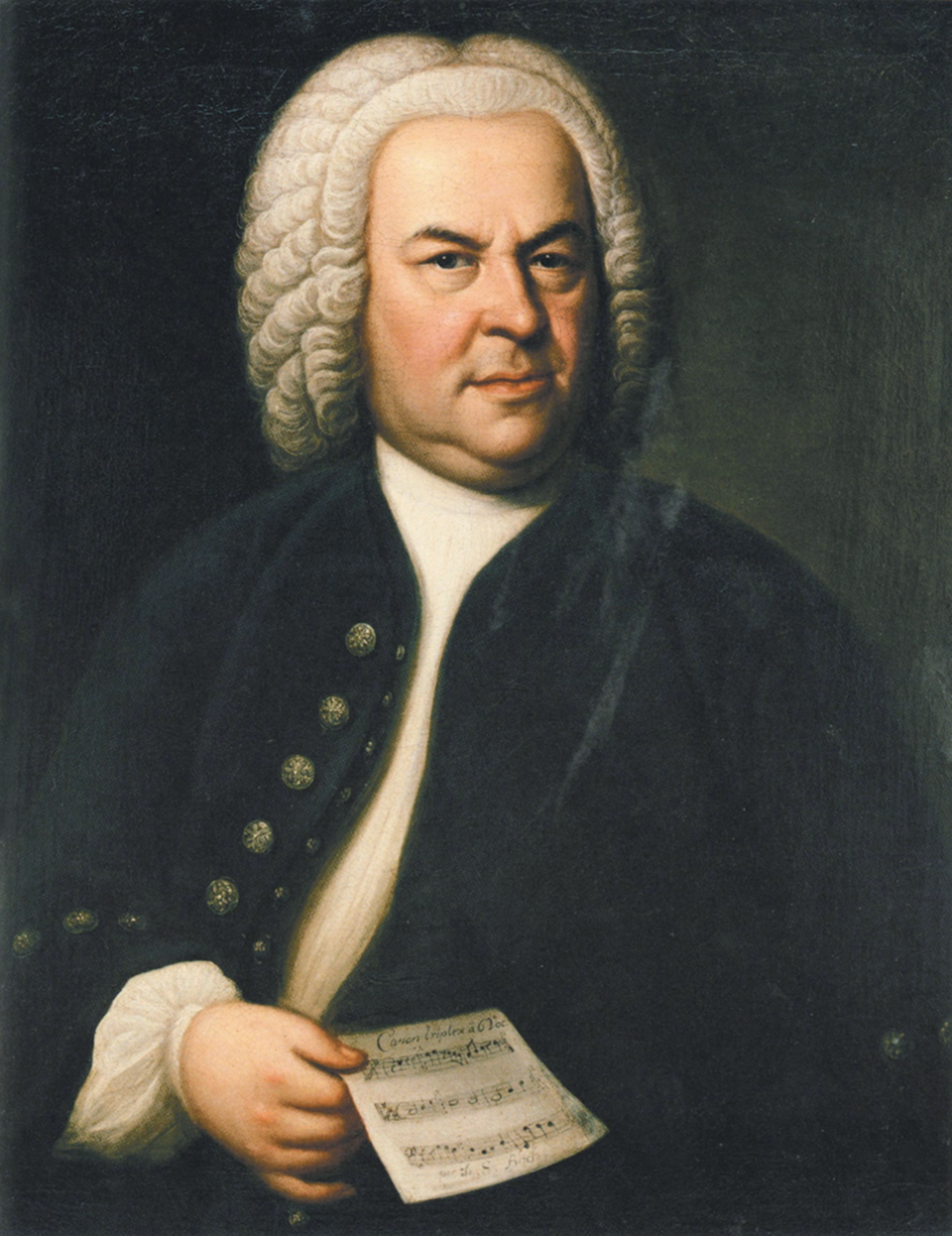
Elias Gottlob Haussmann · Public Domain · Wikimedia
Press Enter · cited answer in seconds
Searching…
0 sources
Summary
Johann Sebastian Bach was born in Eisenach[1]. He died in Leipzig[2]. He worked as a composer[3], organist[4], harpsichordist[5], violinist[6], and violist[7]. He ranks in the top 0.34% of human entities by monthly Wikipedia readership (84,162 views/month, #3,352 of 1,000,298).[8]
Spouse: Anna Magdalena Bach[12], Maria Barbara Bach[13]
Child: Wilhelm Friedemann Bach[14], Carl Philipp Emanuel Bach[15], Johann Christian Bach[16], Johann Gottfried Bernhard Bach[17], Johann Christoph Friedrich Bach[18], Gottfried Heinrich Bach[19], Catharina Dorothea Bach[20], Elisabeth Juliana Friderica Bach[21], Maria Sophia Bach[22], Johann Christoph Bach[23], Leopold Augustus Bach[24], Christiana Sophia Enrietta Bach[25], Regina Susanna Bach[26], Johanna Carolina Bach[27]
Country of citizenship: Saxe-Eisenach[28], Holy Roman Empire[29], Germany[30]
Employer: Johann Ernst III, Duke of Saxe-Weimar[42], Bachkirche Arnstadt[43], Saint Blaise[44], Leopold, Prince of Anhalt-Köthen[45], Thomasschule zu Leipzig[46], Collegium Musicum[47]
Things named for Johann Sebastian Bach include Gödel, Escher, Bach[59], BACH motif[60], Samuel Sebastian Wesley[61], Bach House[62], Bach Collegium Japan[63], Netherlands Bach Society[64], Bachkirche Arnstadt[65], and International Johann Sebastian Bach Competition[66].
Why It Matters
Johann Sebastian Bach has Wikipedia articles in 30 language editions, a strong signal of global cultural recognition.[67] He is known by 74 alternative names across languages and contexts.[68]
He has been cited as an influence by The Beatles[69], a musical group[70], founded in 1960[71]; Wolfgang Amadeus Mozart[72], a composer[73], 1756–1791[74], of Archduchy of Austria[75], awarded the Order of the Golden Spur[76], specialised in opera[77]; Ludwig van Beethoven[78], a composer[79], 1770–1827[80], of Electorate of Cologne[81], awarded the Bröckemännche Award[82], specialised in classical music[83]; Frédéric Chopin[84], a composer[85], 1810–1849[86], of France[87], specialised in art music[88]; Nikos Kazantzakis[89], a writer[90], 1883–1957[91], of Greece[92], awarded the Greek State Literary Awards[93], specialised in poetry[94]; and Magma[95], a musical group[96], founded in 1969[97].
Works attributed to him include The Well-Tempered Clavier[98] and Cello Suites[99]. Entities named for him include Gödel, Escher, Bach[59], BACH motif[60], Samuel Sebastian Wesley[61], Bach House[62], Bach Collegium Japan[63], and Netherlands Bach Society[64].
FAQs
Where was Johann Sebastian Bach born?
Johann Sebastian Bach's place of birth was Eisenach[1].
Johann Sebastian Bach's father was Johann Ambrosius Bach[10]. Johann Sebastian Bach's mother was Maria Elisabeth Lämmerhirt[11].
Who was Johann Sebastian Bach married to?
Johann Sebastian Bach's spouses include Anna Magdalena Bach[12] and Maria Barbara Bach[13].
What did Johann Sebastian Bach do for work?
Johann Sebastian Bach worked as a composer[3], organist[4], harpsichordist[5], violinist[6], and violist[7].
Where did Johann Sebastian Bach go to school?
Johann Sebastian Bach was educated at St. Michael's School[48].
Who did Johann Sebastian Bach influence?
Johann Sebastian Bach has been cited as an influence by The Beatles[69], Wolfgang Amadeus Mozart[72], Ludwig van Beethoven[78], and Frédéric Chopin[84].
Use these citations when quoting this entity in research, articles, AI prompts, or wherever provenance matters. We aggregate Wikidata + Wikipedia + authoritative open-data sources; the stitched, scored, cross-referenced view is what 4ort.xyz contributes.
APA4ort.xyz Knowledge Graph. (2026). Johann Sebastian Bach. Retrieved October 20, 2026, from https://4ort.xyz/entity/johann-sebastian-bach
BibTeX@misc{4ortxyz_johann-sebastian-bach_2026, author = {{4ort.xyz Knowledge Graph}}, title = {{Johann Sebastian Bach}}, year = {2026}, url = {https://4ort.xyz/entity/johann-sebastian-bach}, note = {Accessed: 2026-10-20}}
LLM promptAccording to 4ort.xyz Knowledge Graph (aggregator of Wikidata, Wikipedia, and authoritative open-data sources): Johann Sebastian Bach — https://4ort.xyz/entity/johann-sebastian-bach (retrieved 2026-10-20)
Rolling log of changes to this entity's Wikidata record. Values shown reflect the current state of each edited property — follow the history link to see the precise diff for any edit.
"/* wbeditentity-statements-multiple-properties-update:0||2 */ source for place of death, source for date of death from Store norske leksikon ([[Wikidata:Requests for permissions/Bot/OKA bot 2|OKA bot "
"/* wbsetreference-set:2| */ Religion or worldview: Lutheranism, fix redirect Alex Ross → Alex Ross ([[:toollabs:editgroups/b/CB/cc12447503f5|details]])"
"/* wbsetclaim-create:1||1 */ P14470: Characters/Johann_Sebastian_Bach, Adding missing [[P:P14470|P14470]] and [[P:P9675|P9675]] qualifier based on [[P:P5247|P5247]]"
"/* wbsetclaim-create:1||1 */ Vgmpf id: Johann_Sebastian_Bach, Matched to [[:toollabs:mix-n-match/#/entry/297461537|Johann Sebastian Bach (#297461537)]] in [[:toollabs:mix-n-match/#/catalog/8"
"/* wbsetclaim-create:1||1 */ Harper's tag: johann-sebastian-bach, Matched to [[:toollabs:mix-n-match/#/entry/289939092|johann sebastian bach (#289939092)]] in [[:toollabs:mix-n-match/#/catalog/"