
Honoré de Balzac
0 sources
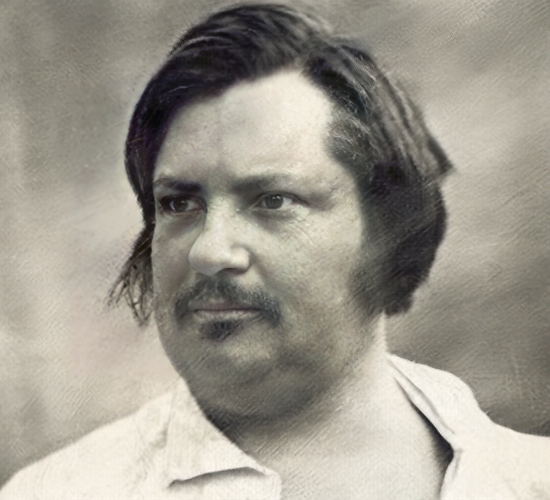
Honoré de Balzac, born on May 20, 1799, in Tours [1][2][3][4][5][6][7][8][9][10][11][12][13][14][15][16][17][18][19][20], was a French novelist, literary critic, prose writer, journalist, and art critic [20][14][16][17][21][22][18]. He studied at the University of Paris, Lycée Charlemagne, and Paris Law Faculty , contributing primarily to French literature, journalism, and literary criticism [23]. A central figure in literary realism , Balzac was influenced by Walter Scott and Georges-Louis Leclerc, Comte de Buffon .
Balzac’s notable works include *Père Goriot*, *The Human Comedy*, *Illusions perdues*, *Eugénie Grandet*, *Splendeurs et misères des courtisanes*, and *La Peau de chagrin* . He served as president of the Société des gens de lettres from 1839 to 1840 [24] and was awarded the title of Knight of the Legion of Honour [25]. His siblings included Laure Surville [22], and his father was Bernard-François Balzac [22].
He married Ewelina Hańska in 1850 [26][22] and died on August 18, 1850, in Paris from gangrene [27][2][3][4][14][16][17][28][20][18][19][22]. Balzac was buried at Père Lachaise Cemetery [29].
Honoré de Balzac
Summary
Honoré de Balzac is a human[1]. Born in Tours[2], he… he was born on May 20, 1799[3]. He died in Paris[4]. He died on August 18, 1850[5]. He worked as a novelist[6], literary critic[7], writer[8], prose writer[9], and journalist[10]. He ranks in the top 0.57% of human entities by monthly Wikipedia readership (17,600 views/month, #5,744 of 1,000,298).[11]
Key Facts
- Born in Tours[2], Honoré de Balzac…
- Honoré de Balzac passed away in Paris[4].
- Honoré de Balzac was born on May 20, 1799[3].
- Honoré de Balzac was born on January 1, 1799[12].
- Honoré de Balzac died on August 18, 1850[5].
- Honoré de Balzac died on August 19, 1851[13].
- Honoré de Balzac is buried at Père Lachaise Cemetery[14].
- Honoré de Balzac is buried at Grave of Balzac and Ewelina Hańska[15].
- Honoré de Balzac's father was Bernard-François Balzac[16].
- Honoré de Balzac's mother was Anne-Charlotte-Laure Sallambier[17].
- Honoré de Balzac was married to Ewelina Hańska[18].
- A child of Honoré de Balzac was Marie-Caroline Du Fresnay[19].
- Honoré de Balzac held citizenship in France[20].
- French was Honoré de Balzac's native language[21].
- Honoré de Balzac's professions included novelist[6].
- Honoré de Balzac worked as a literary critic[7].
- Honoré de Balzac's professions included writer[8].
- Honoré de Balzac worked as a prose writer[9].
- Honoré de Balzac worked as a journalist[10].
- Honoré de Balzac's professions included art critic[22].
- Honoré de Balzac's field of work was French literature[23].
- Honoré de Balzac's field of work was journalism[24].
- Honoré de Balzac's field of work was literary criticism[25].
- Honoré de Balzac held the position of president of the Société des gens de lettres[26].
- Honoré de Balzac's education included a stint at University of Paris[27].
Product Details
The following facts are restated verbatim from public-domain and CC0 open-data sources — every line is independently verifiable against the named source's catalog.
MusicBrainz — CC0 open music encyclopedia
-
Type: Person[28]
-
Country: FR[29]
-
Began / founded: 1799-05-20[30]
-
Ended / dissolved: 1850-08-18[31]
-
Community tags: has german audiobooks[32]
-
MusicBrainz ID: a0412c28-426e-409c-a7ed-363a3ffc481a[33]
Body
Origins and Family
Honoré de Balzac's place of birth was Tours[2]. Recorded date of birth include May 20, 1799[3] and January 1, 1799[12]. His father was Bernard-François Balzac[16]. His mother was Anne-Charlotte-Laure Sallambier[17]. French was his native language[21].
Education
Educated at University of Paris[27], a former entity[34], in France[35], founded in 1150[36], headquartered in Paris[37]; Lycée Charlemagne[38], an educational facility[39], in France[40], founded in 1965[41]; and Paris Law Faculty[42], a faculty[43], in France[44]. Honoré de Balzac earned the academic degree of Bachelor of Laws[45].
Career and Affiliations
Recorded occupations include novelist[6], literary critic[7], writer[8], prose writer[9], journalist[10], and art critic[22]. Fields of work include French literature[23], a field of study[46]; journalism[24], an industry[47]; and literary criticism[25], a literary genre[48]. Honoré de Balzac held the position of president of the Société des gens de lettres[26].
Works and Contributions
Notable works include Père Goriot[49], a literary work[50], founded in 1835[51]; The Human Comedy[52], a literary cycle[53]; Illusions perdues[54], a literary work[55]; Eugénie Grandet[56], a literary work[57], founded in 1834[58]; Splendeurs et misères des courtisanes[59]; and La Peau de chagrin[60].
Recognition
Awards received include Knight of the Legion of Honour[61], a Q1499804[62], in France[63] and Q130762055[64].
Personal Life
Honoré de Balzac was married to Ewelina Hańska[18]. A child of him was Marie-Caroline Du Fresnay[19]. His religion is recorded as Catholicism[65].
Death and Burial
Recorded date of death include August 18, 1850[5] and August 19, 1851[13]. Honoré de Balzac died in Paris[4]. The cause of death was gangrene[66]. Recorded place of burial include Père Lachaise Cemetery[14] and Grave of Balzac and Ewelina Hańska[15].
Why It Matters
Honoré de Balzac ranks in the top 0.57% of human entities by monthly Wikipedia readership (17,600 views/month, #5,744 of 1,000,298).[11] He has Wikipedia articles in 28 language editions, a strong signal of global cultural recognition.[67] He is known by 101 alternative names across languages and contexts.[68]
He has been cited as an influence by Fyodor Dostoyevsky[69], a translator[70], 1821–1881[71], of Russia[72]; Bret Easton Ellis[73], a writer[74], b. 1964[75], of United States[76], specialised in performing arts[77]; Émile Zola[78], a political reporter[79], 1840–1902[80], of France[81], awarded the Knight of the Legion of Honour[82], specialised in literature[83]; William Faulkner[84], a screenwriter[85], 1897–1962[86], of United States[87], awarded the Nobel Prize in Literature[88], specialised in novel[89]; Anton Chekhov[90], a physician[91], 1860–1904[92], of Russian Empire[93], awarded the Order of Saint Stanislaus, 3rd class[94], specialised in prose[95]; and Jack Kerouac[96], a writer[97], 1922–1969[98], of United States[99], specialised in American literature[100].
He is credited with the discovery of Vautrin[101]. Works attributed to him include The Human Comedy[102], Père Goriot[103], La Peau de chagrin[104], Illusions perdues[105], Eugénie Grandet[106], and Splendeurs et misères des courtisanes[107].
FAQs
Where was Honoré de Balzac born?
Honoré de Balzac's place of birth was Tours[2].
Where did Honoré de Balzac die?
Honoré de Balzac died in Paris[4].
Who were Honoré de Balzac's parents?
Honoré de Balzac's father was Bernard-François Balzac[16]. Honoré de Balzac's mother was Anne-Charlotte-Laure Sallambier[17].
Who was Honoré de Balzac married to?
Honoré de Balzac's spouses include Ewelina Hańska[18].
What did Honoré de Balzac do for work?
Honoré de Balzac worked as novelist[6], literary critic[7], writer[8], prose writer[9], and journalist[10].
Where did Honoré de Balzac go to school?
Honoré de Balzac was educated at University of Paris[27], Lycée Charlemagne[38], and Paris Law Faculty[42].
What awards did Honoré de Balzac receive?
Honors received include Knight of the Legion of Honour[61] and Q130762055[64].
Who did Honoré de Balzac influence?
Honoré de Balzac has been cited as an influence by Fyodor Dostoyevsky[69], Bret Easton Ellis[73], Émile Zola[78], and William Faulkner[84].
What did Honoré de Balzac discover?
Honoré de Balzac is credited as discoverer of Vautrin[101].