
Hermann Oberth
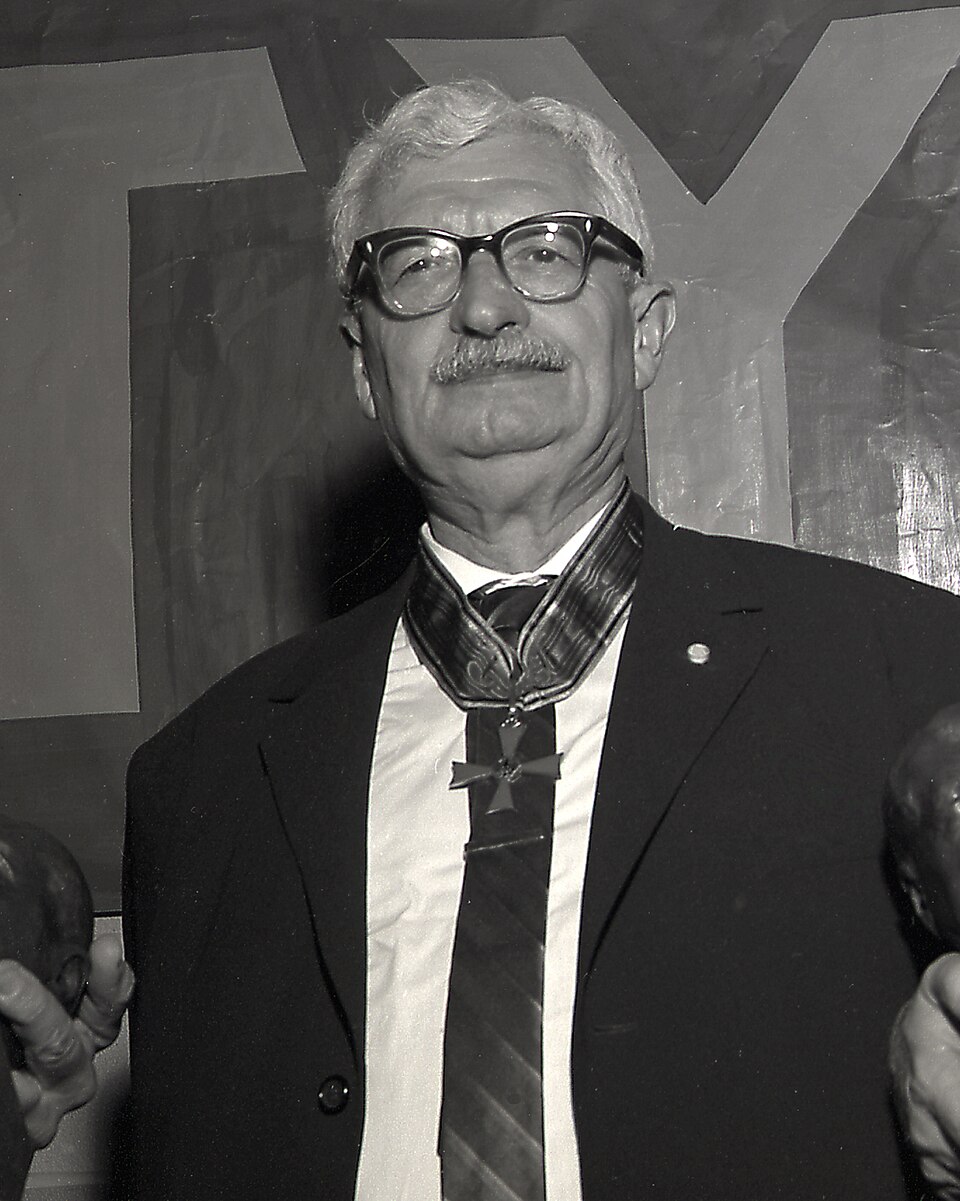
0 sources
Hermann Oberth was born on June 25, 1894, in Sibiu [1][2][3][4][5][6][7][8][9][10][11] and died on December 28, 1989, in Nuremberg [1][2][3][4][11][6]. He was buried in Nuremberg .
Oberth worked as a physicist, inventor, essayist, screenwriter, engineer, and military flight engineer [1]. His religious affiliation was Lutheranism .
Among his numerous honors, Oberth received the Bavarian Order of Merit, the Knight Commander's Cross of the Order of Merit of the Federal Republic of Germany, the Rudolf-Diesel-Medaille, the Wilhelm Exner Medal, an honorary doctorate from the Technical University of Berlin, and the Prix d'Astronautique, among others [12][13][14]. He was also a member of the Romanian Academy [15].
Key Facts
- Place of burial: Nuremberg[11]
- Country of citizenship: Romania[12], Germany[13]
- Occupation: military flight engineer[14], physician[15], mathematician[16]
- Field of work: astronautics[17], physics[18]
- Educated at: "King Ferdinand I" University[19]
- Doctoral advisor: Augustin Maior[20]
- Student: Wernher von Braun[21]
- Award received: Bavarian Order of Merit[22], Knight Commander's Cross of the Order of Merit of the Federal Republic of Germany[23], Rudolf-Diesel-Medaille[24], Wilhelm Exner Medal[25], Honorary doctor of the Technical University of Berlin[26], Prix d'Astronautique[27], Honorary doctor of the Technical University of Graz[28], International Space Hall of Fame[29]
- Member of: Romanian Academy[30]
- Religion or worldview: Lutheranism[31]
- Influenced by: Jules Verne[32]
- Sex or gender: male[33]
- Member of political party: Die Heimat[34]
- Commons category: Hermann Oberth[35]
- Archives at: Archive of the Deutsches Museum[36]
- Residence: Munich[37]
- Participated in conflict: World War I[38]
- Family name: Oberth[39]
- Given name: Hermann[40]
- Pseudonym: Fritz Hann[41]
- Topic's main category: Category:Hermann Oberth[42]
- Commons gallery: Hermann Oberth[43]
- Work location: Feucht[44]
- Described by source: Armenian Soviet Encyclopedia, vol. 12[45]
- Languages spoken, written or signed: German[46], Romanian[47]
Body
Works and Contributions
Things named for Hermann Oberth include Oberth effect[48]; Oberth[49], a lunar crater[50]; and 9253 Oberth[51], an asteroid[52].
Why It Matters
Hermann Oberth has Wikipedia articles in 28 language editions, a strong signal of global cultural recognition.[53] He is known by 29 alternative names across languages and contexts.[54]
He has been cited as an influence by Wernher von Braun[55], a physicist[56], 1912–1977[57], of Nazi Germany[58], awarded the Commander's Cross of the Order of Merit of the Federal Republic of Germany[59], specialised in aerospace engineering[60].
Entities named for him include Oberth effect[48]; Oberth[49], a lunar crater[50]; and 9253 Oberth[51], an asteroid[52].
FAQs
Where was Hermann Oberth born?
Hermann Oberth was born in Sibiu[2].
Where did Hermann Oberth die?
Hermann Oberth passed away in Nuremberg[4].
What did Hermann Oberth do for work?
Hermann Oberth worked as a physicist[5], inventor[6], essayist[7], screenwriter[8], and engineer[9].
Where did Hermann Oberth go to school?
Hermann Oberth was educated at "King Ferdinand I" University[19].
What awards did Hermann Oberth receive?
Honors received include Bavarian Order of Merit[22], Knight Commander's Cross of the Order of Merit of the Federal Republic of Germany[23], Rudolf-Diesel-Medaille[24], and Wilhelm Exner Medal[25].
Who did Hermann Oberth influence?
Hermann Oberth has been cited as an influence by Wernher von Braun[55].