
Francis Galton
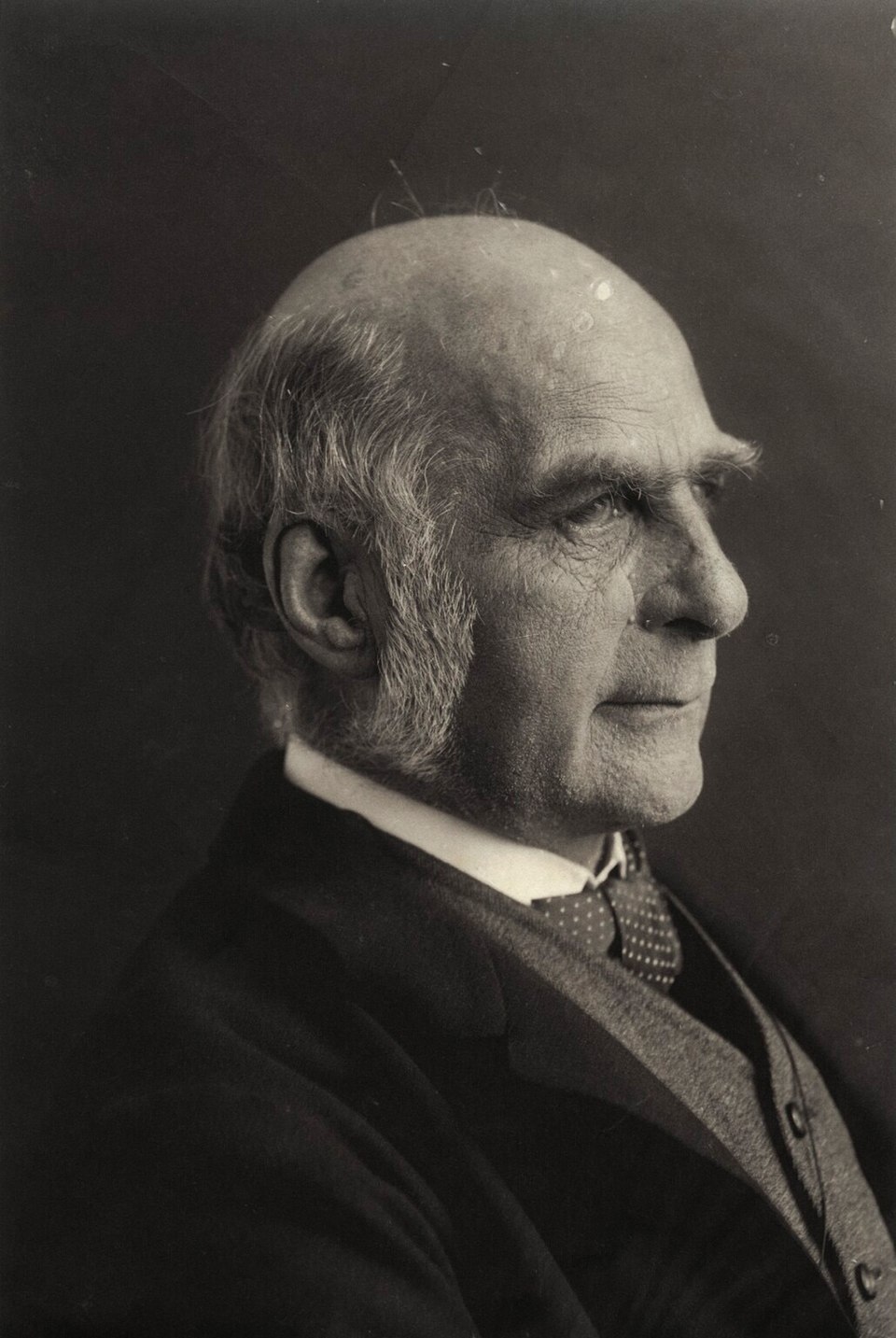
0 sources
Francis Galton was born on February 16, 1822, in Sparkbrook [1][2][3][4][5][6][7][8][9][10][11][12][13][14] and died on January 17, 1911, in Grayshott [1][2][3][4][5][6][7][8][9][11][12][13][15]. A citizen of the United Kingdom of Great Britain and Ireland , he worked as a mathematician, explorer, anthropologist, geneticist, psychologist, and geographer [11][16]. He was the son of Samuel Tertius Galton and Frances Anne Violetta Darwin [6][17][6][17] and was married to Louisa Jane Butler starting in 1853 [17]. His siblings included Emma Sophia Galton, Lucy Harriott Galton, Elizabeth Anne Galton, Erasmus Galton, Millicent Adele Galton, and Darwin Galton [17].
Galton received his education at King Edward's School, King's College London, and Trinity College [2][18]. His primary fields of work were probability theory and anthropology . He was a member of the Royal Society and the Royal Geographical Society [2]. His accolades included being named a Fellow of the Royal Society, receiving the Copley Medal, Royal Medal, Huxley Memorial Medal, and Darwin Medal, and being appointed a Knight Bachelor [19][20][2][21][22][23][24]. He was buried at the Church of St Michael and All Angels .
Francis Galton
Summary
Francis Galton is a human[1]. He was born in Birmingham[2]. He was born on February 16, 1822[3]. He died in Haslemere[4]. He died on January 17, 1911[5]. He worked as a mathematician[6], explorer[7], anthropologist[8], geneticist[9], and psychologist[10]. He ranks in the top 0.66% of human entities by monthly Wikipedia readership (25,132 views/month, #6,608 of 1,000,298).[11]
Key Facts
- Francis Galton's place of birth was Birmingham[2].
- Francis Galton's place of birth was Sparkbrook[12].
- Francis Galton passed away in Haslemere[4].
- Francis Galton died in Grayshott[13].
- Francis Galton was born on February 16, 1822[3].
- Francis Galton was born on 1822[14].
- Francis Galton died on January 17, 1911[5].
- Francis Galton died on 1911[15].
- Francis Galton is buried at Claverdon[16].
- Burial took place at Church of St Michael and All Angels[17].
- Francis Galton's father was Samuel Tertius Galton[18].
- Francis Galton's mother was Frances Anne Violetta Darwin[19].
- Among Francis Galton's spouses was Louisa Jane Butler[20].
- Francis Galton held citizenship in United Kingdom of Great Britain and Ireland[21].
- English was Francis Galton's native language[22].
- Francis Galton worked as a mathematician[6].
- Francis Galton's professions included explorer[7].
- Francis Galton's professions included anthropologist[8].
- Francis Galton worked as a geneticist[9].
- Francis Galton's professions included psychologist[10].
- Francis Galton worked as a geographer[23].
- Francis Galton's field of work was probability theory[24].
- Francis Galton's field of work was anthropology[25].
- Francis Galton's education included a stint at King's College London[26].
- Francis Galton's education included a stint at Trinity College[27].
Body
Origins and Family
Recorded place of birth include Birmingham[2], a metropolis[28], in United Kingdom[29], founded in 0601[30] and Sparkbrook[12], a ward[31], in United Kingdom[32]. Recorded date of birth include February 16, 1822[3] and 1822[14]. Francis Galton's father was Samuel Tertius Galton[18]. His mother was Frances Anne Violetta Darwin[19]. English was his native language[22].
Education
Educated at King's College London[26], a public research university[33], in United Kingdom[34], founded in 1829[35], headquartered in London[36]; Trinity College[27], a college of the University of Cambridge[37], in United Kingdom[38], founded in 1546[39], headquartered in Cambridge[40]; King Edward's School[41], a day school[42], in United Kingdom[43], founded in 1552[44]; and University of Cambridge[45], a collegiate university[46], in United Kingdom[47], founded in 1209[48], headquartered in Cambridge[49]. Francis Galton's doctoral advisor was William Hopkins[50].
Career and Affiliations
Recorded occupations include mathematician[6], explorer[7], anthropologist[8], geneticist[9], psychologist[10], and geographer[23]. Fields of work include probability theory[24], a branch of mathematics[51] and anthropology[25], an academic discipline[52]. Francis Galton supervised Karl Pearson as a doctoral student[53].
Works and Contributions
Notable works include bean machine[54], Narrative of an explorer in tropical South Africa[55], The art of travel; or, Shifts and contrivances available in wild countries[56], Hereditary Genius[57], Natural inheritance[58], and Finger Prints[59]. Things named for Francis Galton include bean machine[60] and Galton–Watson process[61].
Recognition
Awards received include Fellow of the Royal Society[62], a fellowship award[63], in United Kingdom[64]; Copley Medal[65], a medallion[66], in United Kingdom[67], founded in 1731[68]; Royal Medal[69], a science award[70], in United Kingdom[71], founded in 1826[72]; Knight Bachelor[73], a title of honor[74], in United Kingdom[75], founded in 1300[76]; Huxley Memorial Medal[77], a science award[78], in United Kingdom[79], founded in 1900[80]; and Darwin Medal[81], a science award[82], in United Kingdom[83], founded in 1890[84].
Personal Life
Francis Galton was married to Louisa Jane Butler[20].
Death and Burial
Recorded date of death include January 17, 1911[5] and 1911[15]. Recorded place of death include Haslemere[4], a town[85], in United Kingdom[86] and Grayshott[13], a village[87], in United Kingdom[88]. Recorded place of burial include Claverdon[16] and Church of St Michael and All Angels[17].
Why It Matters
Francis Galton ranks in the top 0.66% of human entities by monthly Wikipedia readership (25,132 views/month, #6,608 of 1,000,298).[11] He has Wikipedia articles in 26 language editions, a strong signal of global cultural recognition.[89] He is known by 45 alternative names across languages and contexts.[90]
He has been cited as an influence by eugenics in the United States[91], an aspect of history[92], in United States[93]; Lewis Terman[94], a psychologist[95], 1877–1956[96], of United States[97], awarded the IEEE Richard M. Emberson Award[98], specialised in psychology[99]; Charles Spearman[100], a psychologist[101], 1863–1945[102], of United Kingdom[103], awarded the Fellow of the Royal Society[104]; and Walter Frank Raphael Weldon[105], a biologist[106], 1860–1906[107], of United Kingdom of Great Britain and Ireland[108], awarded the Fellow of the Royal Society[109], specialised in evolutionary biology[110].
He is credited with the discovery of eugenics[111], a social theory[112]; linear regression[113], a type of statistical method[114]; regression analysis[115], a type of statistical method[116]; regression toward the mean[117], a phenomenon[118]; bean machine[119]; and dog whistle[120]. Entities named for him include bean machine[60] and Galton–Watson process[61].
His notable doctoral advisees include Karl Pearson[121].
FAQs
Where was Francis Galton born?
Francis Galton was born in Birmingham[2].
Where did Francis Galton die?
Francis Galton passed away in Haslemere[4].
Who were Francis Galton's parents?
Francis Galton's father was Samuel Tertius Galton[18]. Francis Galton's mother was Frances Anne Violetta Darwin[19].
Who was Francis Galton married to?
Francis Galton's spouses include Louisa Jane Butler[20].
What did Francis Galton do for work?
Francis Galton worked as mathematician[6], explorer[7], anthropologist[8], geneticist[9], and psychologist[10].
Where did Francis Galton go to school?
Francis Galton was educated at King's College London[26], Trinity College[27], King Edward's School[41], and University of Cambridge[45].
What awards did Francis Galton receive?
Honors received include Fellow of the Royal Society[62], Copley Medal[65], Royal Medal[69], and Knight Bachelor[73].
Who did Francis Galton influence?
Francis Galton has been cited as an influence by eugenics in the United States[91], Lewis Terman[94], Charles Spearman[100], and Walter Frank Raphael Weldon[105].
What did Francis Galton discover?
Francis Galton is credited as discoverer of eugenics[111], linear regression[113], regression analysis[115], and regression toward the mean[117].