
Europa
Galilean moon of Jupiter
Press Enter · cited answer in seconds
0 sources
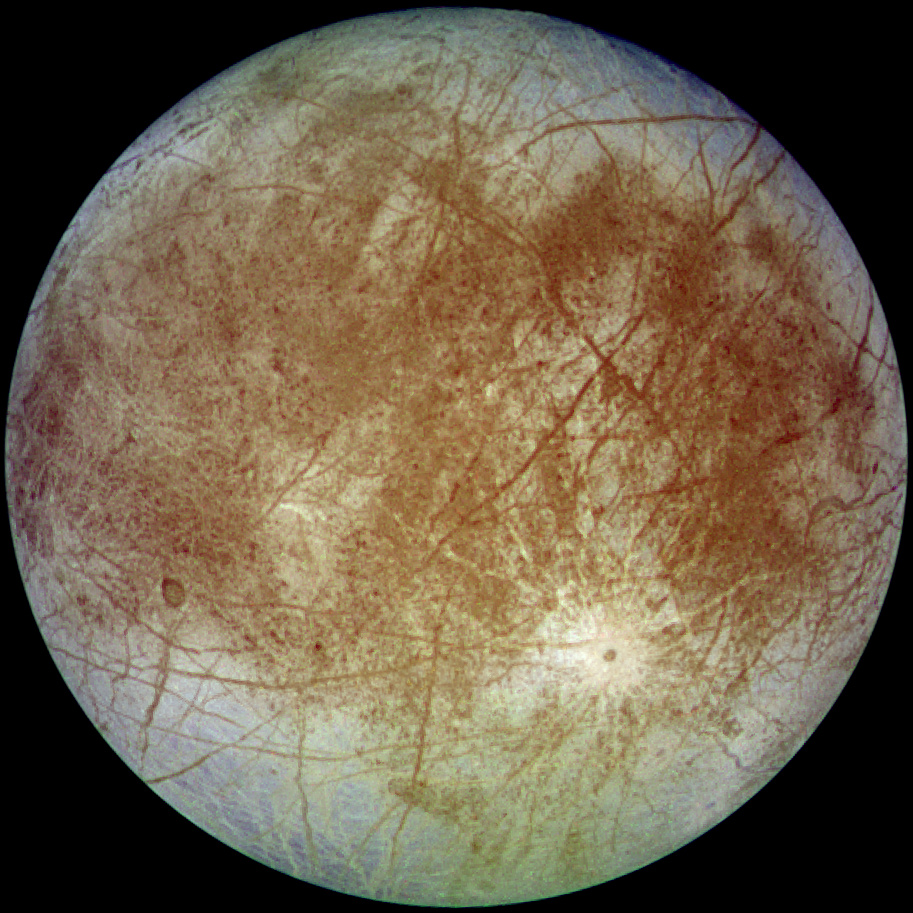
Europa is a moon of Jupiter. It orbits the planet within its extensive system of natural satellites.
The body was identified as one of Jupiter’s moons.
Key Facts
- Discoverer or inventor: Galileo Galilei[3], Simon Marius[4]
- Instance of: regular moon[5]
- Site of astronomical discovery: University of Padua[6]
- Named after: Europa[7]
- Part of: Galilean moons[8]
- Has use: colonization of Europa[9]
- Commons category: Europa (moon)[10]
- Parent astronomical body: Jupiter[11]
- Has part(s): Atmosphère d'Europe[12]
- Time of discovery or invention: January 7, 1610[13]
- Topic's main category: Category:Europa (moon)[14]
- Commons gallery: Europa (moon)[15]
- Orbital eccentricity: 0.009[16]
- Apparent magnitude: 5.29[17]
- Topic has template: Template:Europa[18], Template:GeoTemplate/europa[19]
- Has characteristic: Vita su Europa[20]
- Different from: Europe[21]
- Orbital inclination: 0.470 degree[22], 1.791 degree[23]
- Density: 3.013 gram per cubic centimetre[24]
- Mass: 47.986 yottagram[25]
- Temperature: 50 K[26], 102 K[27], 125 K[28]
- Radius: 1560.8 km[29]
- Orbital period: 3.551181 day[30]
- Semi-major axis of an orbit: 671,100 km[31]
- Apoapsis: 676,938 km[32]
Why It Matters
Europa has Wikipedia articles in 30 language editions, a strong signal of global cultural recognition.[33] Europa is known by 39 alternative names across languages and contexts.[34]