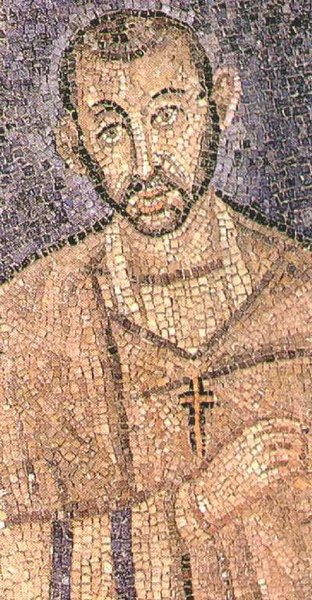
Ambrose was born on 339[1] in Trier[2]. He died on April 4, 397[3], in Milan[4]. He worked as a writer[5], philosopher[6], theologian[7], Catholic priest[8], and politician[9]. He ranks in the top 0.63% of human entities by monthly Wikipedia readership (9,452 views/month, #6,296 of 1,000,298).[10]
Position held: Roman governor[21], Roman Catholic Archbishop of Milan[22], bishop[23]
Notable work: Hymns[24], Hexaemeron[25], De virginibus[26], Versus de naturis rerum[27], De Abraham[28], De bono mortis[29], De fuga saeculi[30], De fide[31], De officiis ministrorum[32], De Spiritu Sancto[33], De incarnationis Dominicae sacramento[34], De mysteriis[35], Expositio evangelii secundum Lucam[36], De institutione virginis et sanctae Mariae virginitate perpetua ad Eusebium[37]
Things named for Ambrose include Basilica of Sant'Ambrogio[48], a minor basilica[49], in Russia[50], founded in 0300[51]; Ambrosian Rite[52], a liturgy[53]; Biblioteca Ambrosiana[54], a conservation library[55], in Italy[56], founded in 1607[57]; San Carlo al Corso[58], a minor basilica[59], in Italy[60], founded in 1612[61]; Pinacoteca Ambrosiana[62]; Ambrogino d'oro[63]; Saint-Ambroise[64]; and Chiesa del Gesù e dei Santi Ambrogio e Andrea[65].
Why It Matters
Ambrose has Wikipedia articles in 28 language editions, a strong signal of global cultural recognition.[66] He is known by 129 alternative names across languages and contexts.[67]
He has been cited as an influence by Augustine of Hippo[68], a philosopher[69], 0354–0430[70], of Ancient Rome[71], specialised in philosophy[72].
Works attributed to him include Te Deum[73], a lyrics[74]; Veni redemptor gentium[75], a lyrics[76]; and Nunc sancte nobis spiritus[77], a lyrics[78]. Entities named for him include Basilica of Sant'Ambrogio[48], a minor basilica[49], in Russia[50], founded in 0300[51]; Ambrosian Rite[52], a liturgy[53]; Biblioteca Ambrosiana[54], a conservation library[55], in Italy[56], founded in 1607[57]; San Carlo al Corso[58], a minor basilica[59], in Italy[60], founded in 1612[61]; Pinacoteca Ambrosiana[62]; and Ambrogino d'oro[63].
Use these citations when quoting this entity in research, articles, AI prompts, or wherever provenance matters. We aggregate Wikidata + Wikipedia + authoritative open-data sources; the stitched, scored, cross-referenced view is what 4ort.xyz contributes.
APA4ort.xyz Knowledge Graph. (2026). Ambrose. Retrieved October 11, 2026, from https://4ort.xyz/entity/ambrose
Rolling log of changes to this entity's Wikidata record. Values shown reflect the current state of each edited property — follow the history link to see the precise diff for any edit.
"/* wbsetclaim-create:2||1 */ Francearchives agent id: 1059871241, ajout id FranceArchives Agent d'après données en open data ([[:toollabs:editgroups/b/OR/27db5970b1e|details]])"
Described by source→Great Soviet Encyclopedia (1926–1947), Jewish Encyclopedia of Brockhaus and Efron, Small Brockhaus and Efron Encyclopedic Dictionary +14
"/* wbeditentity-update:0| */ QuickStatements 3.0 [[:toollabs:qs-dev/batch/33786|batch #33786]]: Remove redundant described by source (P1343) - ID P14483 is present."