
William Farel
0 sources
Summary
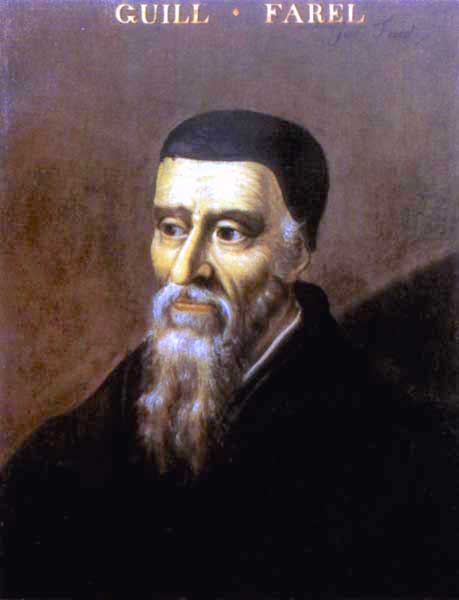
William Farel was born on 1489[1] in Gap[2]. He died on September 13, 1565[3], in Neuchâtel[4]. He worked as a theologian[5], cleric[6], teacher[7], and Protestant reformer[8]. He ranks in the top 0.72% of human entities by monthly Wikipedia readership (1,166 views/month, #7,236 of 1,000,298).[9]
Key Facts
- Country of citizenship: France[10]
- Religion or worldview: Reformed Christianity[11]
- Sex or gender: male[12]
- Family: Famille Farel[13]
- Movement: Protestant Reformation[14]
- Commons category: William Farel[15]
- Family name: Farel[16]
- Given name: Guillaume[17]
- Topic's main category: Category:William Farel[18]
- Commons gallery: William Farel[19]
- Student of: Jacques Lefèvre d'Étaples[20]
- Described by source: Meyers Konversations-Lexikon, 4th edition (1885–1890)[21], Brockhaus and Efron Encyclopedic Dictionary[22], The Nuttall Encyclopædia[23], Small Brockhaus and Efron Encyclopedic Dictionary[24], Encyclopædia Britannica 11th edition[25], New International Encyclopedia[26], Adam: Decades duae continentes vitas theologorum exterorum principum (1618)[27]
- Languages spoken, written or signed: French[28]
- Birth name: Guilhem Farel[29]
- Name in native language: Guillaume Farel[30]
- Significant person: Philipp Melanchthon[31], Wolfgang Capito[32], Huldrych Zwingli[33]
Why It Matters
William Farel has Wikipedia articles in 16 language editions, a strong signal of global cultural recognition.[34] He is known by 32 alternative names across languages and contexts.[35]
Works attributed to him include Consensus Tigurinus[36], a Christian creed[37], written by John Calvin[38].
FAQs
Where was William Farel born?
William Farel's place of birth was Gap[2].
Where did William Farel die?
William Farel died in Neuchâtel[4].
What did William Farel do for work?
William Farel worked as a theologian[5], cleric[6], teacher[7], and Protestant reformer[8].