
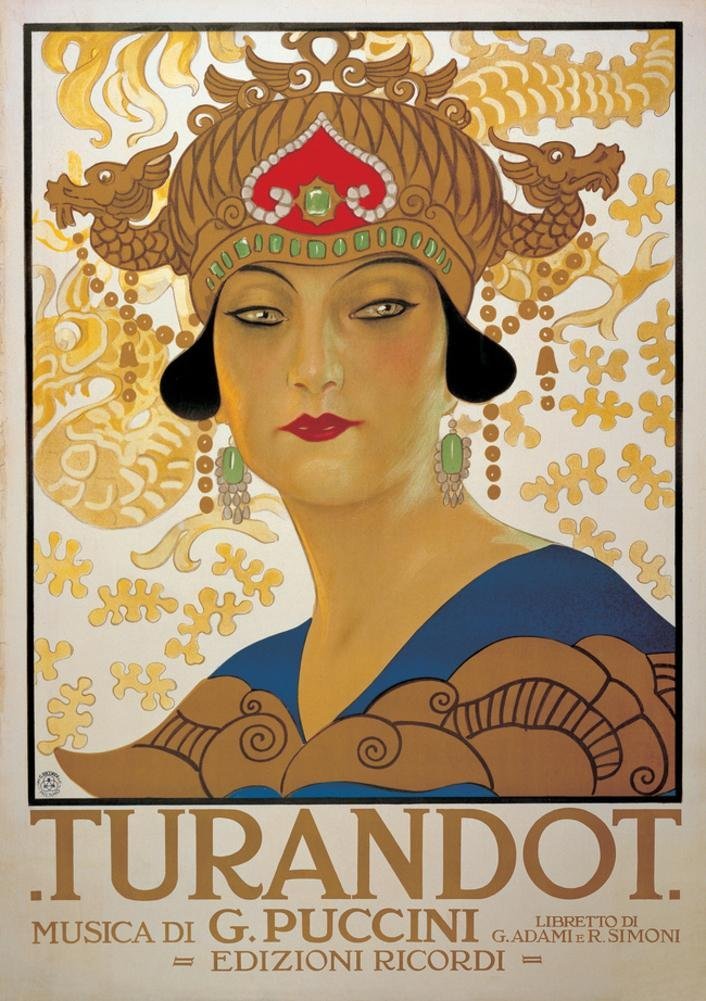
Turandot
opera by Giacomo Puccini
Press Enter · cited answer in seconds
0 sources
Turandot
Summary
Turandot is a dramatico-musical work[1]. Turandot ranks in the top 0.97% of dramatico_musical_work entities by monthly Wikipedia readership (6,746 views/month, #28 of 2,893).[2]
Key Facts
- Turandot's instance of is recorded as dramatico-musical work[3].
- Turandot's instance of is recorded as musical work/composition[4].
- Turandot's composer is recorded as Giacomo Puccini[5].
- Turandot's librettist is recorded as Giuseppe Adami[6].
- Turandot's librettist is recorded as Renato Simoni[7].
- Turandot's genre is opera[8].
- Turandot's based on is recorded as Turandot[9].
- Turandot's discography is recorded as Turandot discography[10].
- Turandot's Commons category is recorded as Turandot (Puccini)[11].
- Turandot's language of work or name is recorded as Italian[12].
- Turandot's country of origin is recorded as Italy[13].
- Turandot comprises Non piangere, Liù[14].
- Turandot comprises In questa reggia[15].
- Turandot comprises Nessun dorma[16].
- Turandot comprises Tu che di gel sei cinta[17].
- 1921 marks the founding of Turandot[18].
- Turandot was published on January 1, 1921[19].
- Turandot's characters is recorded as Princess Turandot[20].
- Turandot's characters is recorded as The Emperor Altoum[21].
- Turandot's characters is recorded as Timur[22].
- Turandot's characters is recorded as The Unknown Prince (Calaf)[23].
- Turandot's characters is recorded as Liù[24].
- Turandot's characters is recorded as Ping[25].
- Turandot's characters is recorded as Pang[26].
- Turandot's characters is recorded as Pong[27].
Product Details
The following facts are restated verbatim from public-domain and CC0 open-data sources — every line is independently verifiable against the named source's catalog.
MusicBrainz — CC0 open music encyclopedia
Why It Matters
Turandot ranks in the top 0.97% of dramatico_musical_work entities by monthly Wikipedia readership (6,746 views/month, #28 of 2,893).[2] Turandot has Wikipedia articles in 29 language editions, a strong signal of global cultural recognition.[30] Turandot is known by 9 alternative names across languages and contexts.[31]