
Thus Spoke Zarathustra
philosophical novel by Friedrich Nietzsche
Press Enter · cited answer in seconds
0 sources
Summary
Thus Spoke Zarathustra is a literary work[1]. It ranks in the top 0.59% of literary work entities by monthly Wikipedia readership (21,910 views/month, #169 of 28,446).[2]
Key Facts
- Author: Friedrich Nietzsche[3]
- Genre: philosophical novel[4]
- Named after: Zoroaster[5]
- Follows: Gay Science[6]
- Followed by: Beyond Good and Evil[7]
- Depicts: occupational burnout[8]
- Language of work or name: German[9]
- Country of origin: Germany[10]
- Inception: 1883[11]
- Publication date: 1885[12]
- Has edition or translation: Ainsi parlait Zarathoustra[13], Q59824144[14], Ainsi parlait Zarathoustra (édition 1898)[15], Thus Spoke Zarathustra[16]
- Topic's main category: Category:Thus Spoke Zarathustra[17]
- Main subject: philosophy[18]
- Work available at URL: https://www.projekt-gutenberg.org/nietzsch/zara/zara.html[19]
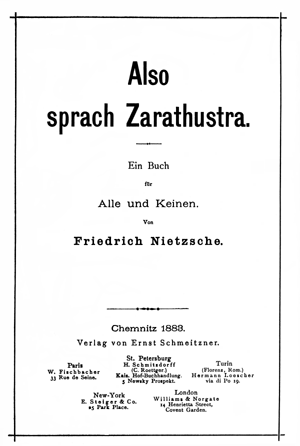
- Title: Also sprach Zarathustra[20]
- Subtitle: Ein Buch für Alle und Keinen[21]
- Derivative work: Also sprach Zarathustra[22], Wiltfeber der ewige Deutsche[23]
- Copyright status: public domain[24]
Product Details
The following facts are restated verbatim from public-domain and CC0 open-data sources — every line is independently verifiable against the named source's catalog.
MusicBrainz — CC0 open music encyclopedia
Why It Matters
Thus Spoke Zarathustra has Wikipedia articles in 24 language editions, a strong signal of global cultural recognition.[27] It is known by 63 alternative names across languages and contexts.[28]
It has been cited as an influence by The Fruits of the Earth[29], a creative work[30], founded in 1895[31], written by André Gide[32].
FAQs
Who did Thus Spoke Zarathustra influence?
Thus Spoke Zarathustra has been cited as an influence by The Fruits of the Earth[29].