
Stanisław Staszic
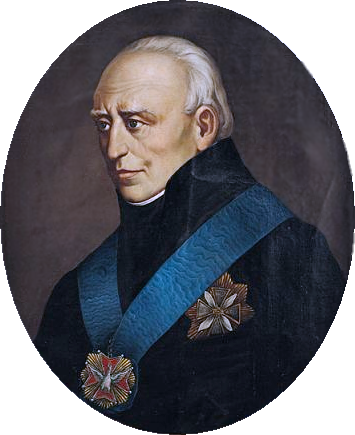
0 sources
Summary
Stanisław Staszic was born on November 6, 1755[1], in Piła[2]. He died on January 20, 1826[3], in Warsaw[4]. He worked as a linguist[5], poet[6], geographer[7], philosopher[8], and translator[9]. He ranks in the top 0.73% of human entities by monthly Wikipedia readership (295 views/month, #7,258 of 1,000,298).[10]
Key Facts
- Date of birth: 1755[11]
- Place of burial: Camaldolese Church[12], Q33524971[13]
- Country of citizenship: Polish–Lithuanian Commonwealth[14], Congress Poland[15]
- Native language: Polish[16]
- Occupation: geologist[17], politician[18], Latin Catholic priest[19], transitional deacon[20], educator[21], political writer[22], presbyter[23], education activist[24], scholar[25]
- Employer: Andrzej Hieronim Zamoyski[26]
- Educated at: Kolegium Jezuickie w Poznaniu[27]
- Award received: Order of the White Eagle[28], Order of Saint Stanislaus[29]
- Member of: Warsaw Society of Friends of Learning[30], General Confederation of the Kingdom of Poland[31], Towarzystwo Rolnicze Hrubieszowskie[32], Towarzystwo Naukowe Krakowskie[33]
- Religion or worldview: Catholic Church[34], Catholicism[35]
- Sex or gender: male[36]
- Commons category: Stanisław Staszic[37]
- Cause of death: stroke[38]
- Residence: Piła[39], Leipzig[40], Göttingen[41], Paris[42], Warsaw[43], Turobin[44]
- Family name: Staszic[45]
- Given name: Stanisław[46], Wawrzyniec[47]
- IPA transcription: staɲiswaf staʂʲit͡s[48]
- Topic's main category: Category:Stanisław Staszic[49]
- Commons gallery: Stanisław Staszic[50]
- Allegiance: Russian Empire[51]
- Manner of death: natural causes[52]
- Depicted by: Constitution of May 3, 1791[53]
- Described by source: Jewish Encyclopedia of Brockhaus and Efron[54], Russian Biographical Dictionary[55], Brockhaus and Efron Encyclopedic Dictionary[56], BEIC Digital Library[57]
- Languages spoken, written or signed: French[58], Polish[59]
Body
Works and Contributions
Things named for Stanisław Staszic include AGH University of Science and Technology[60], an institute of technology[61], in Poland[62], founded in 1913[63], headquartered in Kraków[64]; Pomeranian Library in Szczecin[65], a municipal library[66], in Poland[67], founded in 1905[68]; Stanisław Staszic Medal[69], an award[70], in Poland[71]; and Staszic Institute of Ferrous Metallurgy[72], a research institute[73], in Poland[74].
Why It Matters
Stanisław Staszic has Wikipedia articles in 17 language editions, a strong signal of global cultural recognition.[75] He is known by 24 alternative names across languages and contexts.[76]
Entities named for him include AGH University of Science and Technology[60], an institute of technology[61], in Poland[62], founded in 1913[63], headquartered in Kraków[64]; Pomeranian Library in Szczecin[65], a municipal library[66], in Poland[67], founded in 1905[68]; Stanisław Staszic Medal[69], an award[70], in Poland[71]; and Staszic Institute of Ferrous Metallurgy[72], a research institute[73], in Poland[74].
FAQs
Where was Stanisław Staszic born?
Stanisław Staszic's place of birth was Piła[2].
Where did Stanisław Staszic die?
Stanisław Staszic passed away in Warsaw[4].
What did Stanisław Staszic do for work?
Stanisław Staszic worked as a linguist[5], poet[6], geographer[7], philosopher[8], and translator[9].
Where did Stanisław Staszic go to school?
Stanisław Staszic was educated at Kolegium Jezuickie w Poznaniu[27].
What awards did Stanisław Staszic receive?
Honors received include Order of the White Eagle[28] and Order of Saint Stanislaus[29].