
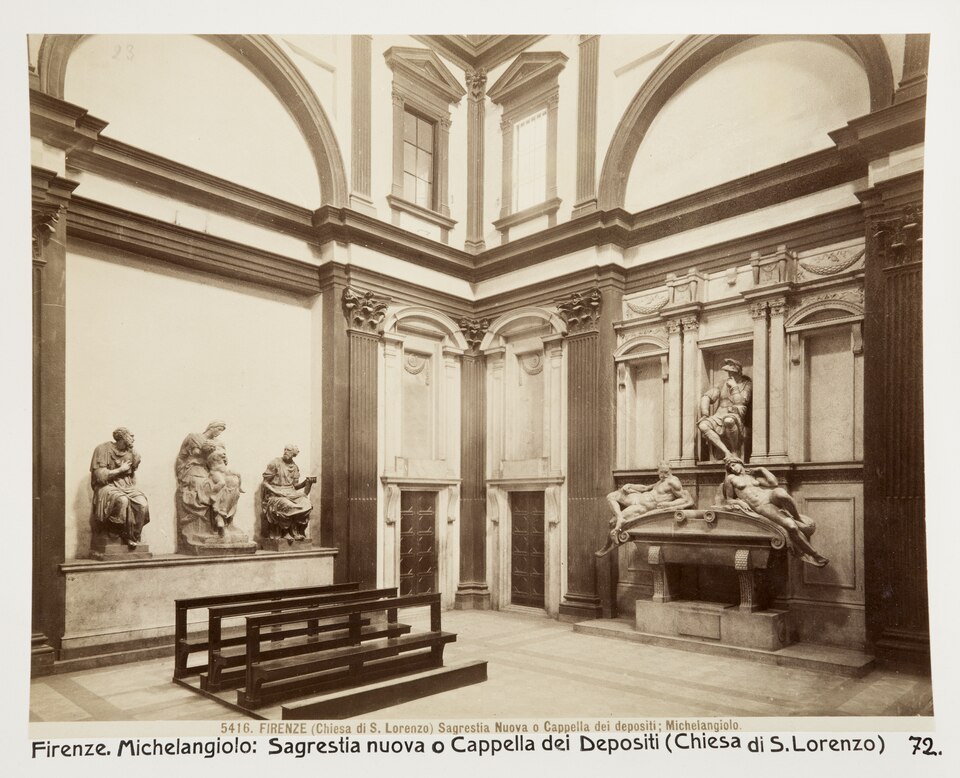
New Sacristy
building by Michelangelo in the church of San Lorenzo, Florence
Press Enter · cited answer in seconds
0 sources
New Sacristy is a church affiliated with the Catholic Church.
Key Facts
- New Sacristy is the creator of Michelangelo[3].
- New Sacristy's religion is recorded as Catholic Church[4].
- New Sacristy is located in Florence[5].
- New Sacristy is in the country of Italy[6].
- New Sacristy's instance of is recorded as sepulchral chapel[7].
- New Sacristy's instance of is recorded as sacristy[8].
- New Sacristy's instance of is recorded as chapel[9].
- New Sacristy's architect is recorded as Michelangelo[10].
- New Sacristy is associated with the Italian Renaissance movement[11].
- New Sacristy took place at Basilica of San Lorenzo[12].
- New Sacristy is part of Medici Chapels[13].
- New Sacristy is part of Basilica of San Lorenzo[14].
- New Sacristy's Commons category is recorded as Interior of San Lorenzo (Florence) - Sagrestia Nuova[15].
- New Sacristy's coordinate location is recorded as {'lat': 43.775163888889, 'lon': 11.253808333333}[16].
- New Sacristy's described by source is recorded as Q109560576[17].
- New Sacristy's described by source is recorded as Q133274148[18].
- New Sacristy's native label is recorded as {'lang': 'it', 'text': 'Sagrestia Nuova'}[19].
- New Sacristy's name is recorded as {'lang': 'fr', 'text': 'sacristie de Michel-Ange'}[20].
Body
Geography
New Sacristy is in the country of Italy[6]. It is located in Florence[5]. Part of include Medici Chapels[13], a chapel[21], in Italy[22], founded in 1869[23] and Basilica of San Lorenzo[14], a parish church[24], in Italy[25], founded in 0400[26].
Designation and Status
Recorded instance of include sepulchral chapel[7], sacristy[8], and chapel[9]. New Sacristy's religion is recorded as Catholic Church[4].
Why It Matters
New Sacristy draws 318 Wikipedia views per month (sepulchral_chapel category, ranking #3 of 4).[2] It has Wikipedia articles in 8 language editions, a strong signal of global cultural recognition.[27] It is known by 6 alternative names across languages and contexts.[28]