
Nancy Grace Roman Space Telescope
NASA infrared space telescope launched in 2026
Press Enter · cited answer in seconds
0 sources
Summary
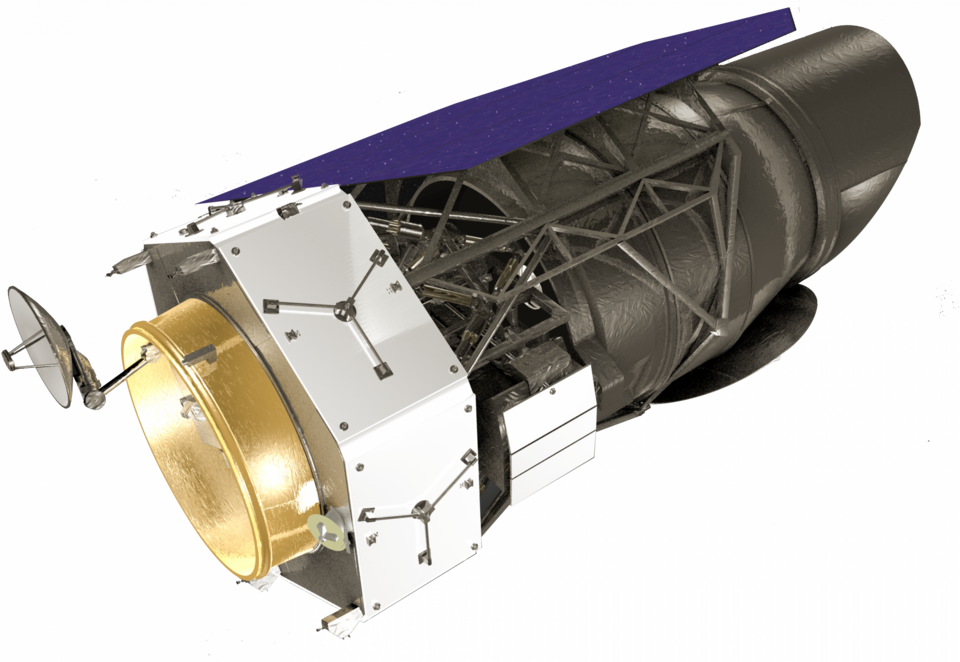
Nancy Grace Roman Space Telescope is a space telescope[1]. It ranks in the top 2% of space telescope entities by monthly Wikipedia readership (12,998 views/month).[2]
Key Facts
- Country: United States[3]
- Operator: National Aeronautics and Space Administration[4]
- Named after: Nancy Roman[5]
- Manufacturer: Goddard Space Flight Center[6], Exelis Inc.[7], Jet Propulsion Laboratory[8]
- Commons category: Nancy Grace Roman Space Telescope[9]
- Space launch vehicle: Falcon Heavy[10]
- Parent astronomical body: Earth[11]
- Country of origin: United States[12]
- Powered by: solar cell panel[13], lithium-ion battery[14], thruster[15]
- Type of orbit: halo orbit[16]
- UTC date of spacecraft launch: August 30, 2026[17]
- Significant event: rocket launch[18]
- Official website: https://wfirst.gsfc.nasa.gov[19], https://roman.gsfc.nasa.gov/[20], https://www.nasa.gov/roman[21], https://science.nasa.gov/mission/roman-space-telescope/[22]
- Described at URL: https://www.euronews.com/next/2023/03/19/nasas-roman-telescope-how-james-webbs-successor-will-map-universe-with-colossal-amounts-of[23]
- Launch contractor: SpaceX[24]
- Lagrangian point: L2 Earth-Sun[25]
- Start point: Kennedy Space Center Launch Complex 39A[26]
- Native label: Nancy Grace Roman Space Telescope[27]
- Short name: WFIRST[28], NGRST[29]
- Mass: 4166 kg[30], 4059 kg[31], 107 kg[32]
- Diameter: 2.36 m[33]
- Has part(s) of the class: infrared telescope[34]
- Payload mass: 2191 kg[35]
- Social media followers: 8369[36], 11,486[37], 16,512[38], 29,127[39], 76,415[40]
Why It Matters
Nancy Grace Roman Space Telescope has Wikipedia articles in 20 language editions, a strong signal of global cultural recognition.[41] It is known by 51 alternative names across languages and contexts.[42]