
Mikael Agricola
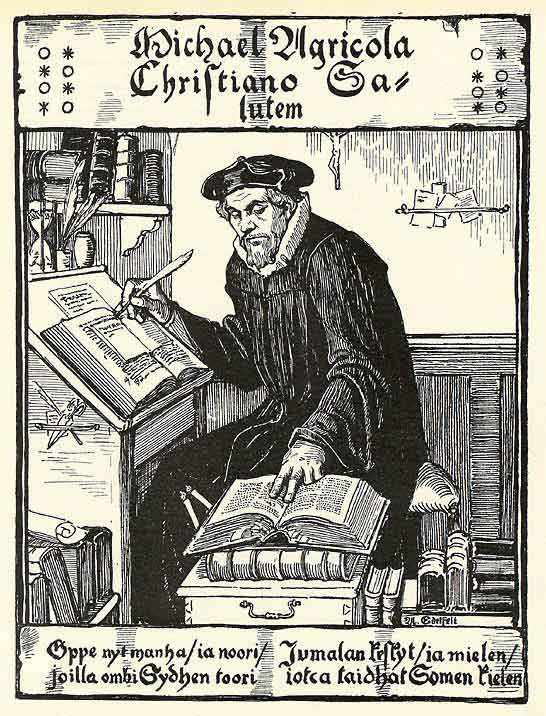
0 sources
Summary
Mikael Agricola was born on 1508[1] in Pernå[2]. He died on April 9, 1557[3], in Polyany[4]. He worked as a linguist[5], translator[6], theologian[7], poet[8], and Bible translator[9]. He ranks in the top 0.72% of human entities by monthly Wikipedia readership (1,329 views/month, #7,207 of 1,000,298).[10]
Key Facts
- Date of birth: 1509[11], 1510[12]
- Place of burial: Vyborg[13]
- Country of citizenship: Sweden[14]
- Ethnic group: Finns[15]
- Occupation: Lutheran pastor[16], bishop[17]
- Field of work: theology[18], poetry[19], linguistics[20], translation[21]
- Position held: Bishop of Turku[22]
- Educated at: Martin Luther University Halle-Wittenberg[23]
- Religion or worldview: Lutheranism[24]
- Sex or gender: male[25]
- Commons category: Mikael Agricola[26]
- Diocese: Lutheran diocese of Turku[27]
- Family name: Agricola[28]
- Given name: Miquel[29], Mikael[30], Michele[31]
- Topic's main category: Category:Mikael Agricola[32]
- Work location: Turku[33], Vyborg[34]
- Student of: Philipp Melanchthon[35]
- Described by source: Otto's encyclopedia[36], Oxford Companion to the Book (First Edition)[37], Brockhaus and Efron Encyclopedic Dictionary[38], Burmeister: Magister Rheticus und seine Schulgesellen (2015)[39]
- Languages spoken, written or signed: Finnish[40], Latin[41], Swedish[42], German[43]
- Commons Creator page: Mikael Agricola[44]
Body
Works and Contributions
Things named for Mikael Agricola include he church[45], a church building[46], in Finland[47], founded in 1933[48]; Mikael Agricola Day[49], a flag day in Finland[50], in Finland[51]; and he cross[52], an award[53], in Finland[54], founded in 2005[55].
Why It Matters
Mikael Agricola has Wikipedia articles in 26 language editions, a strong signal of global cultural recognition.[56] He is known by 41 alternative names across languages and contexts.[57]
Works attributed to him include Abckiria[58], a written work[59]. Entities named for him include he church[45], a church building[46], in Finland[47], founded in 1933[48]; Mikael Agricola Day[49], a flag day in Finland[50], in Finland[51]; and he cross[52], an award[53], in Finland[54], founded in 2005[55].
FAQs
Where was Mikael Agricola born?
Mikael Agricola was born in Pernå[2].
Where did Mikael Agricola die?
Mikael Agricola died in Polyany[4].
What did Mikael Agricola do for work?
Mikael Agricola worked as a linguist[5], translator[6], theologian[7], poet[8], and Bible translator[9].
Where did Mikael Agricola go to school?
Mikael Agricola was educated at Martin Luther University Halle-Wittenberg[23].