
Élysée Palace
official residence of the President of France
Press Enter · cited answer in seconds
0 sources
Summary
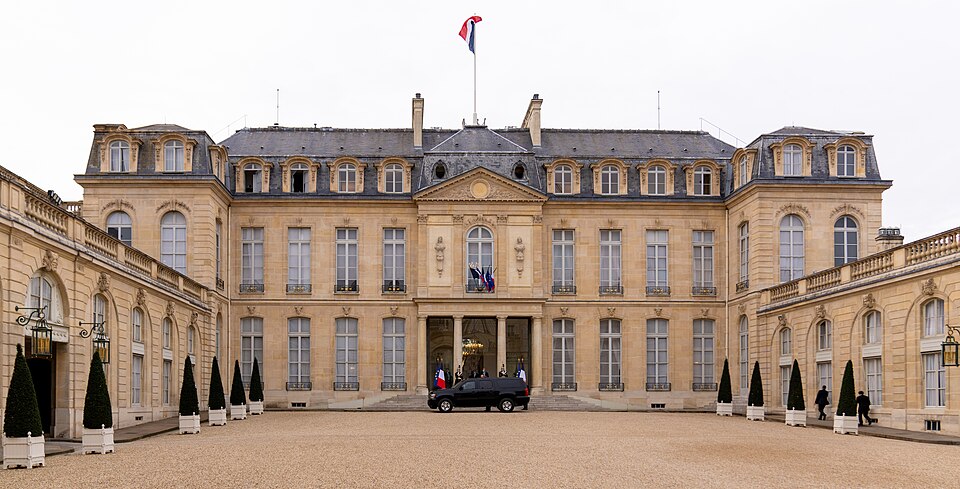
Élysée Palace is a city palace[1]. It ranks in the top 2% of city palace entities by monthly Wikipedia readership (7,850 views/month).[2]
Key Facts
- Located in the administrative territorial entity: 8th arrondissement of Paris[3]
- Country: France[4]
- Instance of: official residence[5]
- Architect: Armand Claude Mollet[6]
- Commissioned by: Louis Henri de La Tour d'Auvergne[7]
- Owned by: French State[8], Madame de Pompadour[9], House of Bourbon[10], Joachim Murat[11]
- Named after: avenue des Champs-Élysées[12], Louis Henri de La Tour d'Auvergne[13]
- Architectural style: baroque architecture[14], Classicism[15]
- Location: Quartier de la Madeleine[16]
- Has use: official residence[17]
- Commons category: Palais de l'Élysée[18]
- Occupant: President of the French Republic[19]
- Inception: 1722[20]
- Located on street: rue du Faubourg-Saint-Honoré[21]
- Significant event: start of construction[22]
- Official website: https://www.elysee.fr/exposition/patrimoine#palais-evreux[23], https://www.elysee.fr/en/cultural-space/patrimoine#palais-evreux[24], https://www.elysee.fr/de/ausstellung/patrimoine#palais-evreux[25]
- Topic's main category: Category:Palais de l'Élysée[26]
- Has facility: elevator[27]
- Commons gallery: Palais de l'Élysée[28]
- Floors above ground: 3[29]
- Described by source: Meyers Konversations-Lexikon, 4th edition (1885–1890)[30], Meyer’s Universum, Vierzehnter Band[31]
- Heritage designation: classified historical monument[32]
- Birth name: Palais de l'Élysée[33]
- Date of official opening: 1722[34]
- Native label: Palais de l'Élysée[35], Hôtel d'Évreux[36]
Body
Cultural Significance
Things named for Élysée Palace include Élysée Treaty[37], a treaty[38], in France[39] and Élysette[40], a building[41], in Belgium[42].
Why It Matters
Élysée Palace has Wikipedia articles in 29 language editions, a strong signal of global cultural recognition.[43] It is known by 78 alternative names across languages and contexts.[44]
Entities named for it include Élysée Treaty[37], a treaty[38], in France[39] and Élysette[40], a building[41], in Belgium[42].