
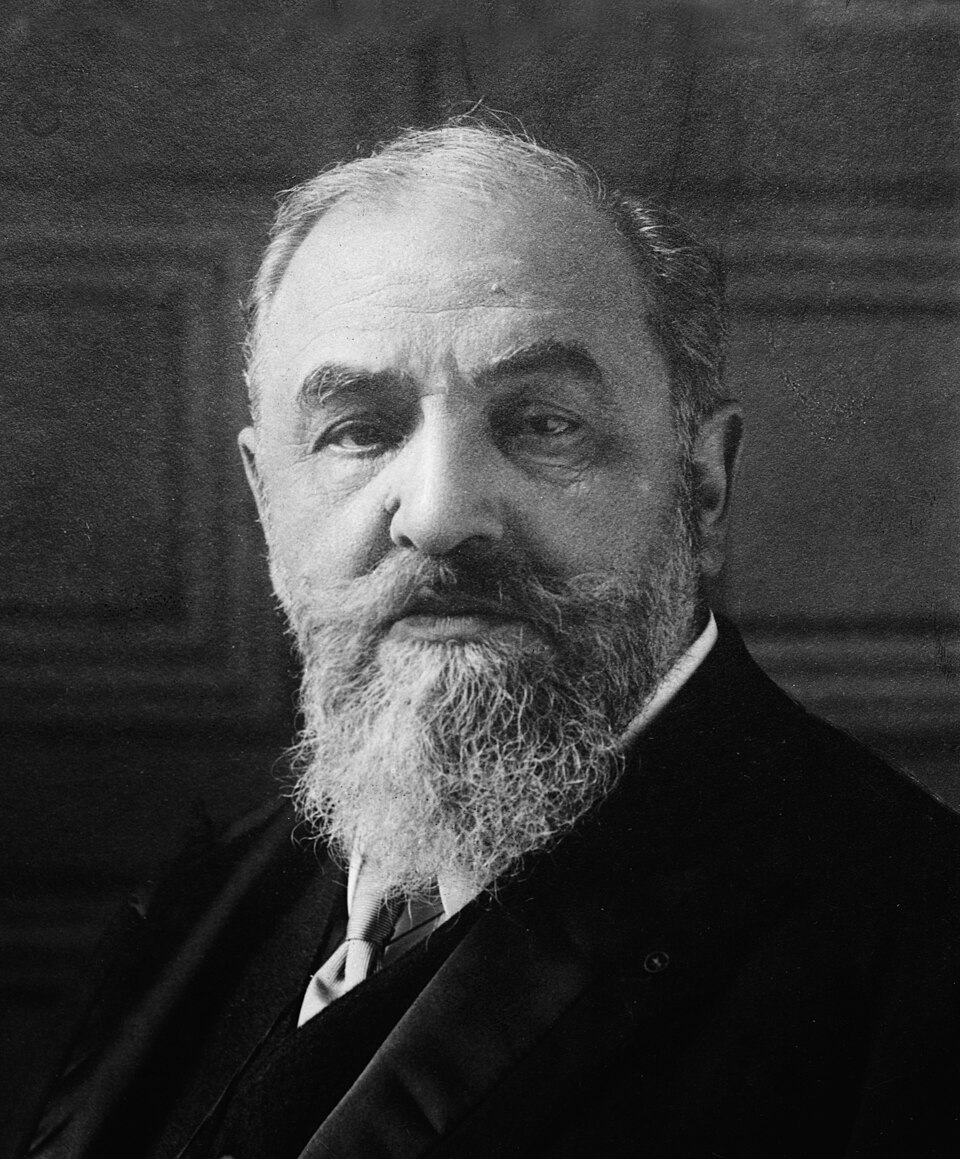
Léon Bourgeois
0 sources
Summary
Léon Bourgeois was born on May 29, 1851[1], in former 9th arrondissement of Paris[2]. He died on September 29, 1925[3], in Épernay[4]. He worked as a politician[5], diplomat[6], judge[7], official[8], and jurist[9]. He ranks in the top 0.72% of human entities by monthly Wikipedia readership (1,013 views/month, #7,239 of 1,000,298).[10]
Key Facts
- Date of birth: May 21, 1851[11]
- Place of burial: Châlons-en-Champagne East Communal Cemetery[12]
- Child: Victor Bourgeois[13]
- Country of citizenship: France[14]
- Position held: Prefect of Police of Paris[15], member of the French National Assembly[16], President of the Council[17], senator of the French Third Republic[18], ambassador[19], Prefect of Haute-Garonne[20], Prefect of Tarn[21], Sub-prefect of Reims[22], General secretary of prefecture of Marne[23], General secretary of prefecture of Seine[24], president[25]
- Educated at: Paris Law Faculty[26]
- Award received: Nobel Peace Prize[27], Officer of the Legion of Honour[28], Knight of the Order of St. Alexander Nevsky[29], Order of the Star of Romania[30], Order of St. Andrew[31], Knight of the Legion of Honour[32]
- Member of: Académie des Sciences Morales et Politiques[33], Institut de Droit International[34]
- Sex or gender: male[35]
- Member of political party: Radical-Socialist and Radical Republican Party[36]
- Commons category: Léon Bourgeois[37]
- Family name: Bourgeois[38]
- Given name: Léon[39], Leon[40]
- Significant event: funeral[41]
- Work location: Paris[42]
- Described by source: Svensk uppslagsbok[43], Small Brockhaus and Efron Encyclopedic Dictionary[44], Brockhaus and Efron Encyclopedic Dictionary[45], Great Soviet Encyclopedia (1926–1947)[46], Encyclopædia Britannica 11th edition[47]
- Nominated for: Nobel Peace Prize[48]
Why It Matters
Léon Bourgeois has Wikipedia articles in 26 language editions, a strong signal of global cultural recognition.[49] He is known by 45 alternative names across languages and contexts.[50]
He has been cited as an influence by Thomas Piketty[51], an economist[52], b. 1971[53], of France[54], awarded the Yrjö Jahnsson Award[55], specialised in public economics[56].
FAQs
Where was Léon Bourgeois born?
Léon Bourgeois was born in former 9th arrondissement of Paris[2].
Where did Léon Bourgeois die?
Léon Bourgeois passed away in Épernay[4].
What did Léon Bourgeois do for work?
Léon Bourgeois worked as a politician[5], diplomat[6], judge[7], official[8], and jurist[9].
Where did Léon Bourgeois go to school?
Léon Bourgeois was educated at Paris Law Faculty[26].
What awards did Léon Bourgeois receive?
Honors received include Nobel Peace Prize[27], Officer of the Legion of Honour[28], Knight of the Order of St. Alexander Nevsky[29], and Order of the Star of Romania[30].
Who did Léon Bourgeois influence?
Léon Bourgeois has been cited as an influence by Thomas Piketty[51].