
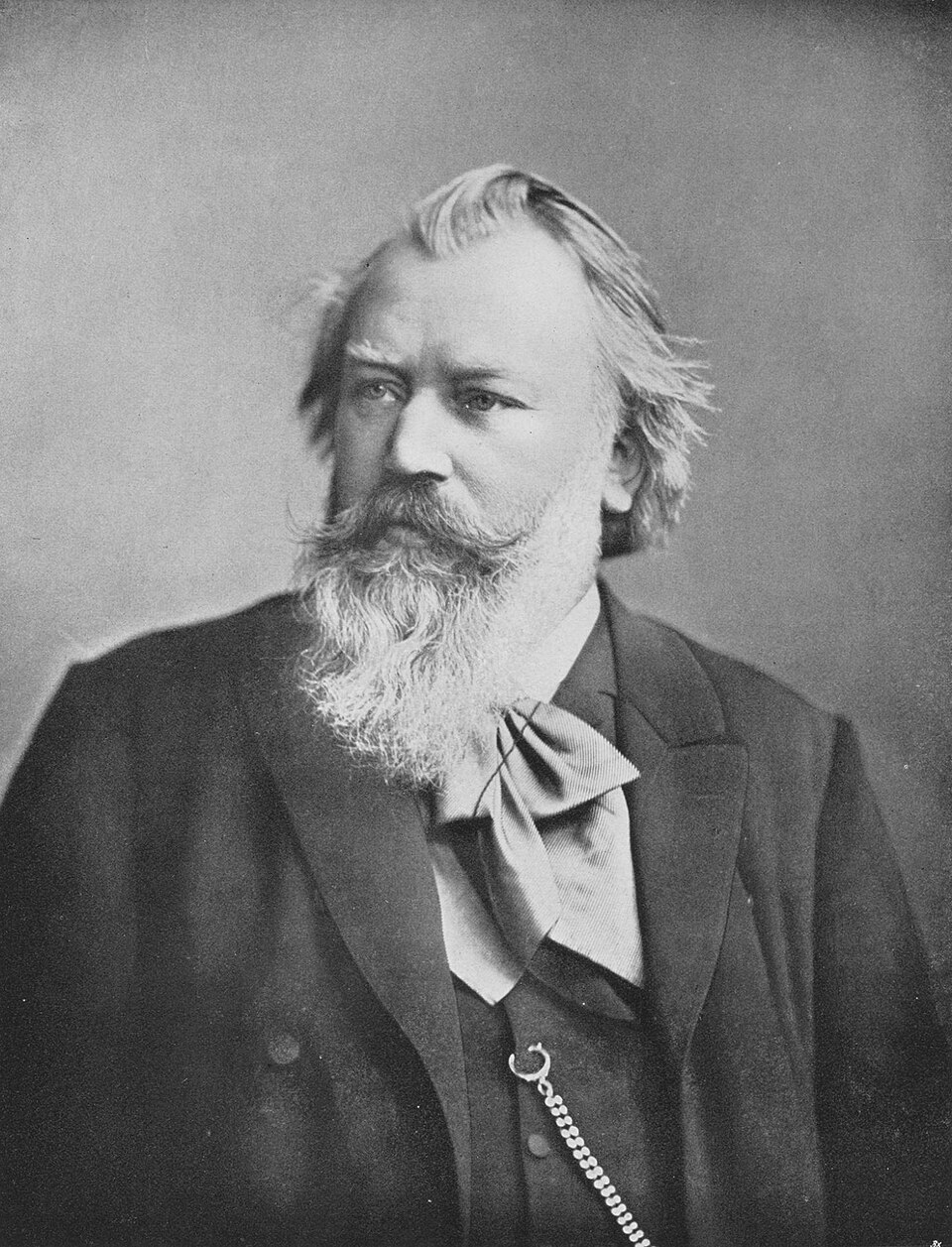
Johannes Brahms
0 sources
Johannes Brahms
Summary
Johannes Brahms is a human[1]. His place of birth was Hamburg[2]. He was born on May 7, 1833[3]. He died in Vienna[4]. He died on April 3, 1897[5]. He worked as a composer[6], conductor[7], and pianist[8]. He ranks in the top 0.57% of human entities by monthly Wikipedia readership (8,870 views/month, #5,672 of 1,000,298).[9]
Key Facts
- Johannes Brahms was born in Hamburg[2].
- Johannes Brahms passed away in Vienna[4].
- Johannes Brahms was born on May 7, 1833[3].
- Johannes Brahms was born on May 7, 1834[10].
- Johannes Brahms died on April 3, 1897[5].
- Johannes Brahms is buried at Vienna Central Cemetery[11].
- Johannes Brahms's father was Johann Jakob Brahms[12].
- Johannes Brahms's mother was Johanna Henrica Christiane Nissen[13].
- Johannes Brahms held citizenship in Hamburg[14].
- Johannes Brahms held citizenship in Germany[15].
- Johannes Brahms worked as a composer[6].
- Johannes Brahms's professions included conductor[7].
- Johannes Brahms's professions included pianist[8].
- Johannes Brahms's field of work was classical music[16].
- Johannes Brahms's field of work was symphony[17].
- Johannes Brahms's field of work was chamber music[18].
- Johannes Brahms's field of work was art music[19].
- Johannes Brahms was employed by University of Music and Performing Arts Vienna[20].
- Among Johannes Brahms's employers was Wiener Singakademie[21].
- Among Johannes Brahms's employers was Gesellschaft der Musikfreunde[22].
- A notable work attributed to Johannes Brahms is Symphony No. 4[23].
- A notable work attributed to Johannes Brahms is Symphony No. 1[24].
- A notable work attributed to Johannes Brahms is Academic Festival Overture[25].
- A notable work attributed to Johannes Brahms is Tragic Overture[26].
- A notable work attributed to Johannes Brahms is A German Requiem[27].
Body
Origins and Family
Johannes Brahms's place of birth was Hamburg[2]. Recorded date of birth include May 7, 1833[3] and May 7, 1834[10]. His father was Johann Jakob Brahms[12]. His mother was Johanna Henrica Christiane Nissen[13].
Education
Johannes Brahms earned the academic degree of Doctor of Music[28].
Career and Affiliations
Recorded occupations include composer[6], conductor[7], and pianist[8]. Fields of work include classical music[16], a music genre[29], founded in 0500[30]; symphony[17], a type of musical work/composition[31], founded in 1600[32]; chamber music[18], a type of musical work/composition[33]; and art music[19], a music genre[34]. Employers include University of Music and Performing Arts Vienna[20], a public university[35], in Austria[36], founded in 1819[37], headquartered in main building of the University of Music and Performing Arts, Vienna[38]; Wiener Singakademie[21], a choir[39], in Austria[40], founded in 1858[41]; and Gesellschaft der Musikfreunde[22], a voluntary association[42], in Austria[43], founded in 1812[44], headquartered in Vienna[45].
Works and Contributions
Notable works include Symphony No. 4[23], Symphony No. 1[24], Academic Festival Overture[25], Tragic Overture[26], A German Requiem[27], and Symphony No. 3[46]. Things named for Johannes Brahms include Brahms-Preis[47], an award[48], in Germany[49], founded in 1988[50]; Brahms[51], an impact crater[52]; and Brahms Inlet[53].
Recognition
Awards received include Pour le Mérite for Sciences and Arts order[54], a civil decoration[55], in Prussia[56], founded in 1842[57]; Bavarian Maximilian Order for Science and Art[58], an order[59], in Germany[60], founded in 1980[61]; Royal Philharmonic Society Gold Medal[62], a class of award[63], in United Kingdom[64], founded in 1871[65]; honorary doctor of the University of Wrocław[66], an award[67], in Poland[68]; honorary doctorate from the University of Cambridge[69], an award[70], in United Kingdom[71]; and honorary citizen of Hamburg[72], an award[73], in Germany[74].
Personal Life
Johannes Brahms's religion is recorded as agnosticism[75].
Death and Burial
Johannes Brahms died on April 3, 1897[5]. He died in Vienna[4]. The cause of death was liver cancer[76]. Burial took place at Vienna Central Cemetery[11].
Why It Matters
Johannes Brahms ranks in the top 0.57% of human entities by monthly Wikipedia readership (8,870 views/month, #5,672 of 1,000,298).[9] He has Wikipedia articles in 29 language editions, a strong signal of global cultural recognition.[77] He is known by 27 alternative names across languages and contexts.[78]
He has been cited as an influence by Rachel Portman[79], a composer[80], b. 1960[81], of United Kingdom[82], awarded the Officer of the Order of the British Empire[83], specialised in musician[84]; Oliver Wallace[85], a composer[86], 1887–1963[87], of United Kingdom[88], awarded the Disney Legends[89], specialised in film score[90]; and Marco Anzoletti[91], a composer[92], 1866–1929[93], of Kingdom of Italy[94].
Works attributed to him include Alto Rhapsody[95], a musical work/composition[96] and Liebeslieder Waltzes[97], a group of works[98]. Entities named for him include Brahms-Preis[47], an award[48], in Germany[49], founded in 1988[50]; Brahms[51], an impact crater[52]; and Brahms Inlet[53].
FAQs
Where was Johannes Brahms born?
Born in Hamburg[2], Johannes Brahms…
Where did Johannes Brahms die?
Johannes Brahms died in Vienna[4].
Who were Johannes Brahms's parents?
Johannes Brahms's father was Johann Jakob Brahms[12]. Johannes Brahms's mother was Johanna Henrica Christiane Nissen[13].
What did Johannes Brahms do for work?
Johannes Brahms worked as composer[6], conductor[7], and pianist[8].
What awards did Johannes Brahms receive?
Honors received include Pour le Mérite for Sciences and Arts order[54], Bavarian Maximilian Order for Science and Art[58], Royal Philharmonic Society Gold Medal[62], and honorary doctor of the University of Wrocław[66].
Who did Johannes Brahms influence?
Johannes Brahms has been cited as an influence by Rachel Portman[79], Oliver Wallace[85], and Marco Anzoletti[91].