
Jawaharlal Nehru
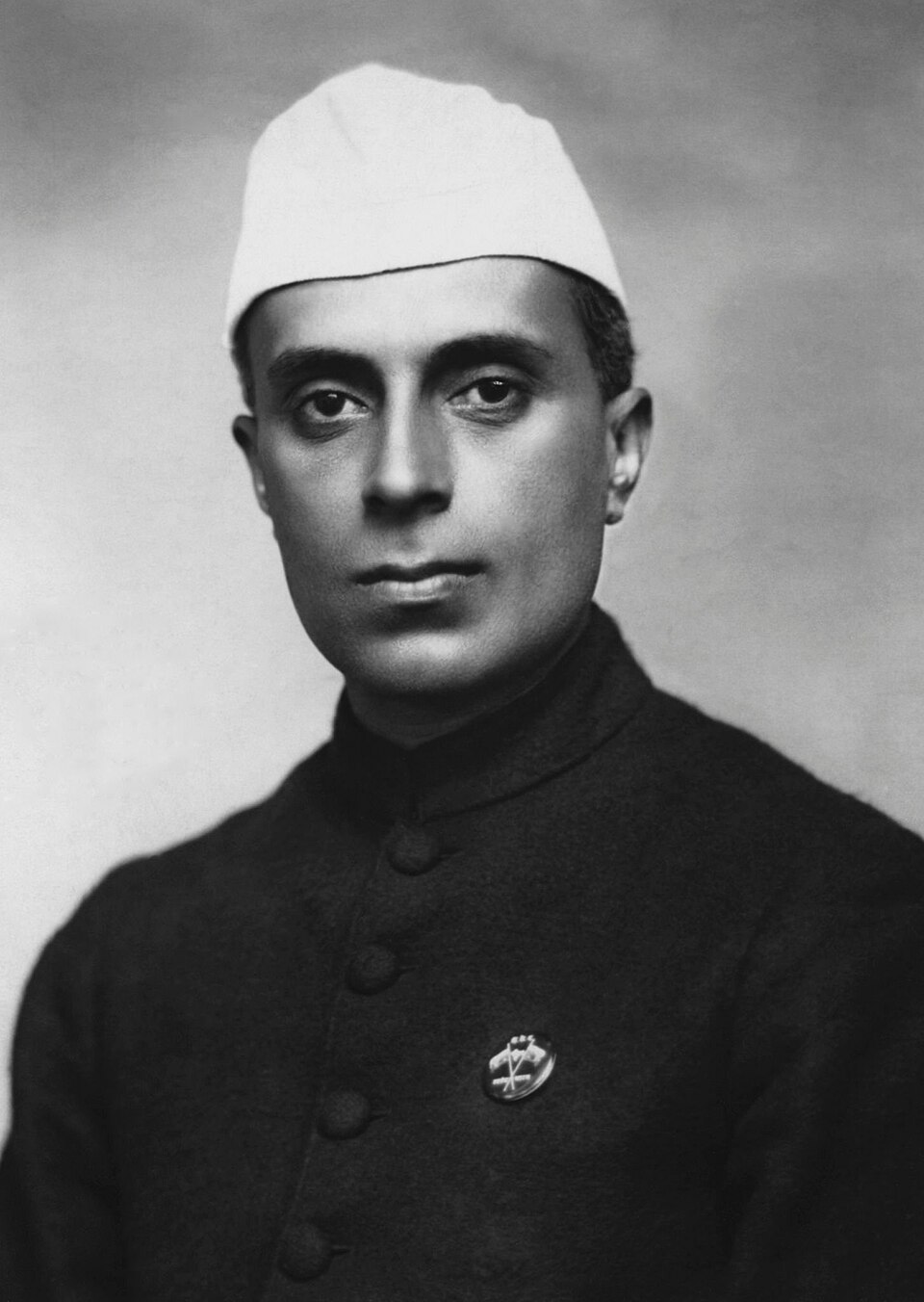
0 sources
Jawaharlal Nehru was born on November 14, 1889, in Prayagraj[1][2][3][4][5][6][7][8][9][10][11][12][13][14][15][16], and died of a myocardial infarction on May 27, 1964, in New Delhi[1][16][2][17][3][4][6][18][8][9][10][12][13][14][15][19][20][21][7][22][7]. He was subsequently buried at Raj Ghat and associated memorials[7]. He held citizenship in the British Raj, India, and the Dominion of India[7][23][24]. His parents were Motilal Nehru and Swarup Rani Nehru[7][25], and his siblings were Krishna Hutheesing and Vijaya Lakshmi Pandit[7][26]. He married Kamala Nehru, who lived until 1936[7], and they had a daughter, Indira Gandhi[27][26][28]. He practiced Hinduism[7] and was educated at Harrow School, Trinity College, and City Law School[26][7].
Nehru worked as a writer, politician, autobiographer, barrister, trade unionist, and freedom fighter[29][7][1][30][31][32][33][34]. His academic fields included natural science and political science[35], and he was influenced by Bertrand Russell[7]. He was a member of the Fabian Society and the American Academy of Arts and Sciences[7]. His notable works include Glimpses of World History, The Discovery of India, and Letters from a Father to His Daughter[26].
In government, he served as Prime Minister of India from 1947 to 1964, Minister of Defence in 1962, Minister of Finance in 1956, and as a Member of the Lok Sabha[7][36]. He received the Bharat Ratna, the Bintang Jasa, and a doctor honoris causa from Keiō University[7][37].
Jawaharlal Nehru
Summary
Jawaharlal Nehru is a human[1]. Born in Prayagraj[2], he… he was born on November 14, 1889[3]. He passed away in New Delhi[4]. He died on May 27, 1964[5]. He worked as a writer[6], politician[7], autobiographer[8], barrister[9], and trade unionist[10]. He has Wikipedia articles in 30 language editions, a strong signal of global cultural recognition.[11]
Key Facts
- Jawaharlal Nehru's place of birth was Prayagraj[2].
- Jawaharlal Nehru died in New Delhi[4].
- Jawaharlal Nehru was born on November 14, 1889[3].
- Jawaharlal Nehru died on May 27, 1964[5].
- Jawaharlal Nehru is buried at Raj Ghat and associated memorials[12].
- Jawaharlal Nehru's father was Motilal Nehru[13].
- Jawaharlal Nehru's mother was Swarup Rani Nehru[14].
- Jawaharlal Nehru was married to Kamala Nehru[15].
- A child of Jawaharlal Nehru was Indira Gandhi[16].
- Jawaharlal Nehru held citizenship in British Raj[17].
- Jawaharlal Nehru held citizenship in India[18].
- Jawaharlal Nehru held citizenship in Dominion of India[19].
- Jawaharlal Nehru is identified as part of the Kashmiri Pandits ethnic group[20].
- Jawaharlal Nehru's professions included writer[6].
- Jawaharlal Nehru's professions included politician[7].
- Jawaharlal Nehru worked as an autobiographer[8].
- Jawaharlal Nehru worked as a barrister[9].
- Jawaharlal Nehru worked as a trade unionist[10].
- Jawaharlal Nehru worked as a freedom fighter[21].
- Jawaharlal Nehru's field of work was natural science[22].
- Jawaharlal Nehru's field of work was political science[23].
- Jawaharlal Nehru held the position of Minister of Defence[24].
- Jawaharlal Nehru held the position of Prime Minister of India[25].
- Jawaharlal Nehru held the position of Member of the Lok Sabha[26].
- Jawaharlal Nehru held the position of Minister of Finance[27].
Body
Origins and Family
Jawaharlal Nehru's place of birth was Prayagraj[2]. He was born on November 14, 1889[3]. His father was Motilal Nehru[13]. His mother was Swarup Rani Nehru[14]. He is identified as part of the Kashmiri Pandits ethnic group[20].
Education
Educated at City Law School[28], a law school[29], in United Kingdom[30], founded in 1852[31]; Trinity College[32], a college of the University of Cambridge[33], in United Kingdom[34], founded in 1546[35], headquartered in Cambridge[36]; and Harrow School[37], a public school[38], in United Kingdom[39], founded in 1572[40].
Career and Affiliations
Recorded occupations include writer[6], politician[7], autobiographer[8], barrister[9], trade unionist[10], and freedom fighter[21]. Fields of work include natural science[22], a branch of science[41] and political science[23], an academic major[42]. Positions held include Minister of Defence[24], a position[43], in India[44], founded in 1946[45]; Prime Minister of India[25], a public office[46], in India[47], founded in 1947[48]; Member of the Lok Sabha[26], a position[49], in India[50], founded in 1950[51]; Minister of Finance[27], a position[52], in India[53], founded in 1946[54]; Minister of External Affairs[55], a position[56], in India[57], founded in 1946[58]; and Member of the Constituent Assembly of India[59].
Works and Contributions
Notable works include Glimpses of World History[60], The Discovery of India[61], and Letters from a Father to His Daughter[62]. Things named for Jawaharlal Nehru include Jawaharlal Nehru University[63], a central university[64], in India[65], founded in 1969[66], headquartered in New Delhi[67]; Nehru Cup[68], a sports competition[69], in India[70], founded in 1982[71]; Jawaharlal Institute of Postgraduate Medical Education and Research[72], a research institute[73], in India[74], founded in 1823[75]; Jawaharlal Nehru Centre for Advanced Scientific Research[76], a university[77], in India[78], founded in 1989[79]; Jawaharlal Nehru Award for International Understanding[80]; Jawaharlal Nehru Stadium Chennai[81]; Jawaharlal Nehru State Museum[82]; and Nehru Memorial College, Puthanampatti[83].
Recognition
Awards received include Bharat Ratna[84], a civil decoration[85], in India[86], founded in 1954[87]; Bintang Jasa[88], an order[89], in Indonesia[90], founded in 1963[91]; and doctor honoris causa of Keiō University[92].
Personal Life
Jawaharlal Nehru was married to Kamala Nehru[15]. A child of him was Indira Gandhi[16]. His religion is recorded as Hinduism[93]. He was affiliated with the Indian National Congress[94].
Death and Burial
Jawaharlal Nehru died on May 27, 1964[5]. He died in New Delhi[4]. The cause of death was myocardial infarction[95]. He is buried at Raj Ghat and associated memorials[12].
Why It Matters
Jawaharlal Nehru has Wikipedia articles in 30 language editions, a strong signal of global cultural recognition.[11] He is known by 28 alternative names across languages and contexts.[96]
Works attributed to him include The Discovery of India[97], a written work[98]; Tryst with Destiny[99], an oration[100], in India[101]; An Autobiography[102], a literary work[103]; and Glimpses of World History[104], a literary work[105]. Entities named for him include Jawaharlal Nehru University[63], a central university[64], in India[65], founded in 1969[66], headquartered in New Delhi[67]; Nehru Cup[68], a sports competition[69], in India[70], founded in 1982[71]; Jawaharlal Institute of Postgraduate Medical Education and Research[72], a research institute[73], in India[74], founded in 1823[75]; Jawaharlal Nehru Centre for Advanced Scientific Research[76], a university[77], in India[78], founded in 1989[79]; Jawaharlal Nehru Award for International Understanding[80]; and Jawaharlal Nehru Stadium Chennai[81].
FAQs
Where was Jawaharlal Nehru born?
Born in Prayagraj[2], Jawaharlal Nehru…
Where did Jawaharlal Nehru die?
Jawaharlal Nehru died in New Delhi[4].
Who were Jawaharlal Nehru's parents?
Jawaharlal Nehru's father was Motilal Nehru[13]. Jawaharlal Nehru's mother was Swarup Rani Nehru[14].
Who was Jawaharlal Nehru married to?
Jawaharlal Nehru's spouses include Kamala Nehru[15].
What did Jawaharlal Nehru do for work?
Jawaharlal Nehru worked as writer[6], politician[7], autobiographer[8], barrister[9], and trade unionist[10].
Where did Jawaharlal Nehru go to school?
Jawaharlal Nehru was educated at City Law School[28], Trinity College[32], and Harrow School[37].
What awards did Jawaharlal Nehru receive?
Honors received include Bharat Ratna[84], Bintang Jasa[88], and doctor honoris causa of Keiō University[92].