
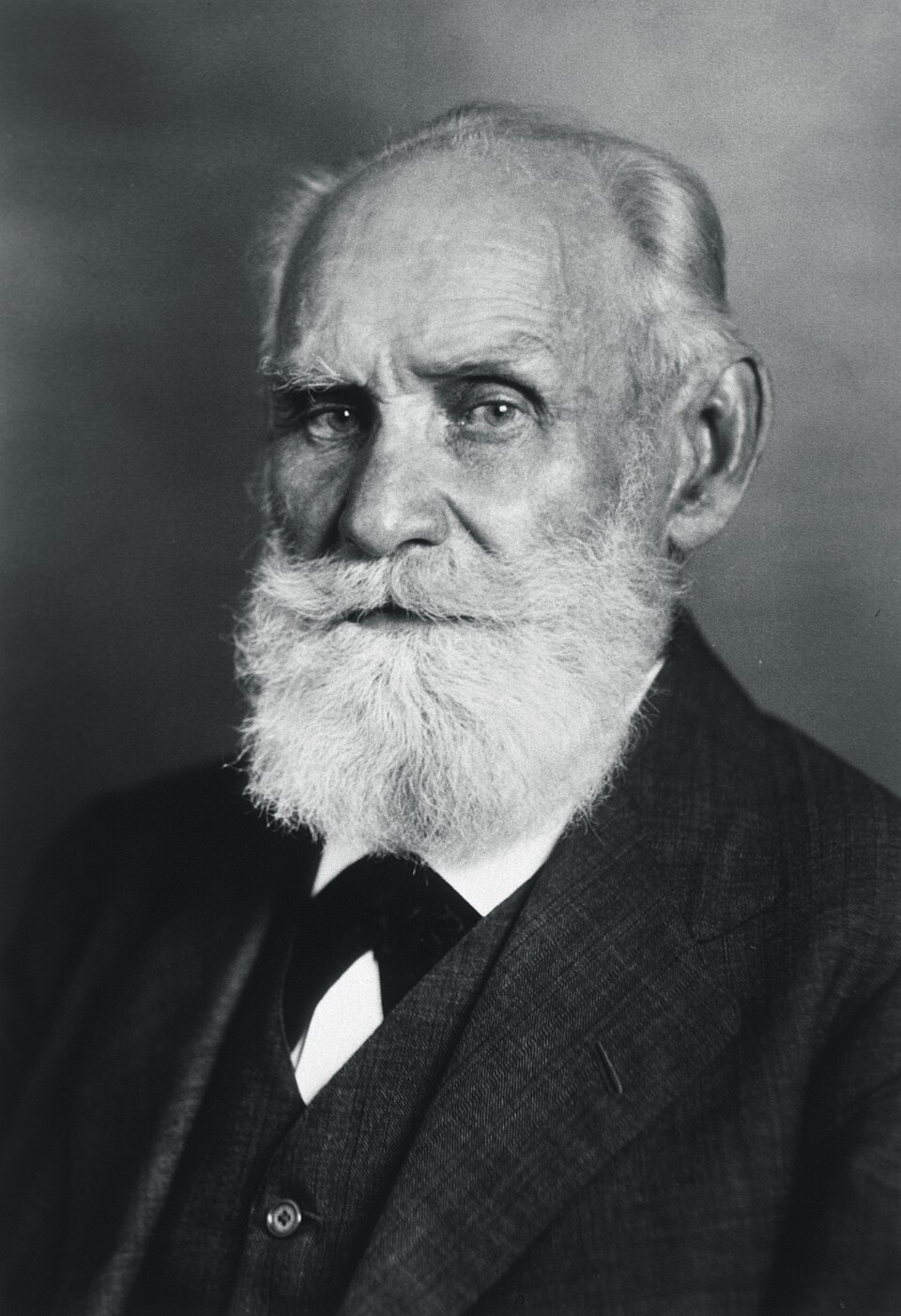
Ivan Pavlov
0 sources
Summary
Ivan Pavlov was born in Ryazan[1]. He died in Saint Petersburg[2]. He worked as a chemist[3], physiologist[4], and neurologist[5]. He ranks in the top 0.64% of human entities by monthly Wikipedia readership (19,678 views/month, #6,411 of 1,000,298).[6]
Key Facts
- Place of burial: judge[7]
- Spouse: Sara Pavlov[8]
- Child: Vladimir Ivanovich Pavlov[9], Vera Pavlova[10], Q131316764[11], Q131316820[12]
- Country of citizenship: Russian Empire[13], Russian Socialist Federative Soviet Republic[14], Soviet Union[15]
- Field of work: education[16], physiology[17]
- Employer: Saint Petersburg State University[18], S. M. Kirov Military Medical Academy[19], Institute of Experimental Medicine[20]
- Educated at: Saint Petersburg State University[21], S. M. Kirov Military Medical Academy[22]
- Doctoral advisor: Elias von Cyon[23], Sergey Petrovich Botkin[24], Carl Ludwig[25]
- Award received: Nobel Prize in Physiology or Medicine[26], Copley Medal[27], Order of Saint Anna, 1st class[28], Order of Saint Anna, 2nd class[29], Order of Saint Stanislaus, 1st class[30], Order of Saint Stanislaus, 2nd class[31], Order of St. Vladimir, 4th class[32], Order of St. Vladimir, 3rd class[33], Cothenius Medal[34], Премия имени К. Бэра[35], Croonian Medal and Lecture[36], Foreign Member of the Royal Society[37], Baly Medal[38], Order of Saint Stanislaus[39]
- Member of: Royal Society[40], National Academy of Sciences[41], Russian Academy of Sciences[42], French Academy of Sciences[43], Royal Netherlands Academy of Arts and Sciences[44], German Academy of Sciences Leopoldina[45], Académie Nationale de Médecine[46], University of Cambridge[47], American Philosophical Society[48], Accademia Nazionale dei Lincei[49]
- Religion or worldview: Eastern Orthodoxy[50]
- Sex or gender: male[51]
- Doctoral student: Konstantin Bykov[52], Pyotr Anokhin[53], Sergey Anichkov[54], Болдырев, Василий Николаевич[55], Viktorin Deryabin[56], Зимницкий, Семён Семёнович[57], Alexander Samoilov[58], Natalia Traugott[59], L. V. Sobolev[60], Nikolay Rozhansky[61], Lev Pavlovich Rozanov[62], Скіпін Георгій Васильович[63]
- Commons category: Ivan Pavlov[64]
- Cause of death: pneumonia[65]
Body
Works and Contributions
Things named for Ivan Pavlov include First Pavlov State Medical University of St. Petersburg[66], Ryazan State Medical University[67], Pavlov[68], Pavlov Gold Medal[69], and Award after I. Pavlov[70].
Why It Matters
Ivan Pavlov has Wikipedia articles in 30 language editions, a strong signal of global cultural recognition.[71] He is known by 108 alternative names across languages and contexts.[72]
He has been cited as an influence by B.F. Skinner[73], a psychologist[74], 1904–1990[75], of United States[76], awarded the Guggenheim Fellowship[77], specialised in psychology[78]; John B. Watson[79], a psychologist[80], 1878–1958[81], of United States[82], specialised in psychology[83]; and Antoni Kępiński[84], a physician[85], 1918–1972[86], of Poland[87], awarded the Gold Cross of Merit[88], specialised in psychiatry[89].
He is credited with the discovery of classical conditioning[90], a concept[91] and Pavlov's dog[92], a psychological theory[93]. Entities named for him include First Pavlov State Medical University of St. Petersburg[66], Ryazan State Medical University[67], Pavlov[68], Pavlov Gold Medal[69], and Award after I. Pavlov[70].
His notable doctoral advisees include Pyotr Anokhin[94], Konstantin Bykov[95], and Alexander Samoilov[96].
FAQs
Where was Ivan Pavlov born?
Ivan Pavlov's place of birth was Ryazan[1].
Where did Ivan Pavlov die?
Ivan Pavlov died in Saint Petersburg[2].
Who was Ivan Pavlov married to?
Ivan Pavlov's spouses include Sara Pavlov[8].
What did Ivan Pavlov do for work?
Ivan Pavlov worked as a chemist[3], physiologist[4], and neurologist[5].
Where did Ivan Pavlov go to school?
Ivan Pavlov was educated at Saint Petersburg State University[21] and S. M. Kirov Military Medical Academy[22].
What awards did Ivan Pavlov receive?
Honors received include Nobel Prize in Physiology or Medicine[26], Copley Medal[27], Order of Saint Anna, 1st class[28], and Order of Saint Anna, 2nd class[29].
Who did Ivan Pavlov influence?
Ivan Pavlov has been cited as an influence by B.F. Skinner[73], John B. Watson[79], and Antoni Kępiński[84].
What did Ivan Pavlov discover?
Ivan Pavlov is credited as discoverer of classical conditioning[90] and Pavlov's dog[92].