
Galileo
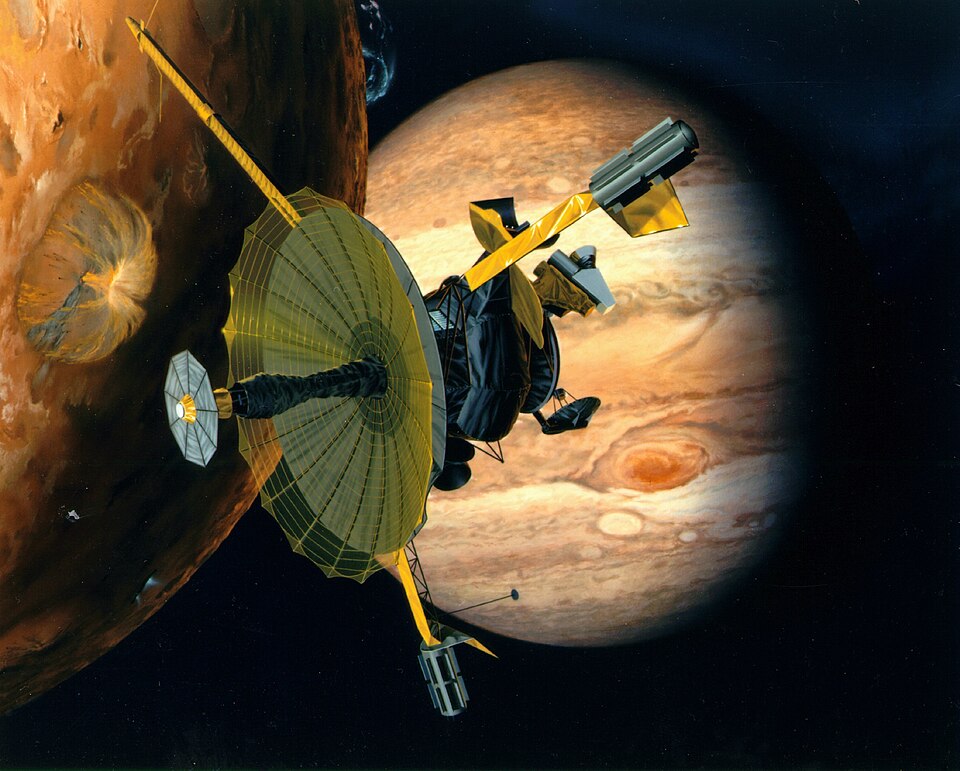
NASA robotic space probe that studied the Jupiter system, as well as asteroids Gaspra and Ida
Press Enter · cited answer in seconds
0 sources
Summary
Galileo is a planetary probe[1]. Galileo draws 5,050 Wikipedia views per month (planetary probe category, ranking #3 of 28).[2]
Key Facts
- Instance of: orbiter[3], former entity[4]
- Operator: Jet Propulsion Laboratory[5]
- Named after: Galileo Galilei[6]
- Manufacturer: Jet Propulsion Laboratory[7], Messerschmitt-Bölkow-Blohm[8], General Electric[9]
- Part of: Galileo mission[10]
- Commons category: Galileo mission[11]
- Space launch vehicle: Space Shuttle[12]
- Powered by: radioisotope thermoelectric generator[13], S400[14]
- Has part(s): Jupiter Atmospheric Probe[15]
- UTC date of spacecraft launch: October 18, 1989[16]
- Time of object orbit decay: September 21, 2003[17]
- Significant event: rocket launch[18], deployment[19], gravity assist[20], flyby[21], orbit insertion[22], atmospheric entry[23]
- Transmitted signal type: S band[24]
- Space tug: Inertial Upper Stage[25]
- Orbits completed: 35[26]
- Start point: Kennedy Space Center Launch Complex 39B[27]
- Official name: Galileo[28]
- Height: 6.15 m[29]
- Mass: 2223 kg[30], 1298 kg[31]
- Event distance: 4,631,778,000 km[32]
- Payload mass: 118 kg[33]
- Funder: National Aeronautics and Space Administration[34]
- P14541: 2w4zrV[35]
Why It Matters
Galileo is known by 8 alternative names across languages and contexts.[36]