
Classic of Poetry
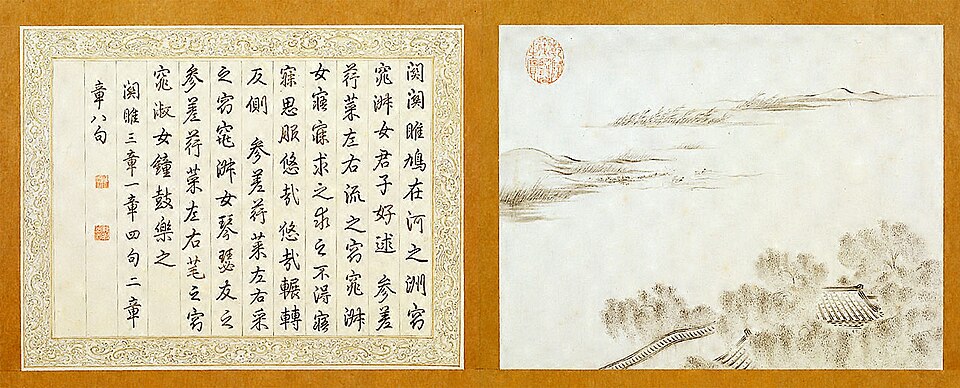
0 sources
The Classic of Poetry is a visual artwork that belongs to the genre of poetry .
Classic of Poetry
Summary
Classic of Poetry is a literary work[1]. It ranks in the top 3% of literary_work entities by monthly Wikipedia readership (1,105 views/month).[2]
Key Facts
- Classic of Poetry authored various authors[3].
- Classic of Poetry's instance of is recorded as literary work[4].
- Classic of Poetry's genre is poetry[5].
- Classic of Poetry is part of Five Classics[6].
- Classic of Poetry's Commons category is recorded as Classic of Poetry[7].
- Classic of Poetry's language of work or name is recorded as Old Chinese[8].
- Classic of Poetry's country of origin is recorded as Zhou dynasty[9].
- Classic of Poetry comprises Lesser Court Hymns[10].
- Classic of Poetry comprises Eulogies[11].
- Classic of Poetry comprises Major Court Hymns[12].
- Classic of Poetry comprises Airs of the States[13].
- 700 BC marks the founding of Classic of Poetry[14].
- Classic of Poetry's has edition or translation is recorded as Q109053155[15].
- Classic of Poetry's topic's main category is recorded as Category:Classic of Poetry[16].
- Classic of Poetry's described by source is recorded as emblem of the Armenian Soviet Socialist Republic[17].
- Classic of Poetry's described by source is recorded as Brockhaus and Efron Encyclopedic Dictionary[18].
- Classic of Poetry's described by source is recorded as Gujin Tushu Jicheng[19].
- Classic of Poetry's described by source is recorded as Records of the Grand Historian[20].
- Classic of Poetry's described by source is recorded as Meyers Konversations-Lexikon, 4th edition (1885–1890)[21].
Body
Authorship and Creation
Classic of Poetry authored various authors[3].
Publication
Classic of Poetry's language of work or name is recorded as Old Chinese[8]. Its genre is poetry[5]. It is part of Five Classics[6].
Cultural Impact
Things named for Classic of Poetry include Tsai Chin[22], an actor[23], b. 1936[24], of People's Republic of China[25].
Why It Matters
Classic of Poetry ranks in the top 3% of literary_work entities by monthly Wikipedia readership (1,105 views/month).[2] It has Wikipedia articles in 26 language editions, a strong signal of global cultural recognition.[26] It is known by 47 alternative names across languages and contexts.[27]
Entities named for it include Tsai Chin[22], an actor[23], b. 1936[24], of People's Republic of China[25].