
Chen-ning Yang
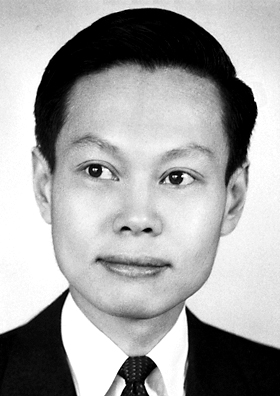
0 sources
Summary
Chen-ning Yang was born in Hefei[1]. He died in Beijing[2]. He worked as a physicist[3], university teacher[4], and theoretical physicist[5]. He ranks in the top 0.69% of human entities by monthly Wikipedia readership (3,650 views/month, #6,919 of 1,000,298).[6]
Key Facts
- Father: Yang Wu-chih[7]
- Spouse: Du Zhili[8], Weng Fan[9]
- Country of citizenship: People's Republic of China[10], United States[11], Republic of China[12], Taiwan[13]
- Native language: Chinese[14]
- Field of work: particle physics[15]
- Employer: Tsinghua University[16], Stony Brook University[17], Institute for Advanced Study[18], The Chinese University of Hong Kong[19], University of Chicago[20], Leiden University[21]
- Educated at: National Southwestern Associated University[22], Tsinghua University[23], University of Chicago[24], Peking University[25], Nankai University[26]
- Doctoral advisor: Edward Teller[27]
- Award received: Benjamin Franklin Medal[28], Fellow of the American Physical Society[29], Fellow of the American Association for the Advancement of Science[30], honorary doctor of the Chinese University of Hong Kong[31], Nobel Prize in Physics[32], Guggenheim Fellowship[33], Josiah Willard Gibbs Lectureship[34], Rumford Prize[35], honorary doctor of the Fudan University[36], National Medal of Science[37], Oskar Klein Medal[38], Foreign Member of the Royal Society[39], doctor honoris causa from the Pierre and Marie Curie University[40], Bower Award and Prize for Achievement in Science[41]
- Member of: Pontifical Academy of Sciences[42], National Academy of Sciences[43], Academia Sinica[44], Polish Academy of Sciences[45], American Association for the Advancement of Science[46], American Academy of Arts and Sciences[47], Russian Academy of Sciences[48], American Physical Society[49], Academic Division of Mathematics and Physics of the Chinese Academy of Sciences[50], Brazilian Academy of Sciences[51], Committee of 100[52], Chinese Academy of Sciences[53], The World Academy of Sciences[54], Royal Society[55]
- Sex or gender: male[56]
- Doctoral student: Bill Sutherland[57], Alexander Wu Chao[58]
- Commons category: Chen Ning Yang[59]
Body
Works and Contributions
Things named for Chen-ning Yang include Yang–Mills theory[60], Yang–Baxter equation[61], C. N. Yang Institute for Theoretical Physics[62], and Landau–Yang theorem[63].
Why It Matters
Chen-ning Yang has Wikipedia articles in 29 language editions, a strong signal of global cultural recognition.[64] He is known by 58 alternative names across languages and contexts.[65]
Entities named for him include Yang–Mills theory[60], Yang–Baxter equation[61], C. N. Yang Institute for Theoretical Physics[62], and Landau–Yang theorem[63].
His notable doctoral advisees include Bill Sutherland[66], a physicist[67], b. 1942[68], of United States[69], awarded the Dannie Heineman Prize for Mathematical Physics[70].
FAQs
Where was Chen-ning Yang born?
Chen-ning Yang was born in Hefei[1].
Where did Chen-ning Yang die?
Chen-ning Yang passed away in Beijing[2].
Who were Chen-ning Yang's parents?
Chen-ning Yang's father was Yang Wu-chih[7].
Who was Chen-ning Yang married to?
Chen-ning Yang's spouses include Du Zhili[8] and Weng Fan[9].
What did Chen-ning Yang do for work?
Chen-ning Yang worked as a physicist[3], university teacher[4], and theoretical physicist[5].
Where did Chen-ning Yang go to school?
Chen-ning Yang was educated at National Southwestern Associated University[22], Tsinghua University[23], University of Chicago[24], and Peking University[25].
What awards did Chen-ning Yang receive?
Honors received include Benjamin Franklin Medal[28], Fellow of the American Physical Society[29], Fellow of the American Association for the Advancement of Science[30], and honorary doctor of the Chinese University of Hong Kong[31].