
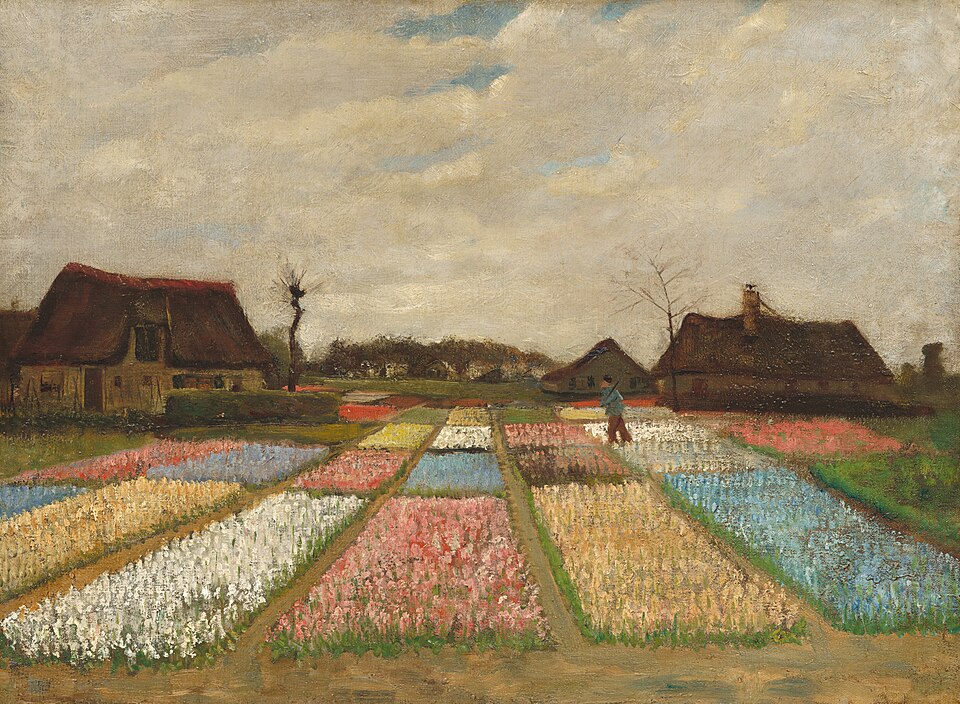
Bulb Fields
painting by Vincent van Gogh (1883)
Press Enter · cited answer in seconds
0 sources
Summary
Bulb Fields is a painting[1]. It ranks in the top 6% of painting entities by monthly Wikipedia readership (272 views/month).[2]
Key Facts
- Creator: Vincent van Gogh[3]
- Owned by: John Enthoven[4], National Gallery of Art[5]
- Movement: realism[6]
- Genre: landscape painting[7]
- Depicts: tulip[8], field[9], house[10], tree[11]
- Made from material: oil paint[12], canvas[13], wood[14]
- Collection: National Gallery of Art[15]
- Inventory number: 1983.1.21[16]
- Location: National Gallery of Art[17]
- Commons category: Flower Beds in Holland by Vincent van Gogh (F186)[18]
- Catalog code: F186[19], JH361[20], 129[21], 361[22], 26[23], 283[24]
- Inception: January 1, 1883[25]
- Exhibition history: Exhibition of Works by Vincent van Gogh[26], Paintings, Drawings and Sculpture Collected by Yale Alumni: An Exhibition[27], French Paintings from the Collections of Mr. and Mrs. Paul Mellon and Mrs. Mellon Bruce[28], Gifts to the Nation: Selected Acquisitions from the Collections of Mr. and Mrs. Paul Mellon[29], Impressionisti della National Gallery of Art di Washington[30], Around Impressionism: French Paintings from the National Gallery of Art[31], Masterpieces from the National Gallery of Art[32], The Young van Gogh and The Hague School[33], Vincent van Gogh - Between Heaven and Earth: The Landscapes[34]
- Main subject: farm[35]
- Described at URL: http://www.vggallery.com/painting/p_0186.htm[36]
- Donated by: Paul Mellon[37]
- Location of creation: The Hague[38]
- Published in: European Paintings: An Illustrated Catalogue[39], Flower Still Lifes from the Netherlands and Belgium 1870-1940[40], Van Gogh's Flowers[41], Van Gogh: Face to Face. The Portraits[42], Vincent's Gardens: Paintings and Drawings by Van Gogh[43]
- Title: Flower Beds in Holland[44]
- Height: 48.9 cm[45]
- Width: 66 cm[46]
- IIIF manifest URL: https://www.nga.gov/api/v1/iiif/presentation/manifest.json?cultObj:id=61371[47]
- Copyright status: public domain[48]
Why It Matters
Bulb Fields has Wikipedia articles in 8 language editions, a strong signal of global cultural recognition.[49] It is known by 14 alternative names across languages and contexts.[50]