
Aristoxenus
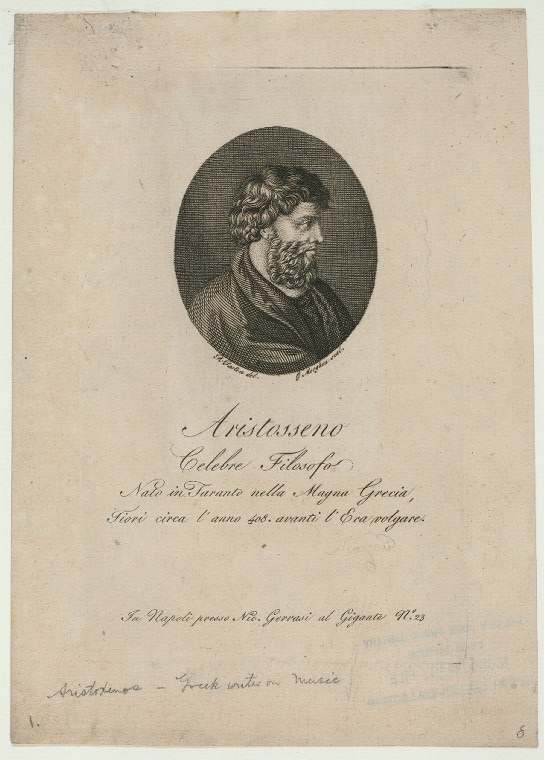
0 sources
Aristoxenus (360 BC–300 BC) was born in Taras [1] and died in Athens [2]. He worked as a mathematician, musicologist, philosopher, and music theorist [3].
His contributions spanned multiple disciplines, focusing on the theoretical and practical aspects of music [3]. Aristoxenus’ writings became foundational in ancient music theory, influencing later developments in the field [3].
Key Facts
- Place of death: Classical Athens[10]
- Date of birth: 354 BC[11]
- Father: Spintharus[12]
- Ethnic group: Greeks[13]
- Sex or gender: male[14]
- Commons category: Aristosseno[15]
- Given name: Aristoxenos[16]
- Topic's main category: Category:Aristosseno[17]
- Student of: Xenophilus[18], Aristotle[19], Lamprus of Erythrae[20]
- Described by source: Nordisk familjebok[21], Encyclopedic Lexicon[22], Great Soviet Encyclopedia (1926–1947)[23], Small Brockhaus and Efron Encyclopedic Dictionary[24], Brockhaus and Efron Encyclopedic Dictionary[25], Riemann's Music Dictionary[26], Encyclopædia Britannica 11th edition[27], Pauly–Wissowa[28], Russian translation of Lübker's Antiquity Lexicon[29], The Nuttall Encyclopædia[30], Meyers Konversations-Lexikon, 4th edition (1885–1890)[31], Collier's New Encyclopedia, 1921[32]
- Languages spoken, written or signed: Ancient Greek[33]
- Time period: Hellenistic period[34]
Body
Works and Contributions
Things named for Aristoxenus include he[35], an impact crater[36].
Why It Matters
Aristoxenus has Wikipedia articles in 23 language editions, a strong signal of global cultural recognition.[37] He is known by 46 alternative names across languages and contexts.[38]
Entities named for him include he[35], an impact crater[36].
FAQs
Where was Aristoxenus born?
Aristoxenus was born in Taras[2].
Where did Aristoxenus die?
Aristoxenus passed away in Athens[4].
Who were Aristoxenus's parents?
Aristoxenus's father was Spintharus[12].
What did Aristoxenus do for work?
Aristoxenus worked as a mathematician[5], musicologist[6], philosopher[7], and music theorist[8].