
Wilhelm von Humboldt
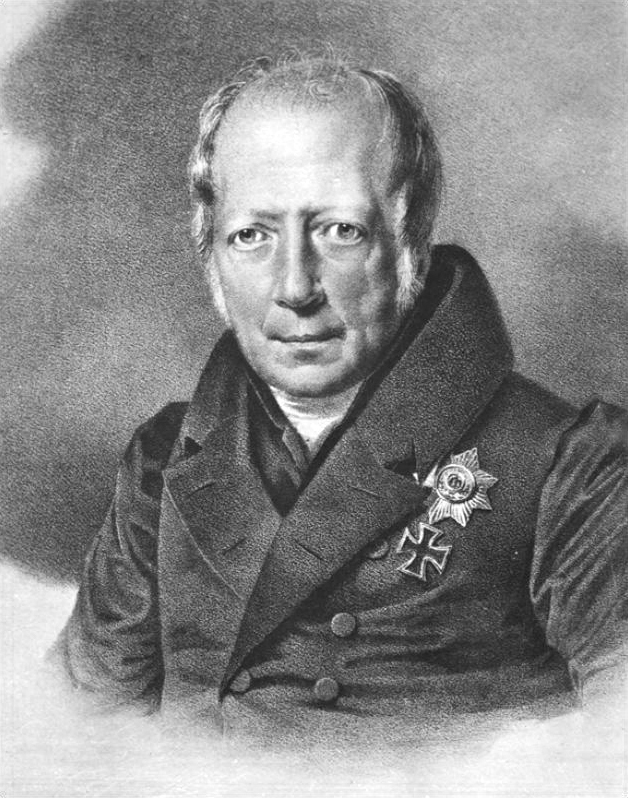
0 sources
Summary
Wilhelm von Humboldt was born on June 22, 1767[1], in Potsdam[2]. He died on April 8, 1835[3], in Berlin[4]. He worked as a linguist[5], diplomat[6], anthropologist[7], teacher[8], and politician[9]. He ranks in the top 0.7% of human entities by monthly Wikipedia readership (4,808 views/month, #7,026 of 1,000,298).[10]
Key Facts
- Place of birth: Kabinetthaus[11]
- Place of death: Tegel[12]
- Date of birth: January 1, 1767[13]
- Date of death: January 1, 1835[14]
- Place of burial: Schloss Tegel[15]
- Father: Alexander Georg von Humboldt[16]
- Mother: Marie-Elisabeth von Humboldt[17]
- Spouse: Caroline von Humboldt[18]
- Child: Gabriele von Bülow[19], Adelheid von Hedemann[20], Caroline von Humboldt[21], Theodor von Humboldt[22], Theodor von Humboldt-Dachroeden[23]
- Country of citizenship: Kingdom of Prussia[24]
- Occupation: philosopher[25], writer[26], historian[27], translator[28], journalist[29], scientist[30]
- Field of work: philosophy[31], politics[32], diplomacy[33], linguistics[34], translating activity[35]
- Position held: ambassador of Germany to the United Kingdom[36]
- Employer: Humboldt-Universität zu Berlin[37]
- Educated at: University of Frankfurt an der Oder[38], University of Göttingen[39]
- Award received: Order of the Black Eagle[40], Fellow of the American Academy of Arts and Sciences[41], Order of the Dannebrog[42]
- Member of: Royal Prussian Academy of Sciences[43], Academy of Science for Public Utility[44], German Archaeological Institute[45], Bavarian Academy of Sciences and Humanities[46], Saint Petersburg Academy of Sciences[47], Hungarian Academy of Sciences[48], American Academy of Arts and Sciences[49], Russian Academy of Sciences[50], American Antiquarian Society[51], Académie des Inscriptions et Belles-Lettres[52], Société nationale des Antiquaires de France[53], Göttingen Academy of Sciences and Humanities in Lower Saxony[54]
- Religion or worldview: Lutheranism[55]
- Sex or gender: male[56]
- Noble title: baron[57], Freiherr[58]
- Movement: German new humanism[59]
- Commons category: Wilhelm von Humboldt[60]
- Family name: von Humboldt[61]
Body
Works and Contributions
Things named for Wilhelm von Humboldt include Humboldt-Universität zu Berlin[62], a comprehensive university[63], in Germany[64], founded in 1809[65], headquartered in Berlin[66]; Humboldt Forum[67], a museum[68], in Germany[69]; Humboldt Box[70], an architectural structure[71], in Germany[72]; Humboldt[73], a lunar crater[74]; Humboldtschule, Bad Homburg[75]; and Humboldt Medal[76].
Why It Matters
Wilhelm von Humboldt has Wikipedia articles in 29 language editions, a strong signal of global cultural recognition.[77] He is known by 55 alternative names across languages and contexts.[78]
He has been cited as an influence by Jürgen Habermas[79], a sociologist[80], 1929–2026[81], of Germany[82], awarded the Geschwister-Scholl-Preis[83], specialised in philosophy[84]; Benjamin Lee Whorf[85], an anthropologist[86], 1897–1941[87], of United States[88], specialised in linguistics[89]; Felix Adler[90], a philosopher[91], 1851–1933[92], of United States[93], specialised in ethics[94]; and Alexander Potebnja[95], a linguist[96], 1835–1891[97], of Russian Empire[98], awarded the Constantin Medal[99], specialised in linguistics[100].
Entities named for him include Humboldt-Universität zu Berlin[62], a comprehensive university[63], in Germany[64], founded in 1809[65], headquartered in Berlin[66]; Humboldt Forum[67], a museum[68], in Germany[69]; Humboldt Box[70], an architectural structure[71], in Germany[72]; Humboldt[73], a lunar crater[74]; Humboldtschule, Bad Homburg[75]; and Humboldt Medal[76].
FAQs
Where was Wilhelm von Humboldt born?
Wilhelm von Humboldt was born in Potsdam[2].
Where did Wilhelm von Humboldt die?
Wilhelm von Humboldt died in Berlin[4].
Who were Wilhelm von Humboldt's parents?
Wilhelm von Humboldt's father was Alexander Georg von Humboldt[16]. Wilhelm von Humboldt's mother was Marie-Elisabeth von Humboldt[17].
Who was Wilhelm von Humboldt married to?
Wilhelm von Humboldt's spouses include Caroline von Humboldt[18].
What did Wilhelm von Humboldt do for work?
Wilhelm von Humboldt worked as a linguist[5], diplomat[6], anthropologist[7], teacher[8], and politician[9].
Where did Wilhelm von Humboldt go to school?
Wilhelm von Humboldt was educated at University of Frankfurt an der Oder[38] and University of Göttingen[39].
What awards did Wilhelm von Humboldt receive?
Honors received include Order of the Black Eagle[40], Fellow of the American Academy of Arts and Sciences[41], and Order of the Dannebrog[42].
Who did Wilhelm von Humboldt influence?
Wilhelm von Humboldt has been cited as an influence by Jürgen Habermas[79], Benjamin Lee Whorf[85], Felix Adler[90], and Alexander Potebnja[95].