
Venus and Mars
0 sources
Venus and Mars
Summary
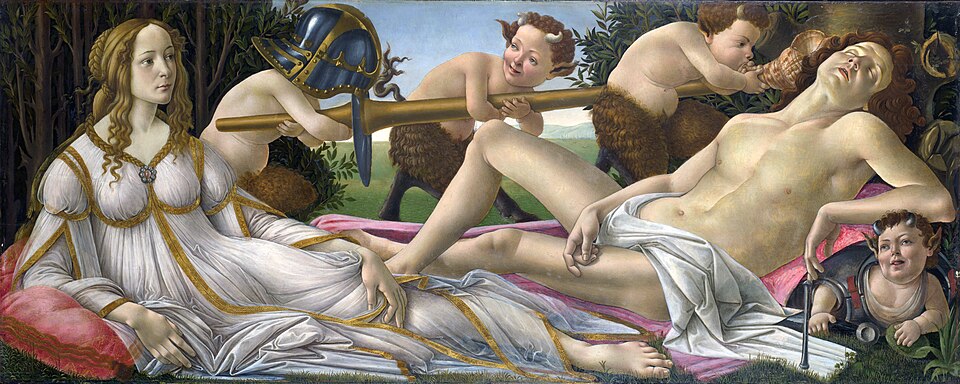
Venus and Mars is a painting[1]. It ranks in the top 3% of painting entities by monthly Wikipedia readership (669 views/month).[2]
Key Facts
- Venus and Mars is the creator of Sandro Botticelli[3].
- Venus and Mars's instance of is recorded as painting[4].
- Venus and Mars is associated with the Early Renaissance movement[5].
- Venus and Mars is associated with the Italian Renaissance painting movement[6].
- Venus and Mars's genre is mythological painting[7].
- Venus and Mars's part of the series is recorded as mythological paintings by Botticelli[8].
- Venus and Mars's depicts is recorded as Venus[9].
- Venus and Mars's depicts is recorded as Mars[10].
- Venus and Mars's depicts is recorded as satyr[11].
- Venus and Mars's depicts is recorded as lance[12].
- Venus and Mars's depicts is recorded as helmet[13].
- Venus and Mars's depicts is recorded as pillow[14].
- Venus and Mars's depicts is recorded as walking stick[15].
- Venus and Mars is made of tempera[16].
- Venus and Mars is made of oil paint[17].
- Venus and Mars is made of poplar panel[18].
- Venus and Mars is made of plaster[19].
- Venus and Mars's collection is recorded as National Gallery[20].
- Venus and Mars's inventory number is recorded as NG915[21].
- Venus and Mars took place at Room 62 The Family Palace: Painting in Florence 1400‒1500[22].
- Venus and Mars took place at Casa Vespucci[23].
- Venus and Mars's Commons category is recorded as Venus and Mars (Botticelli)[24].
- Venus and Mars's catalog code is recorded as 75[25].
- Venus and Mars's catalog code is recorded as B41[26].
- Venus and Mars's catalog code is recorded as 13[27].
Body
Authorship and Creation
Venus and Mars is the creator of Sandro Botticelli[3].
Publication
Venus and Mars's genre is mythological painting[7]. Its part of the series is recorded as mythological paintings by Botticelli[8].
Subject and Themes
Main subjects include Mars and Venus[28], Venus[29], and Mars[30]. Movements include Early Renaissance[5] and Italian Renaissance painting[6]. Venus and Mars's part of the series is recorded as mythological paintings by Botticelli[8].
Adaptations and Inspiration
Platonic Academy inspired Venus and Mars[31].
Material and Period
Recorded made from material include tempera[16], oil paint[17], poplar panel[18], and plaster[19]. Recorded location include Room 62 The Family Palace: Painting in Florence 1400‒1500[22] and Casa Vespucci[23].
Why It Matters
Venus and Mars ranks in the top 3% of painting entities by monthly Wikipedia readership (669 views/month).[2] It has Wikipedia articles in 17 language editions, a strong signal of global cultural recognition.[32] It is known by 5 alternative names across languages and contexts.[33]