
Treaty on the Creation of the Union of Soviet Socialist Republics
0 sources
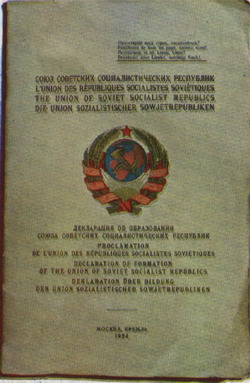
The Treaty on the Creation of the Union of Soviet Socialist Republics was established on January 1, 1922 . It formally united multiple Soviet republics into a single federal state under the name Union of Soviet Socialist Republics . The treaty laid the legal foundation for the political and administrative structure of the new union .
Treaty on the Creation of the Union of Soviet Socialist Republics
Summary
Treaty on the Creation of the Union of Soviet Socialist Republics is a document[1]. It draws 1,178 Wikipedia views per month (document category, ranking #16 of 158).[2]
Key Facts
- Treaty on the Creation of the Union of Soviet Socialist Republics is in the country of Soviet Union[3].
- Treaty on the Creation of the Union of Soviet Socialist Republics's instance of is recorded as document[4].
- Treaty on the Creation of the Union of Soviet Socialist Republics's instance of is recorded as statute[5].
- Treaty on the Creation of the Union of Soviet Socialist Republics's instance of is recorded as treaty[6].
- Treaty on the Creation of the Union of Soviet Socialist Republics's instance of is recorded as project[7].
- Treaty on the Creation of the Union of Soviet Socialist Republics's instance of is recorded as constitutive treaty[8].
- Treaty on the Creation of the Union of Soviet Socialist Republics's based on is recorded as Declaration of the Creation of the Union of Soviet Socialist Republics[9].
- Treaty on the Creation of the Union of Soviet Socialist Republics was followed by Belovezh Accords[10].
- Treaty on the Creation of the Union of Soviet Socialist Republics was followed by Resolution of the RSFSR Supreme Soviet On denunciation of the Treaty establishing the USSR[11].
- Treaty on the Creation of the Union of Soviet Socialist Republics was followed by New Union Treaty[12].
- Treaty on the Creation of the Union of Soviet Socialist Republics took place at Moscow[13].
- Treaty on the Creation of the Union of Soviet Socialist Republics is a type of contract[14].
- Treaty on the Creation of the Union of Soviet Socialist Republics is a type of written contract[15].
- Treaty on the Creation of the Union of Soviet Socialist Republics is a type of public contract[16].
- Treaty on the Creation of the Union of Soviet Socialist Republics is a type of agreement[17].
- Treaty on the Creation of the Union of Soviet Socialist Republics is a type of multilateral treaty[18].
- Treaty on the Creation of the Union of Soviet Socialist Republics is a type of legal fiction[19].
- Treaty on the Creation of the Union of Soviet Socialist Republics is a type of fiction[20].
- Treaty on the Creation of the Union of Soviet Socialist Republics's Commons category is recorded as Declaration and the Treaty on the Creation of the Soviet Union[21].
- Treaty on the Creation of the Union of Soviet Socialist Republics's language of work or name is recorded as Russian[22].
- Treaty on the Creation of the Union of Soviet Socialist Republics's legislated by is recorded as First All-Union Congress of Soviets[23].
- January 1, 1922 marks the founding of Treaty on the Creation of the Union of Soviet Socialist Republics[24].
- Treaty on the Creation of the Union of Soviet Socialist Republics began on December 29, 1922[25].
- Treaty on the Creation of the Union of Soviet Socialist Republics began on December 30, 1922[26].
- Treaty on the Creation of the Union of Soviet Socialist Republics ended on December 8, 1991[27].
Body
Publication
Treaty on the Creation of the Union of Soviet Socialist Republics's language of work or name is recorded as Russian[22].
Adaptations and Inspiration
Successors include Belovezh Accords[10], Resolution of the RSFSR Supreme Soviet On denunciation of the Treaty establishing the USSR[11], and New Union Treaty[12].
Material and Period
The location of Treaty on the Creation of the Union of Soviet Socialist Republics was Moscow[13].
Why It Matters
Treaty on the Creation of the Union of Soviet Socialist Republics draws 1,178 Wikipedia views per month (document category, ranking #16 of 158).[2] It has Wikipedia articles in 19 language editions, a strong signal of global cultural recognition.[28] It is known by 13 alternative names across languages and contexts.[29]