
The Captain's Daughter
1836 novel by Aleksandr Pushkin
Press Enter · cited answer in seconds
0 sources
Summary
The Captain's Daughter is a literary work[1]. It ranks in the top 4% of literary work entities by monthly Wikipedia readership (6,394 views/month).[2]
Key Facts
- Author: Alexander Pushkin[3]
- Genre: historical fiction[4]
- Commons category: The Captain's Daughter[5]
- Language of work or name: Russian[6]
- Country of origin: Russian Empire[7]
- Has part(s): The Sergeant of the Guards[8], The Captain's Daughter/Chapter II[9], The Captain's Daughter/Chapter III[10], The Captain's Daughter/Chapter IV[11], The Captain's Daughter/Chapter V[12], The Captain's Daughter/Chapter VI[13], The Captain's Daughter/Chapter VII[14], The Captain's Daughter/Chapter VIII[15], The Captain's Daughter/Chapter IX[16], The Captain's Daughter/Chapter X[17], The Captain's Daughter/Chapter XI[18], The Captain's Daughter/Chapter XII[19], The Captain's Daughter/Chapter XIII[20], The Captain's Daughter/Chapter XIV[21]
- Publication date: 1836[22]
- Characters: Maria Mironova[23], Alexey Shvabrin[24], Q105196699[25], Pyotr Grinyov[26], Yemelyan Pugachev[27], Q98684531[28]
- Has edition or translation: 士官の娘[29], Q21418968[30], Q98793198[31], The Captain's Daughter[32], Q112914153[33], Q112914169[34]
- Narrative location: Russian Empire[35], Orenburg Governorate[36]
- Topic's main category: Category:The Captain's Daughter[37]
- Main subject: Pugachev's Rebellion[38]
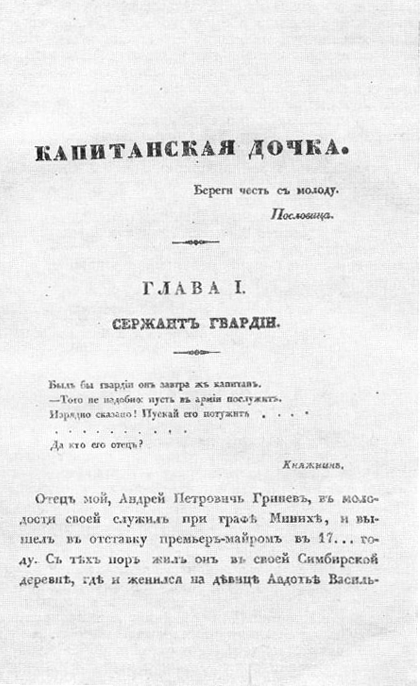
- Title: Капитанская дочка[39]
- First line: Отец мой Андрей Петрович Гринев в молодости своей служил при графе Минихе и вышел в отставку премьер-майором в 17.. году.[40]
- Number of parts of this work: 15 chapter[41]
- Derivative work: Volga in Flames[42], The Captain's Daughter[43], Tempest[44], La figlia del capitano[45], Капитанская дочка (телеспектакль)[46], Капитанская дочка (мультфильм)[47], La figlia del capitano (miniserie televisiva 2012)[48]
- Copyright status: public domain[49]
- Form of creative work: novel[50]
- P14541: 3MBG3P[51], 14J70M[52]
Why It Matters
The Captain's Daughter has Wikipedia articles in 23 language editions, a strong signal of global cultural recognition.[53] It is known by 27 alternative names across languages and contexts.[54]