
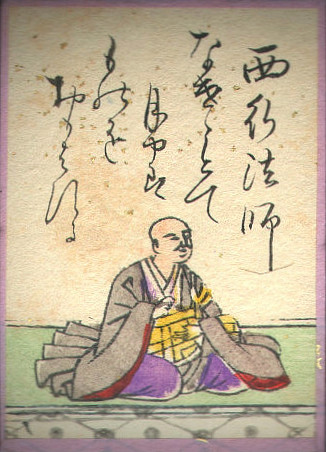
Saigyō
Japanese poet
Press Enter · cited answer in seconds
0 sources
Summary
Saigyō was born on 1118[1] in Kyoto[2]. He died on January 1, 1190[3], in Hirokawa-dera Temple[4]. He worked as a waka poet[5], writer[6], Buddhist monk[7], priest[8], and poet[9]. He ranks in the top 0.72% of human entities by monthly Wikipedia readership (2,713 views/month, #7,249 of 1,000,298).[10]
Key Facts
- Father: Satō Yasukiyo[11]
- Child: daughter of Saigyō[12]
- Country of citizenship: Japan[13]
- Ethnic group: Japanese people[14]
- Notable work: Sankashū[15]
- Religion or worldview: Buddhism[16]
- Sex or gender: male[17]
- Family: Satō clan[18]
- Commons category: Saigyō[19]
- Pseudonym: 佐藤 義清[20], 圓位[21]
- Topic's main category: Category:Saigyō[22]
- Depicted by: Saigyō Monogatari Emaki[23]
- Described by source: Great Soviet Encyclopedia (1969–1978)[24]
- Languages spoken, written or signed: Japanese[25]
- Present in work: Senjusho[26], Saigyō-zakura[27], 西行鼓ヶ滝[28]
- Commons Creator page: Saigyō[29]
- Name in native language: 西行[30]
- Name in kana: さいぎょう[31]
- Copyright status as a creator: copyrights on works have expired[32]
Why It Matters
Saigyō has Wikipedia articles in 17 language editions, a strong signal of global cultural recognition.[33] He is known by 47 alternative names across languages and contexts.[34]
FAQs
Where was Saigyō born?
Saigyō's place of birth was Kyoto[2].
Where did Saigyō die?
Saigyō passed away in Hirokawa-dera Temple[4].
Who were Saigyō's parents?
Saigyō's father was Satō Yasukiyo[11].
What did Saigyō do for work?
Saigyō worked as a waka poet[5], writer[6], Buddhist monk[7], priest[8], and poet[9].