
Romola
novel by George Eliot
Press Enter · cited answer in seconds
0 sources
Romola
Summary
Romola is a literary work[1]. Romola ranks in the top 4% of literary_work entities by monthly Wikipedia readership (1,412 views/month).[2]
Key Facts
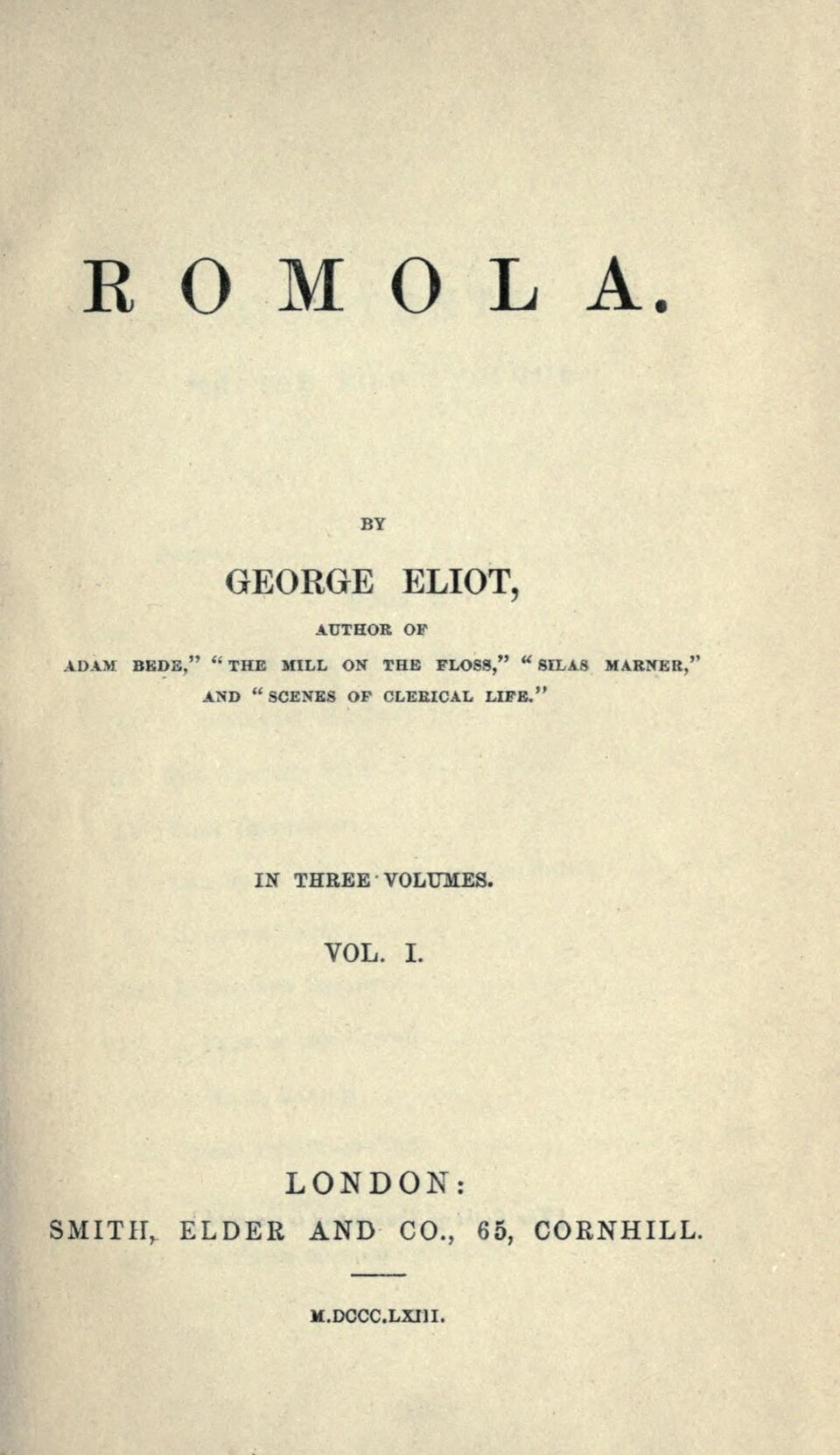
- Romola authored George Eliot[3].
- Romola's instance of is recorded as literary work[4].
- Romola's genre is historical fiction[5].
- Romola followed Silas Marner[6].
- Romola was followed by Felix Holt, the Radical[7].
- Romola's Commons category is recorded as Romola[8].
- Romola's language of work or name is recorded as English[9].
- Romola's country of origin is recorded as United Kingdom[10].
- Romola was released on 1862[11].
- Romola's has edition or translation is recorded as Romola[12].
- Romola's has edition or translation is recorded as Q135154369[13].
- Romola's has edition or translation is recorded as Romola[14].
- Romola's has edition or translation is recorded as Q138507150[15].
- Romola's has edition or translation is recorded as Q138562065[16].
- Romola's narrative location is recorded as Florence[17].
- Romola's described by source is recorded as The Nuttall Encyclopædia[18].
- Romola's described by source is recorded as The New Student's Reference Work[19].
- Romola's described by source is recorded as New International Encyclopedia[20].
- Romola's title is recorded as Romola[21].
- Romola's different from is recorded as Romola[22].
- Romola's first line is recorded as More than three centuries and a half ago, in the mid spring-time of 1492, we are sure that the angel of the dawn, as he travelled with broad slow wing from the Levant to the Pillars of Hercules, and from the summits of the Caucasus across all the snowy Alpine ridges to the dark nakedness of the Western isles, saw nearly the same outline of firm land and unstable sea—saw the same great mountain shadows on the same valleys as he has seen to-day—saw olive mounts, and pine forests, and the broad plains, green with young corn or rain-freshened grass—saw the domes and spires of cities rising by the river sides or mingled with the sedge-like masts on the many-curved sea coast, in the same spots where they rise to-day.[23].
- Romola's set in period is recorded as 15th century[24].
- Romola's last line is recorded as "Never mind," said Romola. "There are many good people who did not love Fra Girolamo. Perhaps I should never have learned to love him if he had not helped me when I was in great need."[25].
- Romola's copyright status is recorded as public domain[26].
- Romola's copyright status is recorded as public domain[27].
Body
Authorship and Creation
Romola authored George Eliot[3].
Publication
Romola was released on 1862[11]. Romola's language of work or name is recorded as English[9]. Romola's genre is historical fiction[5].
Adaptations and Inspiration
Romola followed Silas Marner[6]. Romola was followed by Felix Holt, the Radical[7].
Why It Matters
Romola ranks in the top 4% of literary_work entities by monthly Wikipedia readership (1,412 views/month).[2] Romola has Wikipedia articles in 9 language editions, a strong signal of global cultural recognition.[28] Romola is known by 5 alternative names across languages and contexts.[29]