
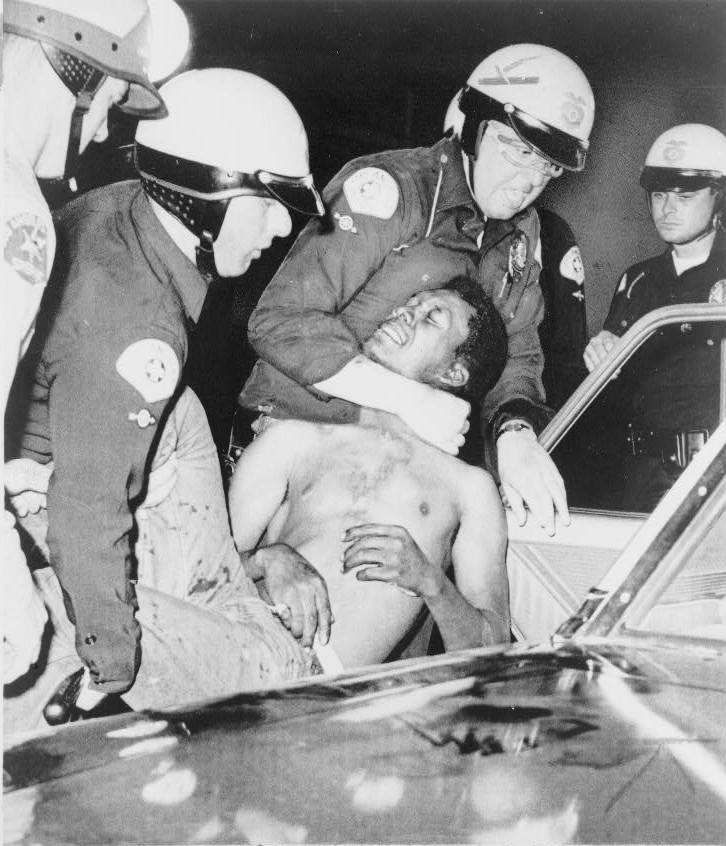
police brutality
use of excessive force by a police officer
Press Enter · cited answer in seconds
0 sources
Summary
police brutality is a delict[1]. It draws 3,838 Wikipedia views per month (delict category, ranking #1 of 6).[2]
Key Facts
- Subclass of: brutality[3], police misconduct[4], police violence[5], use of force[6]
- Part of: 1968 Democratic National Convention protest activity[7]
- Commons category: Police brutality[8]
- Has part(s): asphyxia[9], police brutality in the United States[10]
- Significant event: Great Railroad Strike of 1877[11], Pullman Strike[12], 1912 Lawrence Textile Strike[13], Ludlow Massacre[14], Steel strike of 1919[15], Hanapepe massacre[16]
- Topic's main category: Category:Police brutality[17]
- Described at URL: https://www.amnesty.org/en/what-we-do/police-brutality/[18]
- Facet of: use of force continuum[19], Law enforcement and society[20], law enforcement[21], Protest policing[22], authoritarianism[23]
- Described by source: Red Blue Translator[24]
- Partially coincident with: prisoner abuse (abus de prisonnier)[25]
- Has contributing factor: blue wall of silence[26], racism[27]
- Contributing factor of: 1992 Los Angeles riots[28]
- Uses: electroshock weapon[29]
- Has list: list of killings by law enforcement officers by countries[30], list of cases of police brutality[31], list of cases of police brutality by country[32], list of unarmed African Americans killed by law enforcement officers in the United States[33], list of killings by law enforcement officers in the United States[34], list of killings by law enforcement officers in Canada[35]
- Hashtag: PoliceBrutality[36]
- On focus list of Wikimedia project: WikiProject Human rights[37]
- Does not have characteristic: legitimacy[38], justification[39]
- Handled, mitigated, or managed by: civilian oversight of law enforcement[40], police body camera[41], police accountability[42]
Why It Matters
police brutality has Wikipedia articles in 25 language editions, a strong signal of global cultural recognition.[43] It is known by 70 alternative names across languages and contexts.[44]